
A Short History of a Photojournalist Who Saw It All
Lee Miller’s life reads like a novel—glamorous, harrowing, and fiercely independent. Born Elizabeth Miller in 1907 in Poughkeepsie, New York, she began her career as a fashion model in the 1920s, gracing the pages of Vogue and becoming a muse to artists like Man Ray. But Miller was never content to be just a subject. She stepped behind the camera and forged a career that would take her from the surrealist salons of Paris to the front lines of World War II.
🎨 Early Career: Surrealism and Studio Work
In Paris, Miller became deeply involved in the Surrealist movement. She collaborated with Man Ray, co-discovering the solarization technique and producing haunting, dreamlike images that blurred the line between reality and imagination. Her early work explored themes of identity, femininity, and psychological tension—often with a bold, experimental edge.
After returning to New York, she opened her own studio and worked as a fashion and portrait photographer. But the outbreak of war would soon shift her focus from art to history.
📰 War Correspondent for Vogue
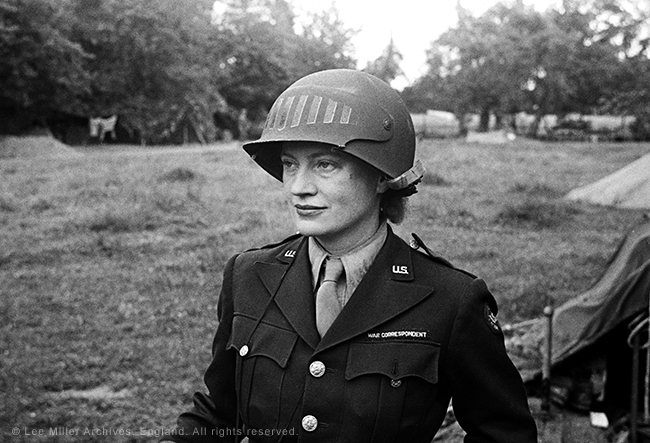
During World War II, Miller became a correspondent for Vogue, one of the few women accredited to cover combat zones. Her assignments took her across Europe:
- The London Blitz: She documented the devastation and resilience of civilians under bombardment.
- Liberation of Paris: Her images captured both celebration and the scars of occupation.
- Buchenwald and Dachau: Miller was among the first to photograph Nazi concentration camps after liberation—her stark, unflinching images remain among the most powerful visual records of the Holocaust.
- Hitler’s apartment: In a surreal twist, she famously bathed in Hitler’s tub just hours after his death, a symbolic act of defiance and reclamation.
Her war photography combined journalistic rigor with emotional depth, challenging viewers to confront the human cost of conflict.

🖋 Legacy and Rediscovery
After the war, Miller retreated from public life, struggling with PTSD and the weight of what she had witnessed. Her work was largely forgotten until her son, Antony Penrose, rediscovered her archives and began promoting her legacy.
Today, Miller is celebrated not only for her technical skill and artistic vision but for her courage and complexity. She shattered gender norms, bore witness to history’s darkest chapters, and left behind a body of work that continues to provoke, inspire, and educate.
🧭 Final Thought
Lee Miller’s journey—from fashion icon to frontline documentarian—is a testament to the power of reinvention and the importance of bearing witness. Her images remind us that photography is not just about beauty—it’s about truth, presence, and the courage to look when others turn away.
 a world without pictures is like coffee without cream and sugar, bitter