X-Photographer Eric Bouvet talks on FUJINON XF55-200mm F3.5-4.8 R LM OIS

cameras, Lenses, Travel

I own this lens and it is a fantastic lens to shoot with. Its no lightweight but knowhere near my old Canon 70-200 f2.8 IS. Well built and solid. I find that it fits better on my XT2 or XT3 and rarely use it on my X Pro’s.

Viltrox 85mm f1.8 for Fuji – Mattias Burling review

cameras, Fujichrome, Lenses, Travel

May certainly be worth a look at the price. 85mm is one of my favorite focal lengths. This gives 127.5mm with the APSc crop factor.

https://www.youtube.com/channel/UCgVwlIabrL100C9_6vyM9-g

  • The lens is very well crafted. Its all metal ,feels better in the hand than the native Fuji primes. It actually feels better built than most lenses.
  • The auto focus is fast with the latest firmware, on par with many native lenses.
  • The image quality on this lens is surprisingly good and itโ€™s an all around solid performer , this lens offers excellent center and edge to edge sharpness and superb resolving power.
  • Right out of camera, the neutral quality of this lens gives skin a subtle sheen, making it and excellent choice for portraiture as well as black and white photography.
  • The textured metal focus ring provides an exceptionally smooth experience and the 145.9ยฐ throw allows for precise focusing, even at closer distances where subtle nuances would be more noticeable.

Short walk with X Pro1 + 14mm f2.8 XF Fujicron

cameras, Fujichrome, Lenses, Travel

Working Wide Without Losing the Subject Old Photographer Series


The name is Fujinon rather than Fujicron, although the mistake is understandable. โ€œFujicronโ€ is an affectionate nickname usually given to Fujifilmโ€™s smaller f/2 lenses because of their resemblance in spirit to Leica Summicrons. The XF 14mm f/2.8 R belongs to an earlier generation of Fujinon primes and has rather more character of its own.


On the original X-Pro1, the 14mm produces the angle of view of approximately a 21mm lens on a full-frame camera. That is properly wide. Not mildly wider than normal and not simply a lens for fitting more into the photograph. It changes how the photographer must work.

A 21mm-equivalent lens sees almost everything.

That can be its strength and its undoing.

The X-Pro1 and 14mm make an attractive combination. The cameraโ€™s rangefinder-style body encourages deliberate observation, while the lens is compact enough not to destroy the balance. It weighs 235 grams and measures just under 59mm long. The complete outfit remains light enough to carry through a long day without becoming a burden.

The X-Pro1 is no longer a fast camera by modern standards. Its autofocus is hesitant in poor light, the electronic viewfinder can feel slow and writing files occasionally requires patience. Its 16-megapixel first-generation X-Trans sensor is also modest by current numerical expectations.

None of this makes it incapable of producing a serious photograph.

Indeed, the original X-Trans sensor has a quality many photographers still enjoy. The files are not aggressively sharp or clinically polished. Colour is rich without being vulgar, and black-and-white conversions have a pleasant tonal solidity. Sixteen megapixels are sufficient unless the photographer intends to crop away most of the frameโ€”which rather defeats the purpose of learning to use a wide lens properly.

The XF 14mm is exceptionally well corrected for such a wide lens. Straight lines generally remain straight, and the corners hold together remarkably well when the lens is stopped down. Its optical construction uses ten elements in seven groups, including two aspherical and three extra-low-dispersion elements. The angle of view is a substantial 90.8 degrees.


Those figures explain its capabilities but not its discipline.

With a 14mm lens, weak framing becomes immediately obvious. Empty pavement spreads across the bottom of the photograph. Buildings appear to lean when the camera is tilted. Arms and faces stretch unpleasantly when placed too close to the edges. Background objects grow out of peopleโ€™s heads because the photographer was concentrating only upon the central subject.

This is not distortion in the usual sense. Much of it is perspective, caused by where the photographer stands and how the camera is held.

The answer is not to keep people safely in the middle of every frame. It is to look carefully around the entire viewfinder before releasing the shutter. A wide lens requires attention from corner to corner. Every sign, hand, wheel, doorway and patch of light becomes part of the photograph.

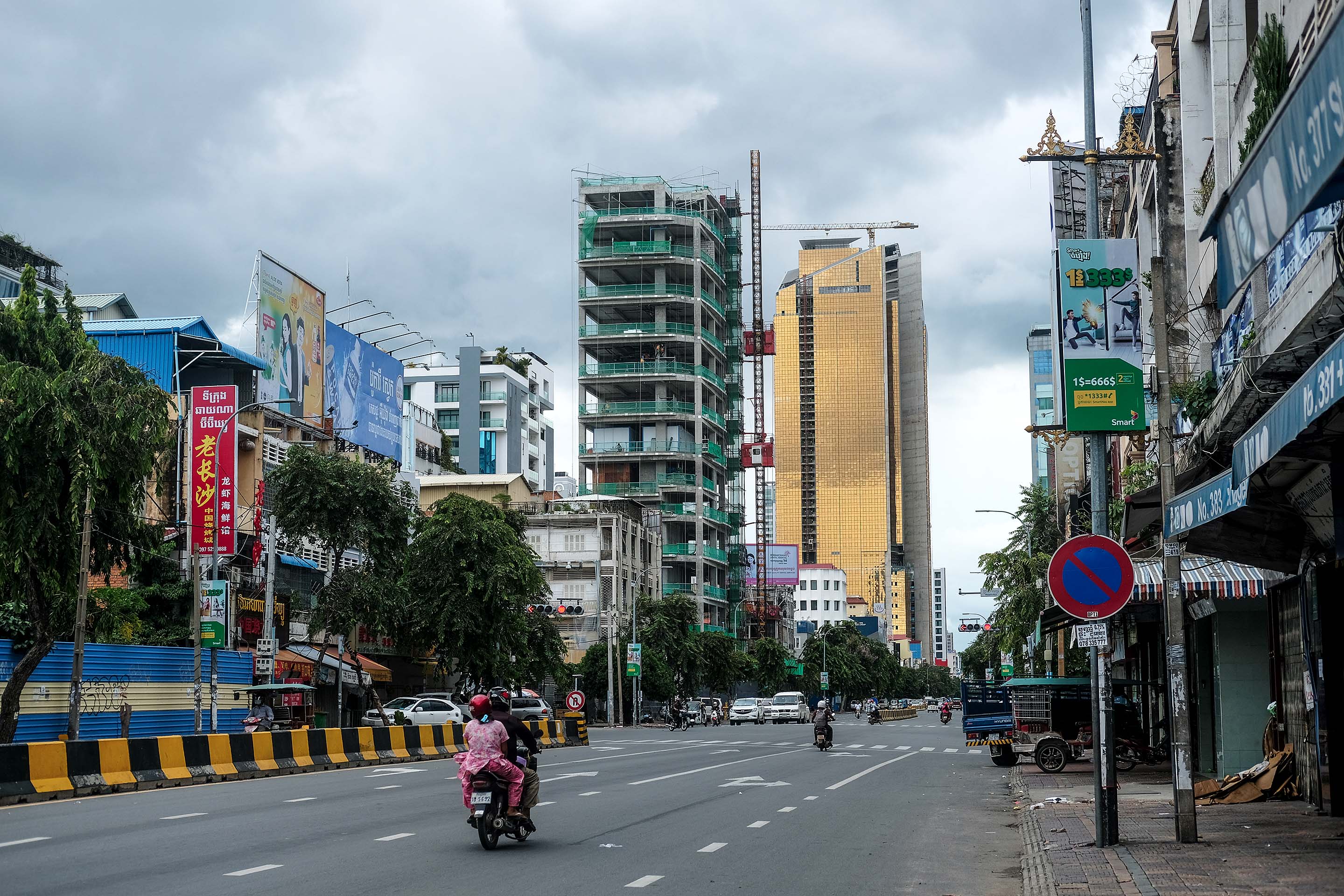
Used close, the lens places the viewer inside the scene. At a market stall, it can show the person, their hands, the goods they are selling and the cramped space in which they work. During a demonstration or public gathering, it can hold the central action and the reaction around it. On a narrow Phnom Penh street, it can include the traffic, buildings and human congestion without forcing the photographer against the opposite wall.

But closeness matters. Stand too far back and people become insignificant figures floating in a large amount of scenery. The photograph may contain everything while saying almost nothing.

The 14mm focuses down to 18 centimetres in its close-focus setting, although its maximum reproduction ratio is only 0.12ร—. More useful is its traditional focus clutch. Pulling the focusing ring backwards reveals a proper distance scale and changes the lens to manual focus. This is especially valuable for street work.

Set the lens to f/8, choose a suitable distance and allow depth of field to do the work. With such a short focal length, a large part of the scene can remain acceptably sharp. The X-Pro1โ€™s uncertain autofocus then becomes largely irrelevant. The photographer watches the subject rather than waiting for a green confirmation box.

The optical viewfinder is part of the X-Pro1โ€™s charm, but the electronic viewfinder is usually more practical with the 14mm. It shows the actual coverage and makes it easier to judge the frame edges. With a lens this wide, a small change in camera position can substantially alter the relationship between foreground and background.


There is no optical stabilisation and neither the camera nor lens is weather-sealed. The aperture ring is also lighter than I would prefer and should be checked occasionally. It can move while the camera is being carried. These are working limitations rather than reasons to dismiss the combination.

At f/2.8 the lens is useful in subdued light, although this is not primarily a lens for shallow depth of field. Even wide open, much of the scene remains recognisable. Its purpose is not to isolate a face against a wash of blur. It is to connect the face to a place.

That makes the X-Pro1 and 14mm a demanding but honest pairing. It does not make composition easy, and it does not hide untidy thinking. The camera slows the photographer down; the lens insists that everything within the frame be considered.

When it works, the resulting photograph does more than show a person. It shows where they are, what surrounds them and how they occupy that small part of the world.

That is the real value of working wide.