


There is a particular expression people adopt when they discover that the camera in your hand is nearly eighteen years old. A small pause, a glance at the battered body, then the question: “Are you still using that?”
Still. As though photography were a subscription that had expired.
The Nikon D700 belongs to a period when digital cameras had become sufficiently good for many photographers to stop worrying about whether digital was sufficiently good. Introduced in 2008, it offered a 12.1-megapixel full-frame sensor, a 51-point autofocus system and five frames per second. It was serious equipment, capable of serious work. Nothing about the arrival of newer cameras has altered what it can record. Nikon’s original announcement

Yet in 2026, choosing one requires an explanation. We have become accustomed to explaining why we keep something, while accepting almost without question the reasons for replacing it.
An old photographer might begin with a simpler question: what is the camera failing to do?
If the answer is that it cannot follow an unpredictable subject reliably enough, cannot provide the resolution a particular job demands, or cannot deliver usable files in the conditions encountered, then replacement makes sense. Equipment should serve the work. There is no virtue in struggling unnecessarily.
But if the answer is merely that newer cameras exist, the case becomes rather thin.
The D700 still makes good photographs. Give it suitable light, a decent lens, accurate focus and an exposure that respects the highlights, and it produces files with ample substance. Faces have texture. Streets have depth. Colour can be convincing, and monochrome can carry the full weight of an expression.
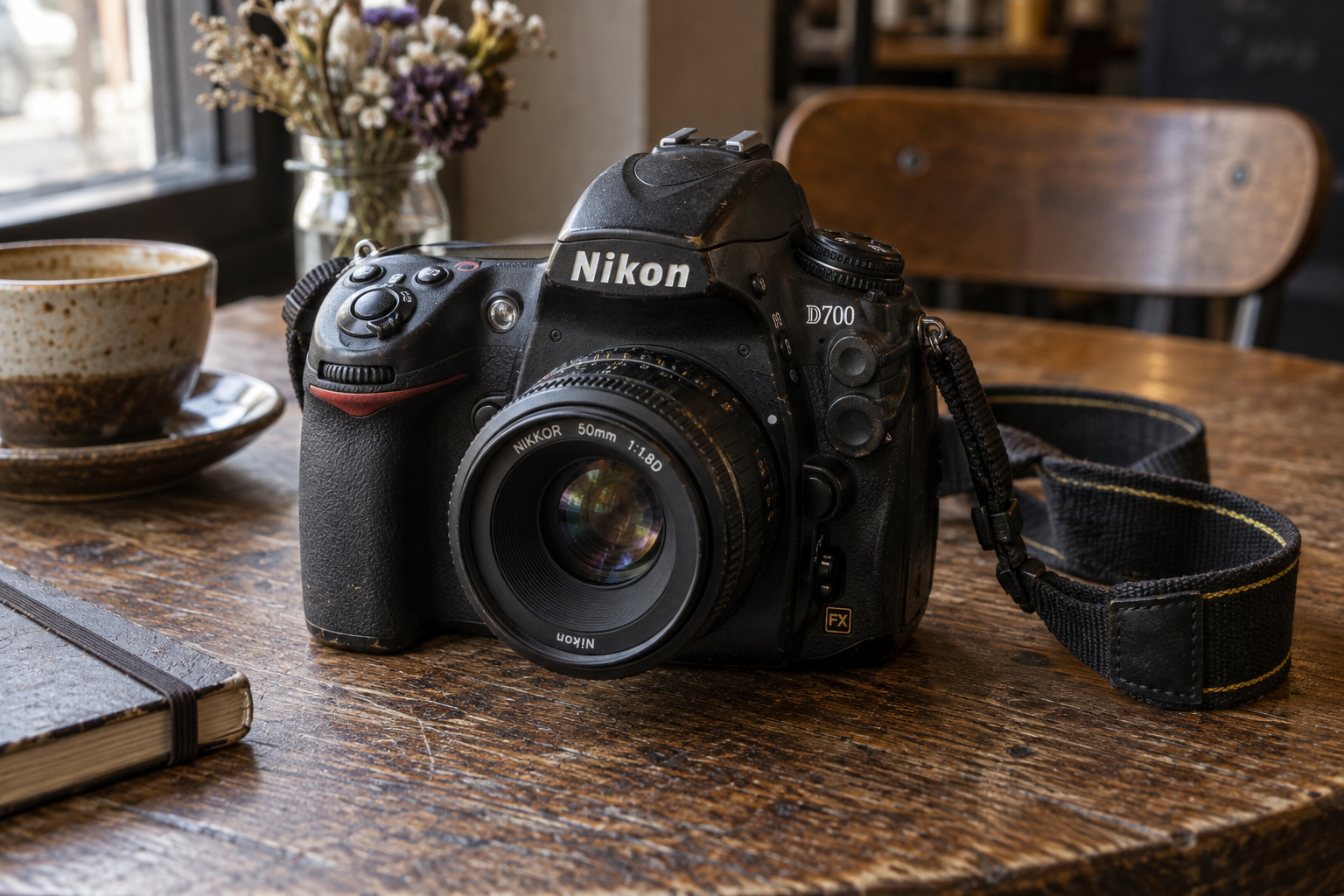
The photograph does not announce the year its sensor was designed. That information usually arrives later, when somebody asks about the equipment.
Twelve megapixels now sounds almost apologetic. We have spent years being taught to regard resolution as a ladder, with progress measured by how many rungs separate the latest purchase from the previous one. There are sound reasons to want more pixels. Large prints, substantial crops and detailed commercial work can all benefit.
But there are also plenty of photographs for which twelve megapixels is enough.
A carefully made D700 file can produce a handsome print. It can illustrate an article, fill a screen and preserve the things that mattered when the shutter was released. Its limitations become more apparent when the photographer starts cutting heavily into the frame. Remove most of the image and there is relatively little information left.
That is a practical restriction, not a moral lesson. Cropping is a legitimate part of photography. Sometimes the picture improves when the edges move. The D700 simply offers less room for that decision than a higher-resolution camera.
For someone who generally composes in the viewfinder and makes modest adjustments afterwards, the restriction may rarely interfere with the work.
The more persuasive reason to carry a D700 is often found in the hands.

Its grip is substantial. Its controls have a physical presence. The optical viewfinder offers a direct view through the lens, with all the pleasures and limitations that entails. There is no preview of the finished exposure waiting inside it; the photographer must judge the light, use the meter and learn how the camera responds.
Some people enjoy that process. Others prefer an electronic viewfinder, and with good reason. Preference does not need to become a campaign.
What matters is whether the camera allows you to work comfortably and attentively. Once its operation becomes familiar, small decisions require less conscious effort. Exposure compensation, focus placement and changes of shutter speed happen without a prolonged consultation with the body.
On the street, that familiarity can be valuable. Expressions pass quickly. A person turns towards the light, somebody enters the background, a hand rises and changes the entire arrangement. The camera needs to respond, but the photographer first needs to notice.








Modern autofocus can improve the chances of getting an eye sharp. It cannot tell you why that particular glance deserves a photograph.
The D700’s autofocus remains useful when handled with an understanding of its behaviour, but it should not be credited with abilities it does not possess. Modern subject recognition and tracking can make demanding work easier. If those capabilities solve a recurring problem, they are worth having.
An old camera earns its place through what it actually delivers. Affection should not be asked to cover missed pictures.

The same honesty applies to image quality. There is much talk of the D700’s distinctive rendering, often accompanied by claims that its files possess a quality newer sensors have somehow lost. Some photographers certainly prefer the results they obtain from it. That preference is real.
The explanation is less straightforward.
Light, lens choice, exposure, white balance and processing all influence the finished photograph. A familiar editing approach may account for much of what someone calls the camera’s character. There is no need to invent a secret ingredient to explain why a picture looks good.
The files can be excellent without being magical.

There is also the considerable advantage of continuing with equipment already owned. A sound D700, a few familiar lenses and a working routine represent a functioning photographic system. Replacing it costs money and demands attention. Sometimes that investment brings a substantial improvement. Sometimes it produces a period of excitement followed by photographs much like the ones made before.
Money saved on equipment can pay for travel, printing or the time needed to return to a subject. Those things may contribute more to the work than another body.
Buying a D700 now is a different proposition from keeping one. The condition of the individual camera matters enormously. A model’s reputation for durability tells you little about how a particular example has been treated. Shutters wear. Controls become unreliable. Batteries age. Previous owners may have worked the camera hard.
A tired example does not become a sensible purchase because somebody describes it as a classic.
Its weight deserves consideration, too. The solidity that feels reassuring when lifting it from a table can become burdensome after several hours of walking. An old photographer should be particularly wary of confusing discomfort with commitment. The camera that leaves you too exhausted to look properly has begun to interfere with the purpose of carrying it.
Nor does age confer artistic authority. Using a D700 does not make someone more thoughtful, more authentic or less susceptible to vanity. Old equipment can become as much of a badge as new equipment. There is nothing especially admirable about announcing that specifications do not matter while repeatedly announcing your specifications.
The useful relationship is quieter.
You pick up the camera because you know it. You take it outside because there is something you want to see. You accept its limitations because they seldom prevent the pictures you are trying to make. When they do, you adapt—or choose another tool.







Technology will continue to improve. Photographers should remain willing to learn from it. But learning does not always require buying, and progress is not always visible in the camera bag.
Sometimes it appears in the willingness to wait. Sometimes in getting closer, understanding a person better, or recognising that the photograph needs more of its surroundings. Sometimes it appears in an edit that finally leaves out the competent picture with nothing to say.
The Nikon D700 remains a reasonable choice in 2026 for a photographer whose needs it still meets. That is a modest claim, but a sufficient one.
Its age will not rescue a weak photograph. Neither will its age spoil a strong one.
Somewhere in front of the lens, a person is about to look up. The light is changing. There is still work to do.

