Nikon D300 vs D300S: A Detailed Comparison

cameras, Lenses, nikon, opinons, thoughts, photography, street, Travel, voluntary

Two rugged DX-format classics, one evolutionary step forward

When Nikon released the D300 in 2007, it was hailed as a “mini D3”—a professional-grade DX body with robust build, advanced autofocus, and excellent image quality. Two years later, the D300S (2009) arrived, refining the formula with subtle but important upgrades. Together, they represent Nikon’s commitment to serious enthusiasts and working photographers who wanted pro handling without the full-frame price tag.

🔍 Sensor & Image Quality

  • D300: 12.3MP DX-format CMOS sensor, ISO 200–3200 (expandable to 6400).
  • D300S: Same 12.3MP sensor, but with improved image processing and slightly better noise control.

Verdict: Both deliver crisp, detailed files with excellent dynamic range for their era. The D300S edges ahead in cleaner high-ISO performance thanks to updated EXPEED processing.

⚙️ Autofocus & Speed

  • D300: 51-point AF system, 6 fps burst (8 fps with battery grip).
  • D300S: Same AF system, but faster response and 7 fps burst (8 fps with grip).

Verdict: The D300S is marginally quicker, making it more appealing for sports and wildlife shooters.

🎥 Video Capability

  • D300: No video recording.
  • D300S: Introduced 720p HD video at 24 fps—a first for Nikon’s semi-pro DX line.

Verdict: The D300S opened the door to hybrid shooting, though video features were basic compared to modern standards.

🧱 Build & Handling

  • Both cameras feature magnesium alloy bodies, full weather sealing, and pro-level ergonomics.
  • D300S added dual card slots (CF + SD) for flexible storage and backup.
  • Slight refinements in button layout and responsiveness made the D300S feel more polished.

💰 Value & Legacy

  • D300: More affordable on the used market, still a solid choice for those who don’t need video.
  • D300S: Holds higher value thanks to incremental upgrades, dual card slots, and video capability.
📝 Final Thought

The D300 was revolutionary, bringing pro-level performance to DX shooters. The D300S refined that legacy, adding speed, video, and workflow improvements. Today, both are remembered as rugged, reliable workhorses—but if you want the most versatile of the two, the D300S is the smarter pick.
The Nikon D800E v Nikon D810

cambodia, Lenses, nikon, opinons, thoughts, photography, street, Travel

The D800E and D810 are siblings built for resolution and dynamic range—the D800E (2012) introduced Nikon’s 36MP era with a no‑AA optical filter for maximum micro‑detail, while the D810 (2014) refined that formula with cleaner high‑ISO performance, faster processing, and improved video and usability—making the D800E a classic detail‑seeker and the D810 a more versatile, modern workhorse.

Overview

The D800E and D810 occupy the same creative space: high‑resolution full‑frame DSLRs aimed at landscape, studio, and commercial shooters. The D800E removed the anti‑aliasing filter to push resolving power, which rewarded sharp lenses but could increase moiré. The D810 kept the 36MP class but reworked the sensor readout, processing pipeline, and ergonomics to reduce noise and improve overall image quality and handling.

Sensor, Image Quality, and ISO

Both cameras use 36MP full‑frame sensors, but the D810’s sensor and processor deliver cleaner high‑ISO performance and wider usable dynamic range, especially in shadow recovery and highlight retention. The D800E’s no‑AA approach gives slightly crisper micro‑detail in ideal conditions, but the D810’s improvements make it more forgiving in real‑world shooting and post‑processing.

Autofocus, Speed, and Usability

The D810 benefits from incremental AF and performance upgrades introduced after the D800E. It’s lighter and tuned for a smoother shooting experience, with firmware and menu refinements that matter during long shoots. The D800E remains competent for studio and tripod work, but the D810’s refinements make it better for mixed assignments where speed and workflow matter.

Video and Hybrid Use

If you plan to shoot video, the D810 is the stronger choice: improved video features and cleaner processing give it an edge for hybrid shooters. The D800E was primarily a stills machine; the D810 broadened the camera’s appeal to creators who need both stills and motion with high fidelity.

Practical Trade‑offs and Recommendations

  • Choose the D800E if you prioritize absolute micro‑detail and shoot mostly on tripod or in controlled studio/landscape conditions; pair it with the sharpest optics you can afford and be prepared to manage moiré in post.
  • Choose the D810 if you want the same resolution with better high‑ISO performance, improved handling, and more flexible video/field use—it’s the more versatile, future‑proof option for mixed professional work.
  • Actionable steps: test your lenses for resolving power before committing; if you shoot handheld or in variable light, favor the D810; if you print very large and control every variable, the D800E still rewards discipline.

Final Thought

Both cameras are milestones in Nikon’s lineup: the D800E is a purist’s tool for extracting every ounce of detail, while the D810 is the pragmatic evolution—keeping the resolution but smoothing the rough edges for everyday professional use. Your choice comes down to workflow, subject matter, and how much post‑processing you’re willing to manage

The Fujifilm X‑Pro3

cambodia, Fujichrome, fujifilm, Lenses, opinons, thoughts, photography, pictures, street, Travel

The Fujifilm X‑Pro3 is a distinctive, rangefinder‑style mirrorless camera that excels in build quality, image rendering, and unique design philosophy—but ongoing issues include reliability concerns with its sub monitor, shutter button feedback, and its unconventional hidden LCD, which some photographers find impractical.

📸 Core Strengths

  • Design Philosophy: The X‑Pro3 was built to encourage “viewfinder‑first” shooting. Its hidden LCD forces photographers to rely on the hybrid optical/electronic viewfinder, echoing the discipline of film cameras.
  • Build Quality: Constructed with a titanium top and bottom plate, weather sealing, and robust ergonomics, the X‑Pro3 is designed for durability in professional use.
  • Sensor & Image Quality: Equipped with a 26.1MP APS‑C X‑Trans IV sensor, it delivers excellent colour reproduction, dynamic range, and Fujifilm’s renowned film simulations.
  • Hybrid Viewfinder: The defining feature—users can switch between an optical viewfinder (OVF) and a high‑resolution electronic viewfinder (EVF), offering flexibility for different shooting styles.
  • Performance: Fast autofocus with 425 phase‑detect points, improved low‑light sensitivity, and solid burst shooting at 11fps mechanical or 20fps electronic shutter.

⚠️ Ongoing Problems & Criticisms

  • Sub Monitor Failures: Multiple users have reported issues with the small “sub monitor” on the back (which displays film simulation and settings). Failures or malfunctions have been noted, sometimes outside warranty.
  • Shutter Button Feedback: Some photographers complain that the shutter button loses its tactile “second click,” making it harder to confirm when an image has been taken.
  • Hidden LCD Design: While philosophically bold, the flip‑down LCD frustrates many users who rely on quick image review or live view shooting. Critics argue it slows workflow and feels impractical.
  • Reliability Concerns: Threads on photography forums highlight worries about long‑term durability, with scattered reports of component failures.
  • Video Limitations: Although capable of 4K recording, the X‑Pro3 is not optimised for video compared to Fujifilm’s X‑T series.

✅ Best Use Cases

  • Street photography, where discretion and OVF shooting are valued.
  • Documentary and travel work, especially for photographers who embrace intentional, viewfinder‑driven shooting.
  • Enthusiasts who appreciate Fujifilm’s film simulations and want a camera that enforces discipline.

✨ Summary

The X‑Pro3 is a niche but powerful tool: it rewards photographers who embrace its philosophy of slowing down and shooting deliberately. Its titanium build, hybrid viewfinder, and superb sensor make it a joy for those aligned with its design ethos. However, ongoing problems with the sub monitor, shutter button feedback, and the divisive hidden LCD design mean it’s not universally loved. For photographers who value reliability and modern conveniences, the X‑T series may be a safer bet; for those who want a camera that challenges their habits, the X‑Pro3 remains unique.

Fujifilm X-E2 Review: Vintage Meets Modern Performance

cambodia, cameras, fujifilm, Lenses, opinons, thoughts, photography, pictures, street, Travel, voluntary
  • Image Quality: At its core, the X‑E2 features a 16.3‑megapixel APS‑C X‑Trans CMOS II sensor. This sensor uses a unique colour filter array that mimics film grain, eliminating the need for an optical low‑pass filter. The result is sharp, detailed images with rich colour reproduction.
  • Fast Autofocus: The hybrid AF system combines contrast and phase detection, achieving focus speeds as fast as 0.08 seconds. With 49 AF points, it’s responsive enough for everyday shooting and moderate action.
  • Retro Design & Handling: Styled like a classic rangefinder, the X‑E2 offers tactile dials for shutter speed and exposure compensation. Its magnesium alloy body feels solid yet compact, appealing to photographers who enjoy manual control.
  • Electronic Viewfinder: A 2.36‑million‑dot EVF provides a crisp, detailed preview, while the 3‑inch LCD (1.04M dots) supports easy composition and playback.
  • Performance: Powered by the EXR Processor II, the camera delivers 7fps continuous shooting, in‑camera RAW conversion, and film simulation modes that replicate Fujifilm’s iconic film stocks.
  • Connectivity & Extras: Built‑in Wi‑Fi allows for image transfer and remote shooting. Creative features include multiple exposure, panorama mode, focus peaking, and digital split image for precise manual focus.

⚖️ Limitations

  • No 4K video: Limited to 1080p recording.
  • Fixed screen: No articulation or touchscreen functionality.
  • ISO performance: Usable up to ISO 6400, but noise becomes noticeable at higher settings.

✅ Best Use Cases

  • Street photography, thanks to its discreet retro styling.
  • Travel and documentary work, with compact size and versatile lens options.
  • Enthusiast photographers who value manual controls and film‑like rendering.

✨ Summary

The Fujifilm X‑E2 remains a well‑balanced mirrorless camera that combines vintage charm with capable modern features. Its sensor, EVF, and tactile controls make it a joy for photographers who prioritise image quality and creative handling over cutting‑edge specs. For those seeking a reliable, affordable entry into Fujifilm’s X system, the X‑E2 is still a worthy companion.

The Enduring Legacy of the Nikon D800

cameras, Lenses, opinons, thoughts, pictures, street, Travel, voluntary

When Nikon released the D800 in 2012, it was nothing short of a landmark. Its 36.3‑megapixel full‑frame sensor rivaled medium format resolution, setting a new standard for detail and dynamic range in DSLR photography. More than a decade later, the D800 remains a relevant and compelling choice—particularly for photographers who value image quality over speed or convenience.

The strengths of the D800 are clear. Its sensor delivers exceptional resolution, making it ideal for landscapes, editorial work, and large prints where fine detail matters. The wide dynamic range, paired with a base ISO of 100, allows for impressive highlight and shadow recovery—still competitive with newer models. Built from magnesium alloy with weather sealing, the body was designed for professionals and continues to prove its durability in the field. Compatibility with Nikon’s vast F‑mount lens ecosystem, including legacy AF‑D glass, adds flexibility and long‑term value. And on today’s used market, the D800 offers remarkable price‑to‑performance—often available for under $500, a fraction of its original $3,000 retail price.

Of course, limitations exist. Autofocus, while solid, lacks the speed and precision of modern mirrorless systems. Low‑light performance is decent but not on par with newer sensors, with noise becoming noticeable above ISO 3200. The absence of conveniences like Wi‑Fi, touchscreen controls, or an articulating display may frustrate those accustomed to modern ergonomics. And at over 900 grams body‑only, the D800 is undeniably heavy, which can be a drawback for travel or street photography.

Yet these trade‑offs are part of the D800’s character. It is not a flashy camera, but a disciplined one. It rewards intentional shooting, careful composition, and thoughtful use of light. In 2025, it remains ideally suited for landscape and editorial photography, studio portraiture under controlled lighting, and even street work with legacy lenses. For ethical photojournalism, where resolution and dynamic range matter more than speed, the D800 still fits seamlessly into a responsible workflow.

The Nikon D800 endures because it embodies reliability, resolution, and restraint. It is a tool for photographers who value discipline over convenience, craft over trend. More than a relic, it is a reminder that great cameras are not defined by novelty, but by the lasting quality of the images they produce.

📸 Nikkor 70–210mm f/4–5.6 AF-D: A Sleeper Telephoto Worth Knowing

cambodia, Lenses, opinons, thoughts, photography, pictures, street, Travel

In a world obsessed with fast primes and pro-grade zooms, the Nikkor 70–210mm f/4–5.6 AF-D is often overlooked. Released in the late 1980s and refined through the 1990s, it’s a lens that quietly delivers—especially for street, travel, and candid work where discretion and versatility matter.

🔍 Optical Performance

  • Sharpness: Respectable across the range, especially in the centre. It holds up well even on higher-resolution sensors, though it won’t match modern primes or pro zooms.
  • Contrast & Colour: Slightly cool rendering; contrast is decent but not punchy.
  • Bokeh: Fair—better at 135mm than at 210mm.
  • Distortion: Minimal at 70mm, increasing pincushion distortion toward 210mm.

⚙️ Build & Handling

  • Construction: Solid for its class—metal mount, decent heft (~590g), and a push-pull zoom design. Not weather-sealed, and it does pump air when zooming.
  • Autofocus: Fast for its era, especially the AF-D version with improved gearing. Noisy and not ideal for video, but snappy enough for street and candid work.
  • Size: Compact for a telephoto zoom, making it a good fit for travel or discreet shooting.

💰 Value & Use Cases

  • Price: Often found used for £80–£150, (I picked up my perfect copy for 50$ US here in PP) making it one of the best-value Nikon telephoto zooms available.
  • Best For:
    • Street photography with reach
    • Travel and urban detail work
    • Candid portraits at a distance
    • Vintage DSLR setups or film bodies

⚠️ Limitations

  • Low-light performance: With a variable aperture of f/4–5.6, it’s not ideal for dim conditions.
  • No VR (Vibration Reduction): You’ll need steady hands or fast shutter speeds.
  • Push-pull zoom: Some find it less precise than modern ring zooms.

✅ Final Assessment

The Nikkor 70–210mm f/4–5.6 AF-D is not flashy, but it’s reliable. It rewards photographers who value presence, anticipation, and discretion over technical perfection. For street work, especially in bright conditions, it’s a sleeper lens that punches above its weight.

If your style is unpolished but intentional, this lens fits right in.

📸 Program Mode and the Myth of Purism: A Street Photographer’s Perspective

cameras, fujifilm, Lenses, opinons, thoughts, photography, pictures, street, Travel

There’s a myth in photography: that “real” photographers must shoot in full manual mode, especially if they own expensive gear. The implication is that Program Mode is a shortcut, a crutch, or even a betrayal of the craft.

But here’s the truth: Program Mode is not a weakness. It’s a strategy.

I. The Myth of Manual Purism

Manual mode is often treated as a badge of honour. It suggests mastery, control, and technical discipline. But photography is not a competition in purity—it is a practice of seeing.

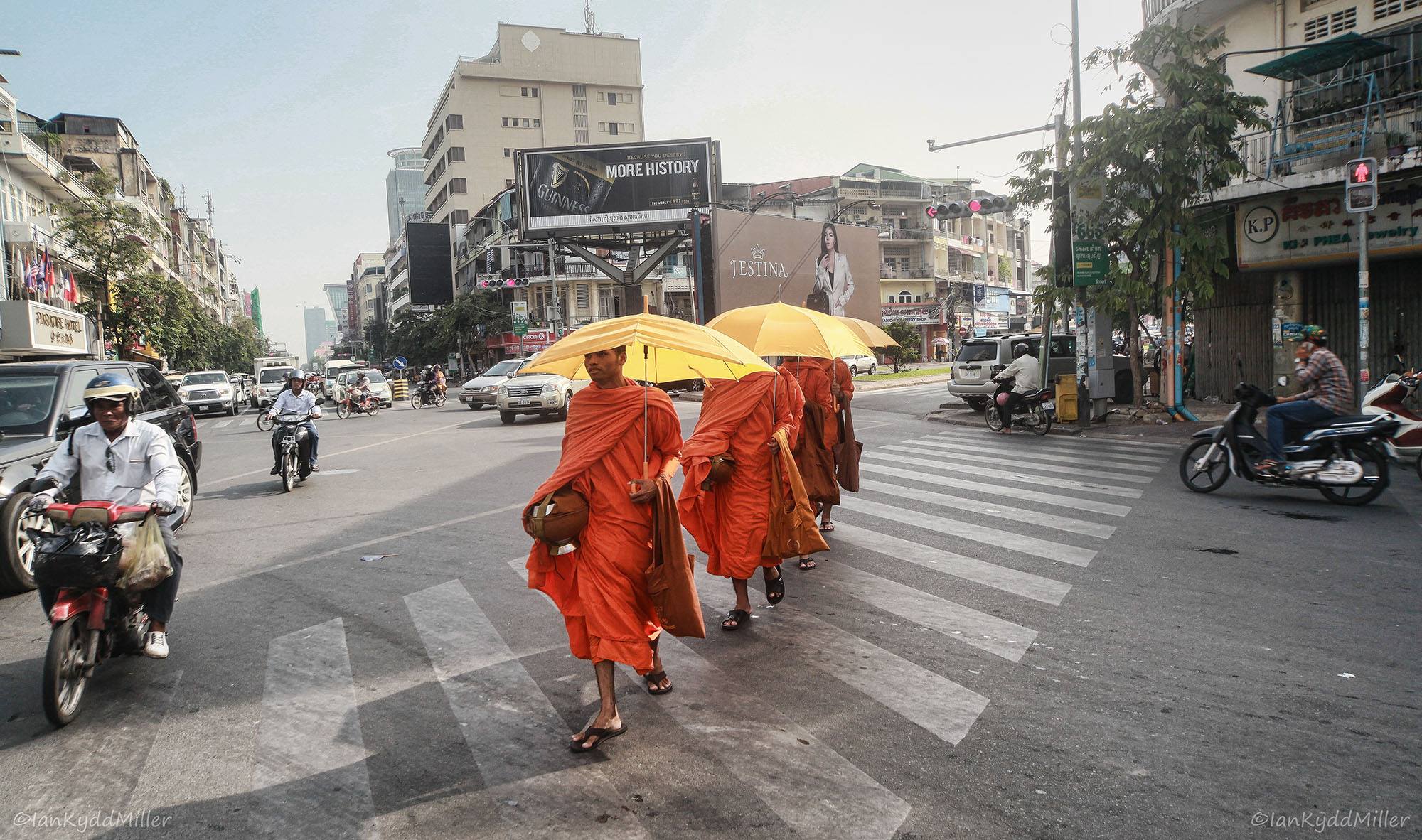
Street photography, especially in Phnom Penh’s fast‑moving rhythm, demands presence more than technical gymnastics. If fiddling with dials makes you miss the moment, then the pursuit of “purism” has already failed.

II. Program Mode as a Discipline

Program Mode doesn’t mean surrendering creativity. It means letting the camera handle exposure basics while you focus on what matters most: composition, timing, and anticipation.

When monks step into morning light or a vendor gestures mid‑conversation, you don’t have time to calculate shutter speed and aperture. Program Mode frees you to be present, to anticipate, and to react.

III. Control Is Still Yours

Modern DSLRs are not mindless machines. Program Mode allows overrides:

  • Exposure compensation to adjust brightness.
  • Program shift to balance aperture and shutter.
  • Focus lock to control depth and subject.

You’re not giving up control—you’re choosing where to invest your attention. The camera becomes a collaborator, not a dictator.

IV. Anticipation Over Perfection

Street photography is about anticipation—the ability to sense a moment before it happens. Burst shooting captures micro‑variations, but anticipation is the discipline that guides it.

Program Mode supports this discipline. It keeps you ready, so when the decisive moment arrives, you’re not buried in settings—you’re alive to the rhythm of the street.

V. Philosophy of Use

An expensive DSLR is a tool. Its value lies not in how “manual” you shoot, but in how authentically you capture.

If Program Mode helps you stay present in Phnom Penh’s streets—catching candid gestures, fleeting light, and authentic human connection—then it is serving your vision.

Closing Call: The Decisive Moment Doesn’t Care

The decisive moment doesn’t care what mode you used. It cares that you were there, attentive, and ready.

Program Mode is acceptable because photography is not about proving technical purity—it’s about making images that resonate.

🎯 Why Sharp Focus Matters in Photography

Lenses, opinons, thoughts, photography, pictures, street, Travel

Clarity isn’t just technical—it’s emotional

Focus is more than a technical checkbox. It’s a storytelling tool. A sharply focused image draws the viewer’s eye exactly where you want it—whether that’s a subject’s eyes, a product detail, or a fleeting moment in motion. Blurry or misfocused shots can feel accidental, distracting, or amateurish unless used deliberately for artistic effect.

🔍 What “Sharp Focus” Really Means

  • Plane of focus: The specific area in your frame that’s tack-sharp. Everything else falls into blur depending on depth of field.
  • Subject isolation: Sharp focus helps separate your subject from the background, especially with wide apertures.
  • Viewer engagement: Crisp detail invites viewers to linger, explore textures, and emotionally connect with the subject.
  • Professionalism: Sharpness signals control and intent—essential in commercial, editorial, and portfolio work.

🧠 Common Focus Mistakes

  • Back-focus or front-focus: The camera locks onto the wrong part of the scene—e.g., ears instead of eyes.
  • Focus-recompose errors: Reframing after focusing can shift the plane of focus, especially at wide apertures.
  • Motion blur mistaken for soft focus: Slow shutter speeds can cause blur even if focus is accurate.
  • Autofocus mode mismatch: Using single-point AF for moving subjects or wide-area AF for precise portraits can lead to missed shots.

⚙️ How to Nail Sharp Focus

  • Use single-point AF for precision: Especially for portraits—aim for the closest eye.
  • Switch to continuous AF for movement: Track subjects with AF-C or AI Servo modes.
  • Check depth of field: Wide apertures (f/1.4–f/2.8) require pinpoint accuracy; stop down for more forgiving focus.
  • Stabilize your camera: Use tripods, monopods, or fast shutter speeds to avoid motion blur.
  • Review with magnification: Zoom in on your LCD or EVF to confirm critical sharpness.

🎨 When Soft Focus Works

  • Dreamy portraits: Slight softness can flatter skin and evoke nostalgia.
  • Motion blur storytelling: Intentional blur can convey speed, emotion, or chaos.
  • Atmospheric scenes: Fog, rain, or low light can benefit from selective softness.

But these effects only work when chosen, not when accidental.

📝 Final Thought

📸 The Exposure Triangle

opinons, thoughts, photography, pictures, street, Travel

Mastering the balance of light in photography

The Exposure Triangle is the foundation of photographic technique. It describes the relationship between three key settings—aperture, shutter speed, and ISO—that together determine how bright or dark your image will be. Understanding how these elements interact is essential for achieving correct exposure and creative control.

🔺 The Three Sides of the Triangle

  1. Aperture (f-stop)
    • Controls how much light enters through the lens.
    • Wide apertures (e.g., f/1.8) let in more light and create shallow depth of field (blurry backgrounds).
    • Narrow apertures (e.g., f/16) let in less light but increase depth of field (more of the scene in focus).
  2. Shutter Speed
    • Determines how long the sensor is exposed to light.
    • Fast speeds (e.g., 1/1000s) freeze motion.
    • Slow speeds (e.g., 1/30s or longer) allow motion blur or creative long exposures.
  3. ISO
    • Adjusts the sensor’s sensitivity to light.
    • Low ISO (100–200) produces clean, noise-free images.
    • High ISO (1600+) helps in low light but introduces grain/noise.

⚖️ How They Work Together

  • Changing one setting affects the others. For example:
    • If you open the aperture wider, you may need a faster shutter speed or lower ISO to avoid overexposure.
    • If you increase ISO in low light, you can use a faster shutter speed but risk more noise.
  • The triangle is about balance: each side compensates for the others to achieve the desired exposure.

🧠 Practical Tips

  • Use aperture priority mode when depth of field is your main concern (portraits, landscapes).
  • Use shutter priority mode when motion control is key (sports, long exposures).
  • Use manual mode to take full creative control and learn how the triangle works in practice.
  • Check your histogram to ensure highlights and shadows aren’t clipped.

🎨 Creative Control

Correct exposure isn’t always about technical perfection. Sometimes photographers intentionally underexpose for mood or overexpose for a dreamy effect. Mastering the triangle gives you the freedom to bend the rules deliberately.

📝 Final Thought

The Exposure Triangle is more than a technical concept—it’s a creative toolkit. By understanding how aperture, shutter speed, and ISO interact, you gain the ability to shape not just the brightness of your image, but its mood, sharpness, and emotional impact.

📸 Understanding Correct Exposure in Photography

Lenses, opinons, thoughts, photography, pictures, street, Travel

Why it matters and how to achieve it

Exposure refers to the amount of light that reaches your camera’s sensor. Too much light, and your photo is overexposed—washed out with lost highlight detail. Too little, and it’s underexposed—dark, noisy, and lacking shadow detail. Correct exposure is about balance: capturing detail in both highlights and shadows while preserving the atmosphere of the scene.

🔺 The Exposure Triangle

  1. Aperture (f-stop)
    • Controls how much light enters through the lens.
    • Wide apertures (f/1.4–f/2.8) let in more light and create shallow depth of field.
    • Narrow apertures (f/8–f/16) reduce light but increase depth of field, keeping more of the scene sharp.
  2. Shutter Speed
    • Determines how long the sensor is exposed to light.
    • Fast speeds (1/1000s) freeze motion.
    • Slow speeds (1/30s or longer) allow motion blur or creative long exposures.
  3. ISO
    • Adjusts sensor sensitivity to light.
    • Low ISO (100–200) produces clean images with minimal noise.
    • High ISO (1600+) helps in low light but introduces grain.

Together, these three settings form the exposure triangle, and adjusting one requires compensating with another to maintain balance.

🧠 Methods for Achieving Correct Exposure

  • Metering Modes: Cameras offer matrix, center-weighted, and spot metering to measure light differently. Choosing the right mode helps avoid over/underexposure in tricky lighting.
  • Histogram Check: Reviewing the histogram ensures highlights and shadows aren’t clipped. A balanced histogram indicates proper exposure.
  • Exposure Compensation: Adjusting +/– EV lets you fine-tune brightness without changing aperture or shutter speed.
  • Bracketing: Shooting multiple exposures (under, correct, over) ensures you capture the best version, especially in high-contrast scenes.
  • Manual Mode Practice: Learning to balance aperture, shutter, and ISO manually builds confidence and creative control.

🎨 Creative Considerations

Correct exposure isn’t always about technical perfection. Sometimes, intentional underexposure adds mood, or overexposure creates a dreamy effect. The key is knowing the rules well enough to break them deliberately.

📝 Final Thought

Exposure is the heartbeat of photography. By mastering aperture, shutter speed, and ISO—and using tools like histograms and metering—you gain control over both technical accuracy and creative expression. Correct exposure ensures your images are not just visible, but powerful.