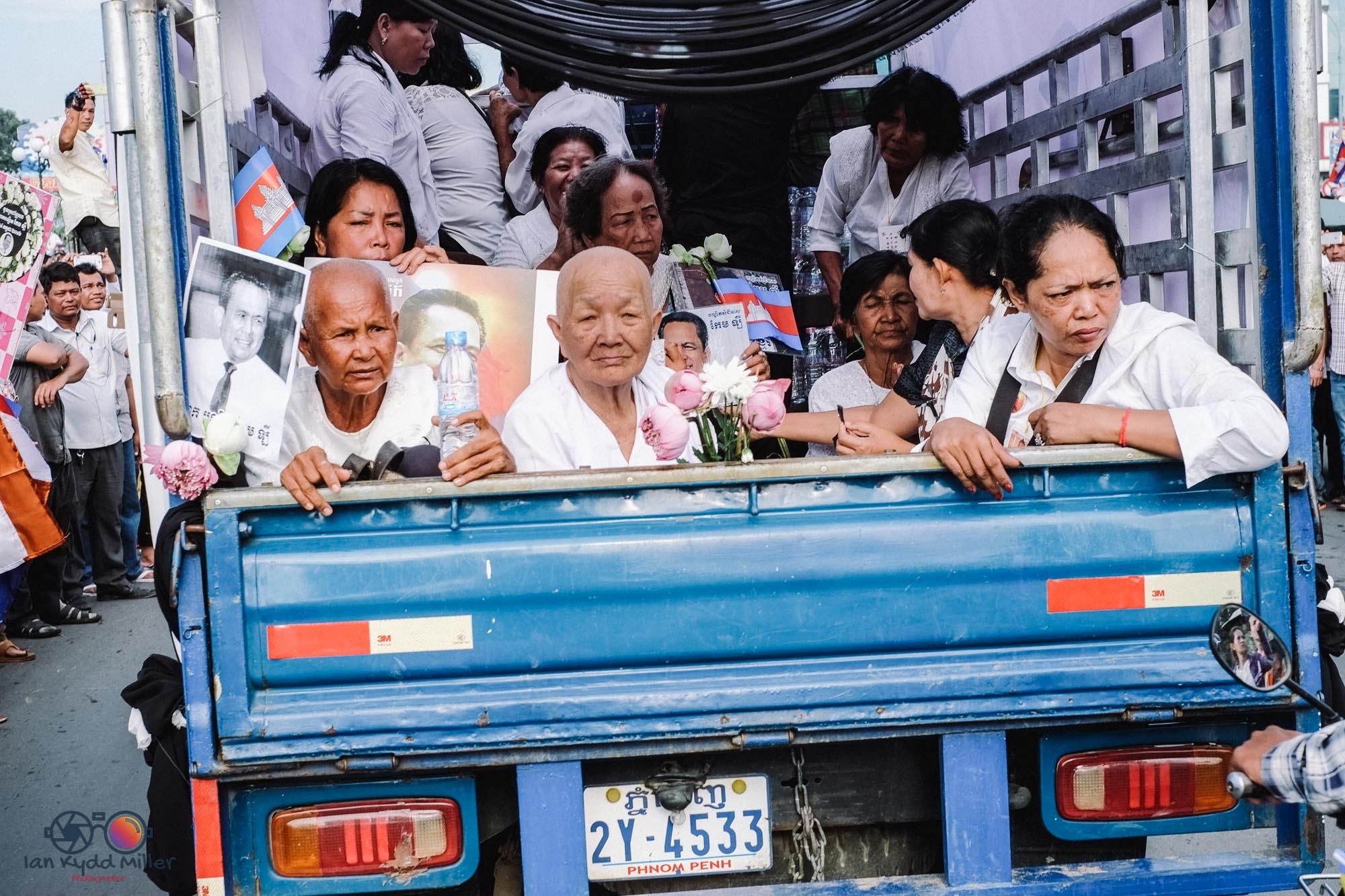
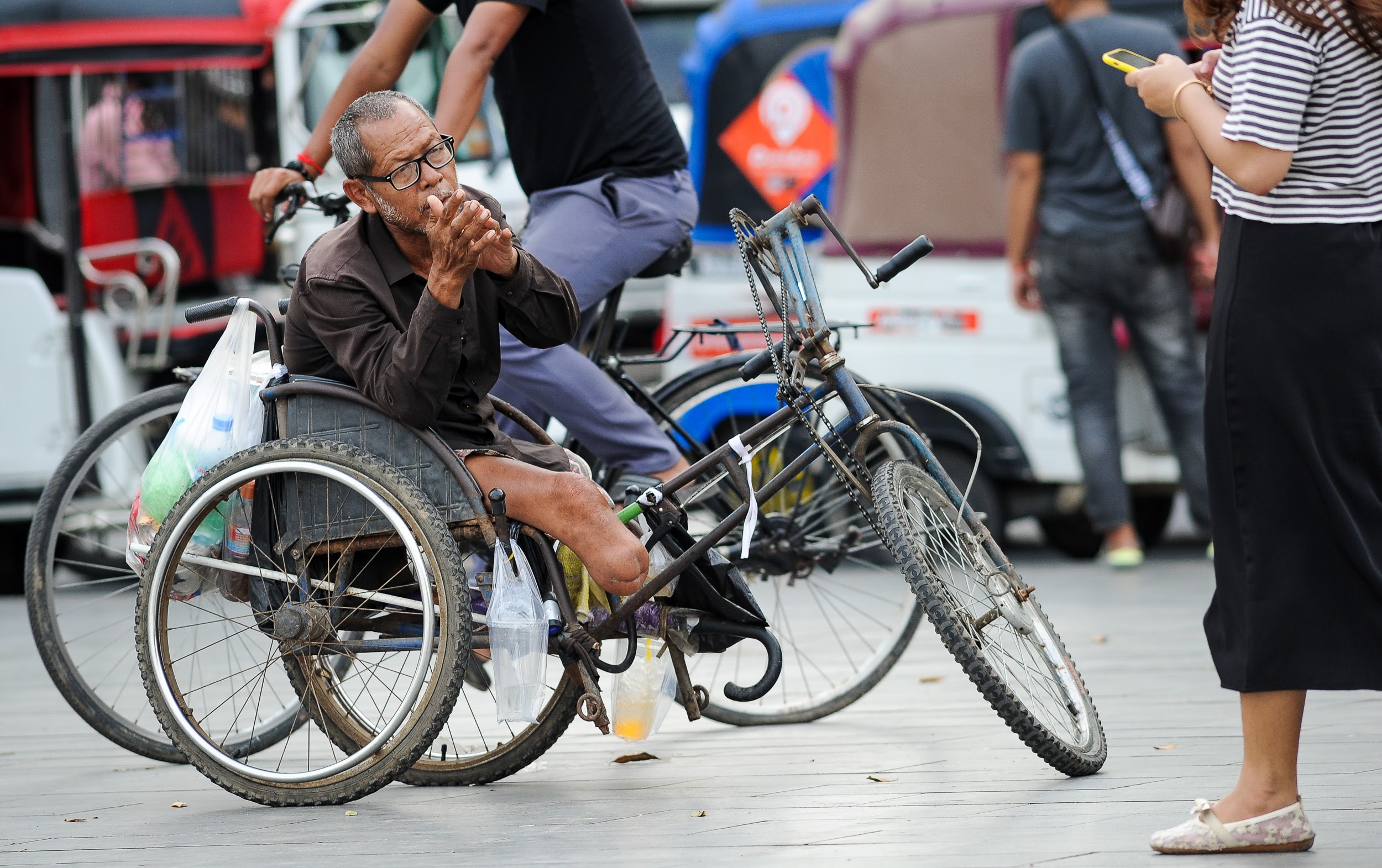
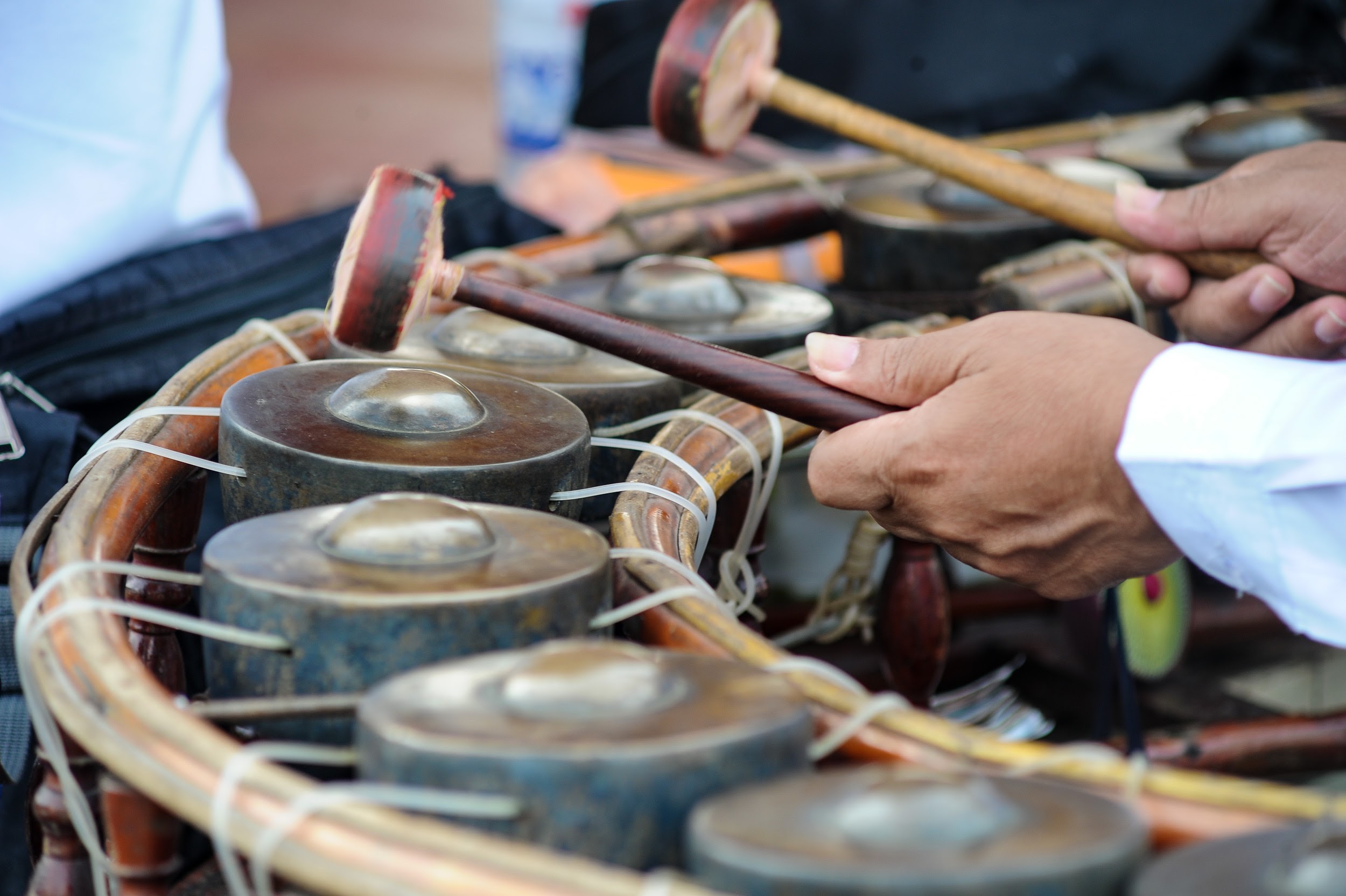
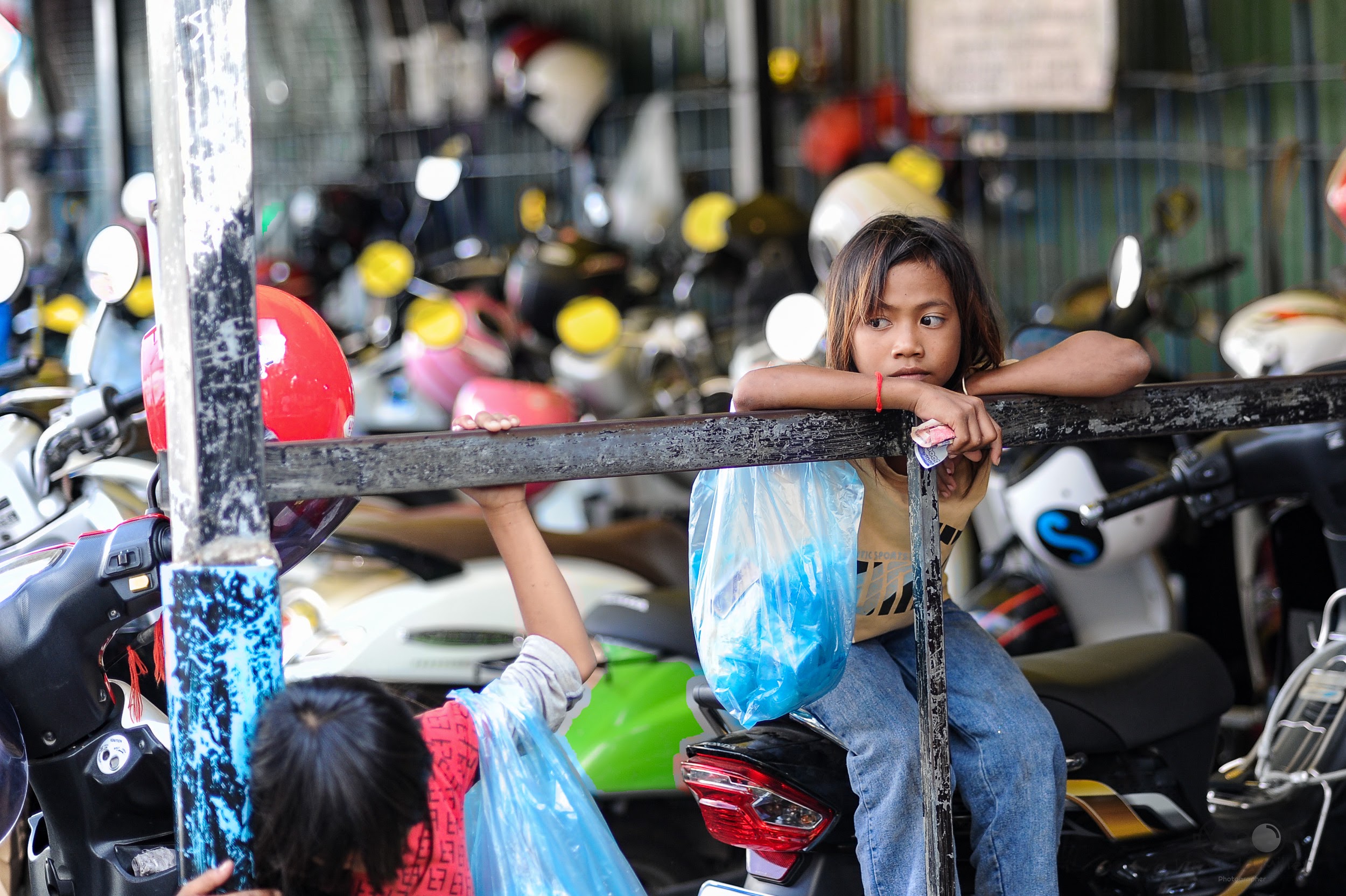
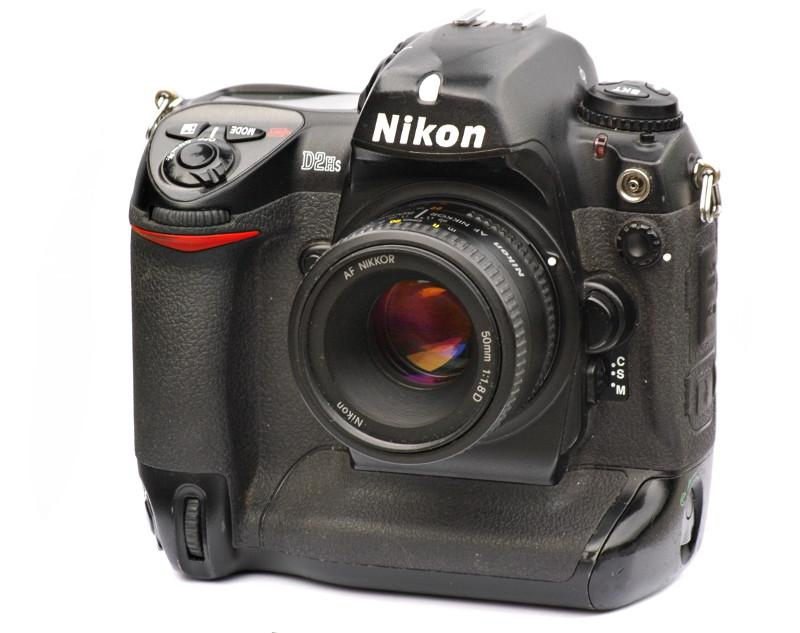
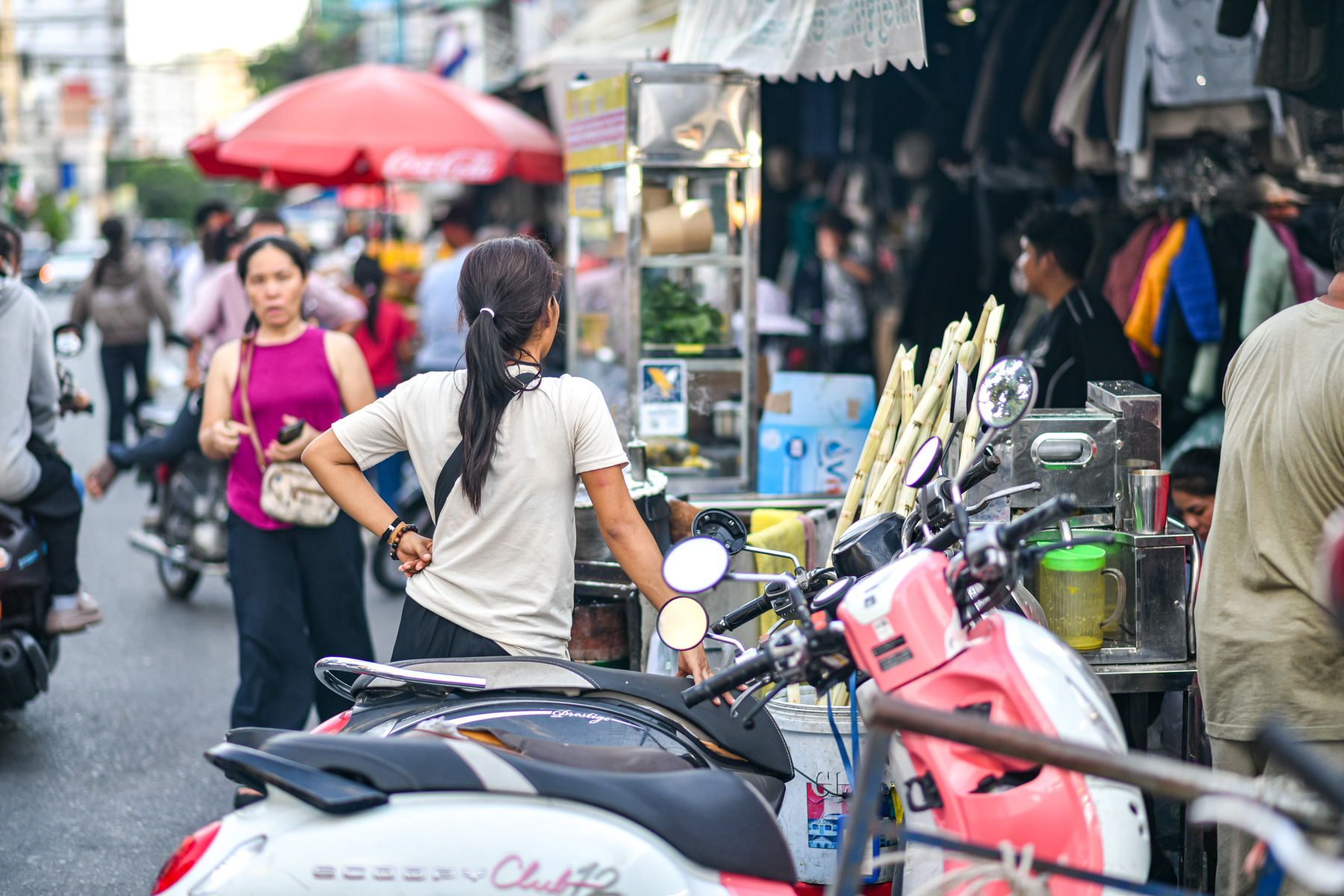
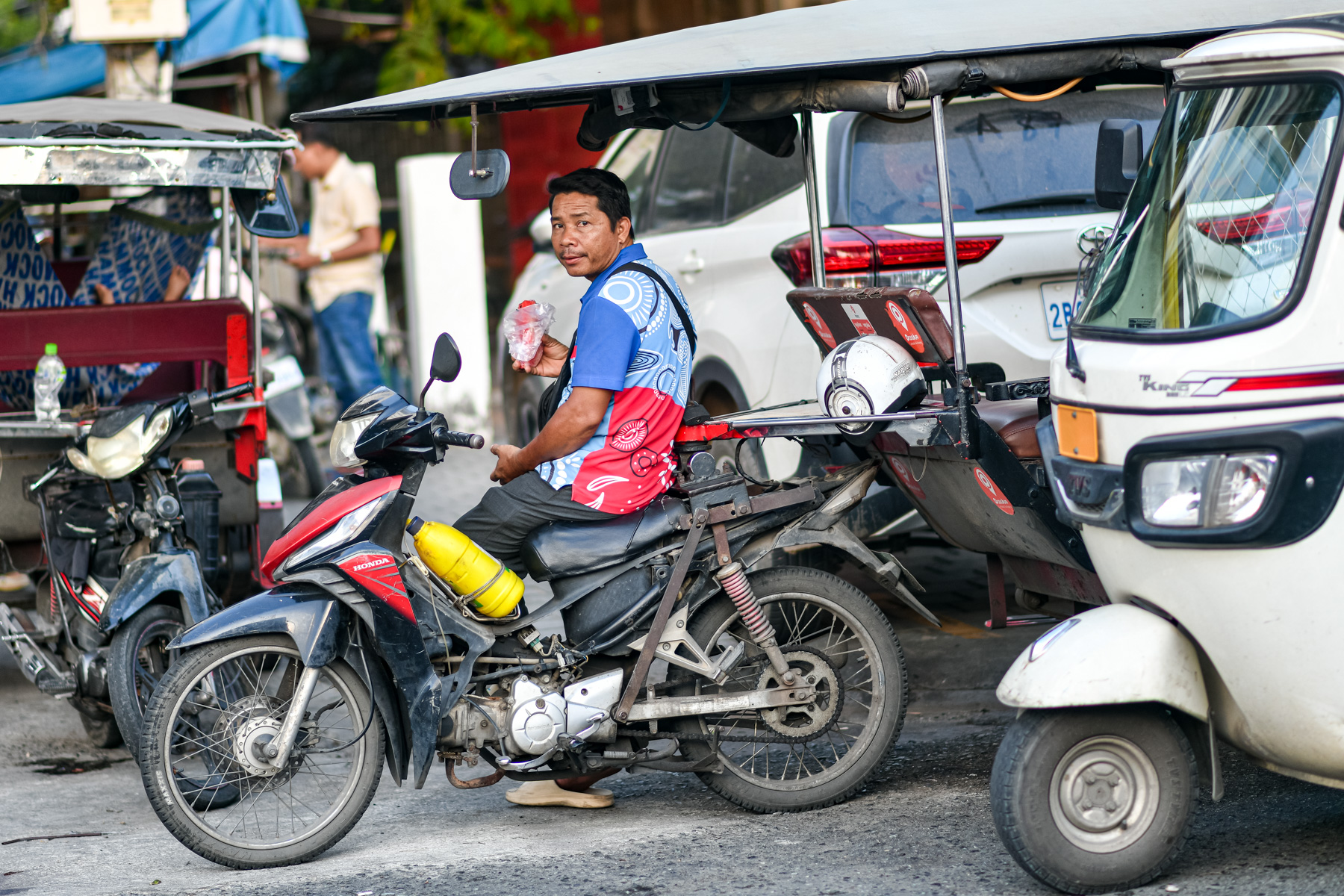
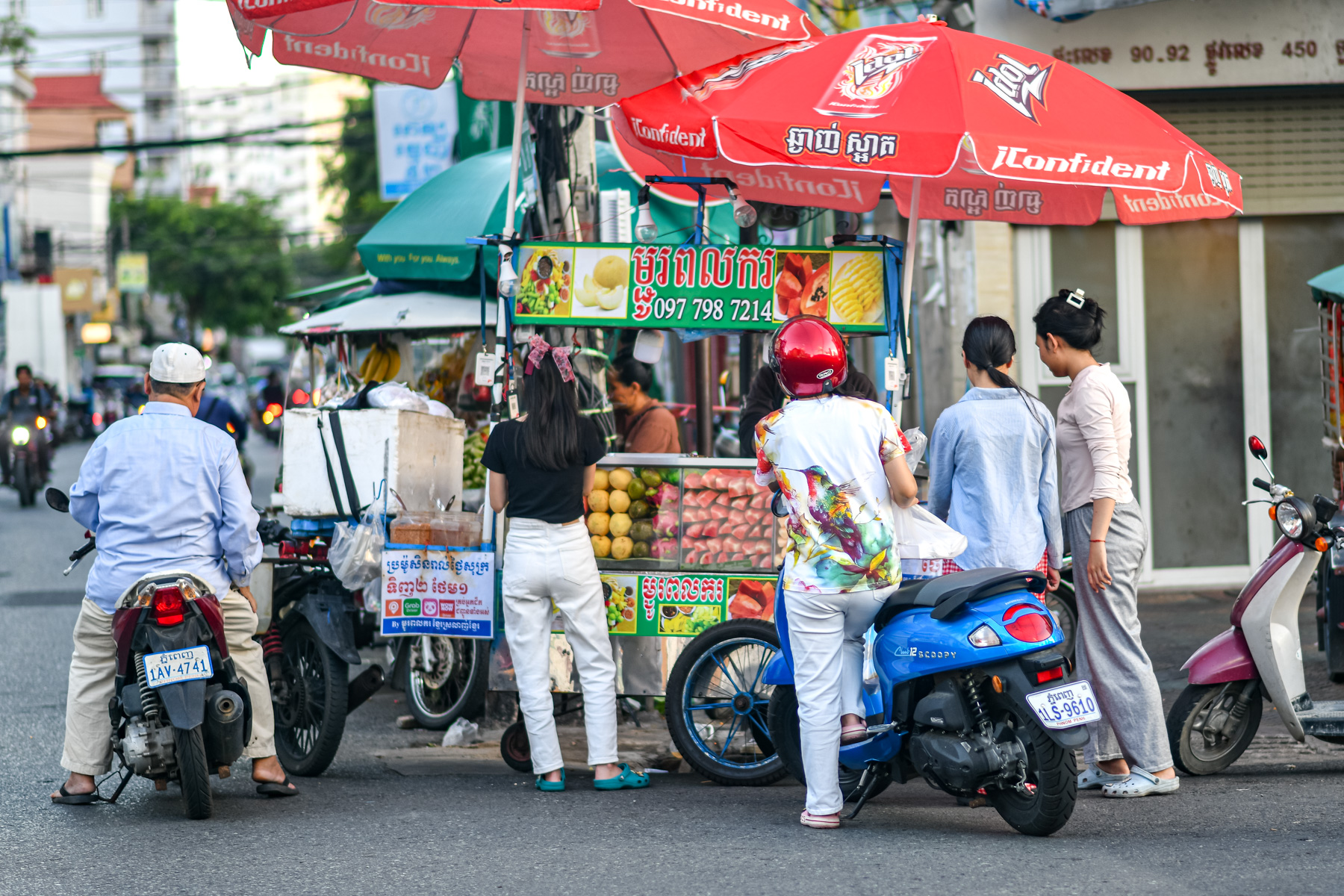
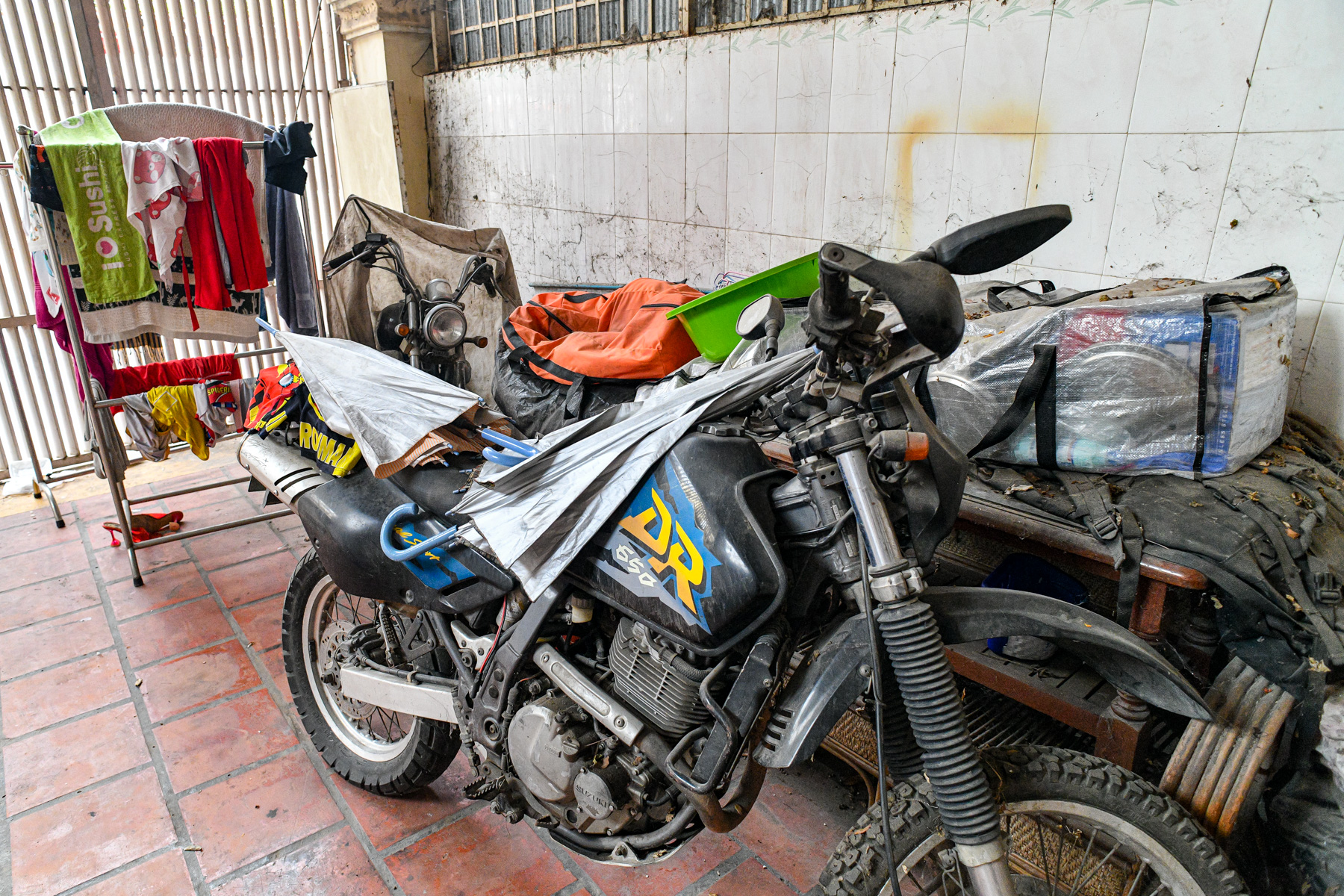
The Nikon D300S is old. There is no point pretending otherwise. It appeared in 2009, when 12 megapixels were considered quite sufficient and cameras were still expected to be cameras rather than computers with lenses attached.
Today, it is dismissed as obsolete. Too few pixels, too much noise and none of the modern wizardry that identifies eyes, animals, vehicles and possibly the intentions of the photographer. Yet attach a Nikkor 50mm f/1.4, charge the battery and take it into the street, and the old Nikon quietly reminds you that it has not forgotten how to make a photograph.
On the D300S, the 50mm gives roughly the same field of view as a 75mm lens on a full-frame camera. That makes it less of a general-purpose standard lens and more of a short portrait lens. It is particularly well suited to faces, small gestures and those moments on the street that benefit from a little distance.
The f/1.4 aperture gives the camera something its ageing sensor appreciates: light. The D300S is at its best between ISO 200 and 800. ISO 1600 remains useful if the exposure is right, but this is not a camera that enjoys having badly underexposed shadows dragged back from the dead in Lightroom.
You have to expose properly.
That was once considered a normal part of photography.
The 50mm is not perfectly sharp at f/1.4. It can be slightly soft, with lower contrast and a little colour fringing around bright edges. That does not always matter. Used for a portrait, the gentler rendering can be rather attractive. Stop it down to f/2 or f/2.8 and it becomes a different lens—sharper, stronger and still capable of separating the subject from the background.
Both the older 50mm f/1.4D and the newer f/1.4G work properly on the D300S. The camera has its own autofocus motor, so the screw-driven D lens is perfectly at home. Autofocus may not possess modern eye-detection intelligence, but the D300S has Nikon’s excellent 51-point system. Put the focus point over the eye and it will usually do exactly what it is told.
The body still feels magnificent. Solid, purposeful and designed for a photographer’s hands. Important controls have proper buttons and dials. The viewfinder is clear, the shutter response is immediate and the camera will keep working without trying to offer advice.
The files are only 12.3 megapixels, but “only” is doing rather a lot of unnecessary work in that sentence. Twelve megapixels are enough for strong prints, websites, publications and most of the ways photographs are actually viewed. A poor photograph does not improve because it contains 45 million pixels, and a good one does not become irrelevant because it contains twelve.
Naturally, there are limitations. Highlights require care. The shadows cannot be opened endlessly. High ISO files show their age, and the video function is best forgotten. There is no stabilisation, no electronic viewfinder and no autofocus system clever enough to find the subject while you think about something else.
You must hold the camera steadily. You must choose the focus point. You must watch the shutter speed, understand the light and press the button at the right moment.
In other words, you must take the photograph yourself.
Perhaps that is why I still enjoy cameras such as the D300S. They do not attempt to flatter us. They reward good technique and expose lazy habits. When the picture is sharp, properly exposed and alive with something worth seeing, you know that you had a hand in making it.
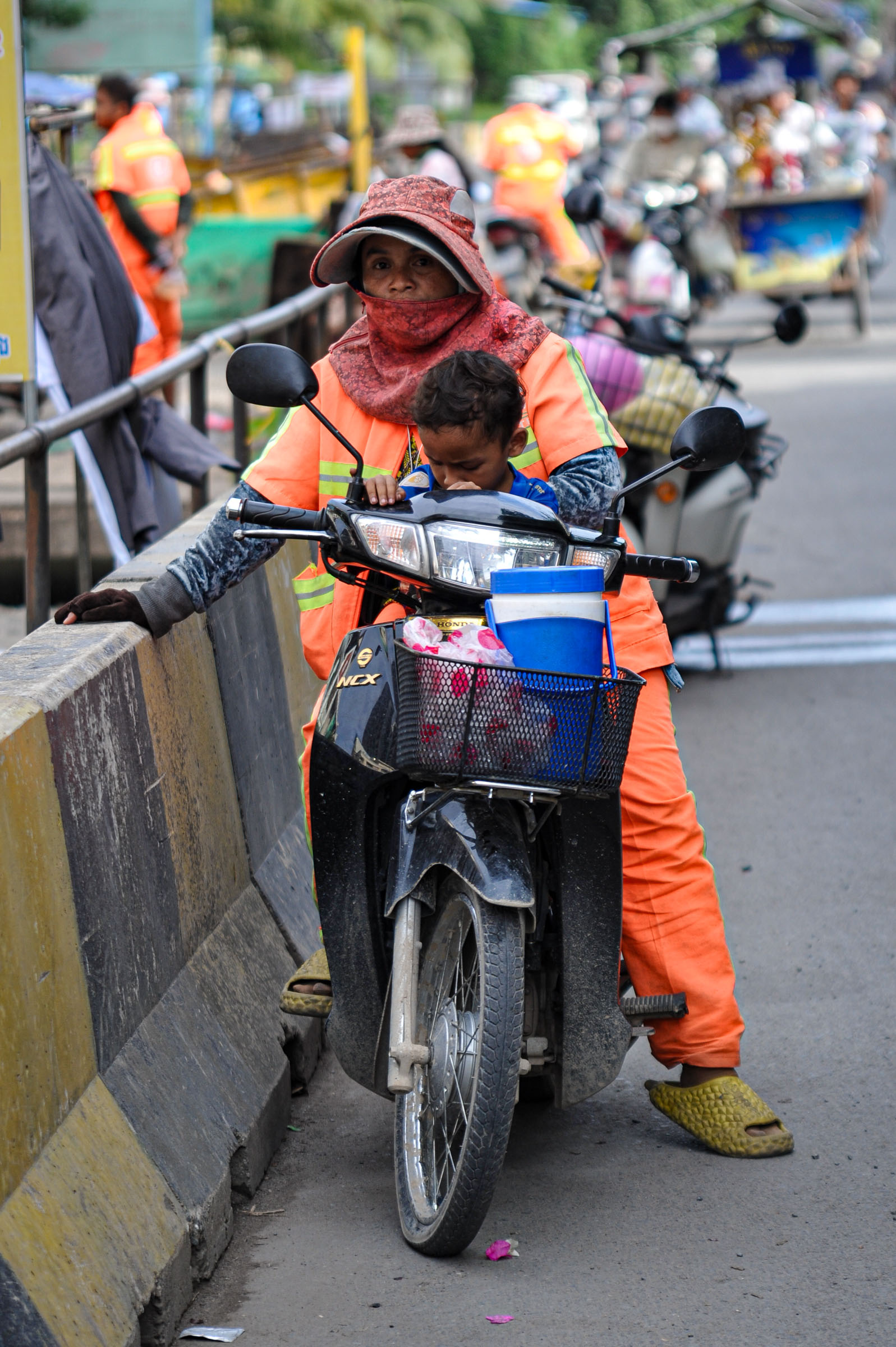
The D300S and 50mm f/1.4 combination is particularly good for street portraits. The lens gives enough distance to observe without crowding people, while the wide aperture separates a face from the usual confusion of the street. It is a simple combination: one camera, one lens and one way of looking.
Is it old? Certainly.
Is it technologically outdated? Of course.
Is it obsolete? Not while it still makes the pictures you want to make.
The Nikon D300S does not know that the camera industry has left it behind. Fit the 50mm, walk into decent light and it simply gets on with the job. Quietly, reliably and without fanfare.
Sometimes an old camera is not waiting to be replaced.
There was a time when I travelled with enough photographic equipment to open a small camera shop. Two camera bodies, several lenses, flashguns, filters, chargers, spare batteries, cleaning equipment and a tripod heavy enough to support a railway bridge.
Age—and several decades of sore shoulders—has taught me differently. The travelling photographer does not need to carry everything. He needs to carry the right things and, more importantly, understand how to use them.
My first essential is a dependable camera. It does not have to be the latest model, possess the most megapixels or arrive with artificial intelligence hiding behind every button. It must simply be a camera I know and trust.
For me, that might be an old Nikon D700, a D3S or the magnificent D850 when I want every last piece of detail. The important thing is familiarity. When something happens in front of me, I do not want to search through menus or wonder which button controls the focus mode. The camera should feel like an old friend—slightly battered perhaps, but always ready.
Then there is the lens.
One good lens is often enough. A 35mm or 50mm prime makes a wonderfully simple travelling companion. A practical zoom such as a 24–70mm or 24–120mm gives greater flexibility without requiring a bag full of glass. If I know that people will be my principal subject, an 85mm may earn its place.
The temptation is to pack a lens for every possibility. Resist it. Too many choices slow the photographer down. You begin changing lenses instead of making pictures.
A spare battery is essential. Two are better if the day will be long. Batteries have a wicked sense of humour and usually expire just as the light becomes beautiful or something interesting begins to happen.
Memory cards should be reliable, sensibly sized and carried somewhere safe. I would rather use several moderate-capacity cards than trust an entire journey to one enormous card. Cards can fail, disappear or be accidentally formatted. Spreading the work across more than one is a small form of insurance.
Every evening, whenever possible, I copy the day’s photographs onto a laptop or portable drive. Ideally, I keep two copies in separate places. A camera can be replaced. The photographs from a journey cannot.
A comfortable camera strap matters more than most people realise. The strap supplied with the camera may be adequate for an afternoon, but after eight hours in the heat it can begin to feel like a cheese wire. A good shoulder or wrist strap keeps the camera secure without advertising its value to everybody in the street.
The camera bag should be small, strong and ordinary-looking. I do not need something that resembles military luggage and announces that expensive equipment is inside. It must protect the camera, provide quick access and leave enough room for the unglamorous necessities: water, tissues, a notebook and perhaps something to eat.
Good footwear may be the most important photographic equipment I own. Travelling photography is done with the feet. Interesting pictures are rarely made while sitting in an air-conditioned hotel room complaining about the midday light.
Comfortable, broken-in shoes allow me to keep walking, turn down another street and stay out for another hour. That extra hour is often when the best photograph appears.
Clothing should suit the place rather than the photographer’s imagined appearance. Lightweight, loose clothing works in the Cambodian heat. A hat offers protection from the sun, while a light waterproof layer can save both photographer and camera when the sky suddenly opens.
Water is not optional. Neither is sun protection. An exhausted, dehydrated photographer stops seeing properly and begins making foolish decisions. Travel photography requires enough energy to remain observant, patient and respectful.
A small cleaning cloth and blower are useful, especially in dusty streets or humid conditions. There is no need to carry a laboratory. Most cleaning can wait until the evening. Changing lenses in wind, dust or heavy rain should be avoided whenever possible.
I also carry a notebook. A mobile phone can record names and details, but a notebook never runs out of power and does not distract me with messages. If I photograph somebody and speak with them, I can write down their name, the location and a few details about the encounter. Those notes may later give the photograph its proper meaning.
The phone remains valuable. It provides maps, weather information, translation, emergency communication and a perfectly capable backup camera. I may be an old photographer, but I am not foolish enough to ignore a useful tool simply because it does not have a Nikon badge.
Documents, money and emergency information need careful thought. I keep copies of my passport, insurance details and important telephone numbers separately from the originals. A little local currency should be kept somewhere accessible, with the remainder divided between safer locations.
Respect is another essential, although it weighs nothing.
Learn something about the country. Understand local customs. Notice when a camera is welcome and when it is not. A photograph is never worth humiliating somebody, entering a sacred place improperly or creating trouble for a person who has allowed you into their life.
Finally, carry curiosity.
Equipment may help us record what we find, but curiosity is what leads us towards it. Walk slowly. Look behind you, look up. Leave the obvious tourist route. Sit somewhere and allow life to continue without chasing it. Talk to people without immediately raising the camera.
The travelling photographer’s essentials are not really about preparing for every possible picture. They are about remaining light enough—physically and mentally—to recognise the picture that is actually there.
After all these years, my packing list has become shorter. One trusted camera. One useful lens. Batteries, cards, water, good shoes and somewhere safe to store the photographs.
There are camera and lens combinations that make perfect sense on paper. And then there are combinations that make sense when you actually go outside and use them.
For me, the Nikon D850 with the Nikkor 85mm f/1.8G belongs firmly in the second category.
On paper, it’s an impressive combination. The D850 gives me 45.7 megapixels, excellent dynamic range, a serious autofocus system and one of the best optical viewfinders Nikon ever put into a DSLR. The 85mm f/1.8G gives me a relatively small and light short telephoto with a fast aperture and excellent image quality.
That’s all very nice. But specifications aren’t why I like it.
I like it because of the way it makes me photograph people.
I’ve always enjoyed the 85mm focal length. There is something about the distance it puts between me and the person I’m photographing. I’m not standing six feet away with a 35mm lens pointing a camera directly into somebody’s face. I’m farther back. I can watch.
And watching has always been one of the most important parts of photography for me. You begin to notice things. The way somebody stands. A hand resting against a wall. Two people talking. A face suddenly illuminated as somebody turns towards the light. A cigarette being raised. A glance across the road.
These things happen quickly, but they don’t always need to be photographed from three feet away.
Sometimes standing back allows the photograph to happen.
The 85mm gives me that space.
And the D850 gives me the confidence that when I press the shutter, there will be plenty in the file.
The 85mm changes the way you see
Put a 35mm lens on a camera and the street becomes part of the photograph.
Put an 85mm on it and you start selecting pieces from the street. That’s an important difference.
With a wider lens I’m thinking about foreground, background, architecture, people and how everything fits together.
With the 85mm I’m looking for something else.
I’m looking for the picture inside the scene.
A person framed against a doorway. A face separated from a chaotic background. A splash of colour. Someone caught for a second in good light. A small gesture that would disappear inside a wider composition.
The 85mm simplifies things.
Perhaps that’s why I’ve always liked it.
After enough years taking photographs, I’ve become less interested in putting everything into the frame. Quite often I’m trying to remove things.
The 85mm does some of that work before I even press the shutter.
Then put 45.7 megapixels behind it
This is where the D850 becomes interesting. The 85mm f/1.8G is easily good enough to produce beautifully detailed files on the D850. And those files are enormous.
I don’t photograph with the intention of cropping everything afterwards. I still want to make the composition in the viewfinder. That’s part of taking the photograph.
But I’m not precious about cropping either.
If taking a little off the edge improves the picture, I’ll do it. If changing the proportions makes the photograph stronger, I’ll do that too.
The photograph matters more than some imaginary rule about preserving every millimetre of the original frame. And 45.7 megapixels gives me tremendous freedom.
I can photograph somebody slightly more loosely, leaving a little room for movement, and decide afterwards exactly where the edges belong. That’s particularly useful with people because people have the irritating habit of moving.
The D850 gives me room to work.
Sharpness isn’t everything
People talk endlessly about sharp lenses. This one certainly is. The Nikkor 85mm f/1.8G is capable of producing an enormous amount of detail on the D850, particularly once stopped down slightly.
But I don’t walk around photographing resolution charts.
For me, the more interesting characteristic is what happens to the background. At wider apertures the 85mm separates a person beautifully from everything behind them.
You don’t necessarily need to shoot at f/1.8. In fact, I often prefer a little more depth of field. At f/2.2, f/2.8 or f/4, there is still plenty of separation while giving me a little insurance if the person moves. That’s important.
At close distances, f/1.8 can give very little depth of field. Get the focus slightly wrong and you can have wonderfully sharp eyelashes and soft eyes. That’s not quite the triumph we were hoping for.
Sometimes photographers become obsessed with shooting a fast lens permanently wide open because they’ve paid for f/1.8. You don’t have to.
The aperture ring isn’t welded in position. Use what the photograph needs.
The D850 isn’t subtle
Let’s get this out of the way. Nobody is going to mistake a Nikon D850 for a discreet little street camera. It’s a substantial lump. People notice it.
But the 85mm f/1.8G helps.
Instead of putting a huge 70–200mm f/2.8 on the front and walking around looking like I’ve been assigned to photograph the Olympics, the 85mm keeps the whole arrangement relatively sensible. The lens weighs roughly 350 grams. For an 85mm full-frame lens capable of f/1.8, that’s refreshingly reasonable. The balance on the D850 is excellent. The body gives me something substantial to hold while the lens doesn’t drag the whole thing forward.
It’s still not light. After several kilometres my feet and shoulders will happily provide a second opinion. But it is a combination I can actually walk with. And that’s important because street photography involves an awful lot more walking than photographing.
Distance without detachment
There’s a criticism sometimes made about longer lenses in street photography. People say they make the photographer detached.
I don’t agree.
Distance and detachment aren’t the same thing.
You can stand two metres from somebody and make a photograph containing absolutely no connection whatsoever. Or you can stand fifteen metres away and notice a tiny human moment that says something. The connection comes from the photographer. Not the focal length.
What the 85mm gives me is breathing room. I can observe before I photograph. That’s important to the way I work.
I’m interested in people, but I’m not interested in turning every encounter into a confrontation between photographer and subject. Sometimes I’ll talk. Sometimes I’ll ask. Sometimes somebody knows perfectly well I’m photographing them. And sometimes I’m simply observing ordinary life unfolding in a public place. The 85mm allows all of those approaches.
Autofocus that simply works
Modern mirrorless cameras have extraordinary autofocus. Eye detection is wonderful technology. But I don’t find myself struggling with the D850.
Its 153-point autofocus system remains extremely capable.
Put an AF point where I want it. Focus. Take the photograph. That’s basically it.
The 85mm f/1.8G focuses quickly enough for the kind of work I’m doing. I’m not photographing Formula One cars coming towards me at 200 mph. I’m photographing people.
Walking. Talking. Working. Waiting. Living.
The combination handles that perfectly well.
And because I’ve used Nikon DSLRs for years, I don’t spend much time thinking about the controls. That might be the greatest advantage of all.
A familiar camera becomes almost invisible to the photographer.
My fingers know where things are. My eye stays in the viewfinder. I’m watching what’s happening rather than searching through menus.
The viewfinder matters
This is another reason I enjoy the D850. That big optical viewfinder with an 85mm attached is a lovely way to look at people. There’s no electronic screen between me and what’s happening. Just glass, mirror, light and the subject.
Perhaps I’m showing my age. That’s fine. I’m an old photographer. I’m allowed.
I don’t dislike electronic viewfinders. They’re extremely useful and modern ones are superb. But an optical viewfinder still feels different.
It’s immediate. The world doesn’t suddenly become brighter because I’ve changed exposure compensation. The photograph hasn’t happened yet. I have to judge it. I rather enjoy that.
It’s not a perfect combination
Nothing is.
The D850 is heavy. The shutter isn’t quiet. There is no in-body stabilisation. Forty-five-megapixel RAW files consume storage at an impressive rate.
And 85mm isn’t a universal focal length. Sometimes there’s simply nowhere to stand. You’re backed against a wall wishing you’d brought a 35mm. Sometimes something happens close to you and the 85mm is just too tight. You miss photographs. That’s the price of using a prime lens.
But there’s another side to that.
Restrictions make you work.
If I’ve got an 85mm attached, I start looking for 85mm photographs. Instead of constantly zooming in and out, I move. Or I wait.
Or I accept that a particular photograph isn’t mine. That’s not necessarily a bad discipline.
One camera. One lens.
There’s something wonderfully uncomplicated about leaving home with one camera and one lens. No bag full of alternatives. No standing on a street corner wondering whether I should change from the 35mm to the 50mm or perhaps try the 70–200mm.
Just the D850. The 85mm. A spare battery that I’ll probably never need. And my feet.
Then the photography begins.
The longer I take photographs, the less interested I become in having every possible option available.
Too much equipment can become its own distraction. You start thinking about cameras instead of pictures. I love cameras. I’ve owned plenty of them and enjoyed most of them.
But eventually the camera has to shut up and let me work.
The D850 and 85mm f/1.8G do that.
They give me extraordinary image quality without requiring much thought. I know what 85mm looks like. I know roughly where I need to stand. I know how the D850 behaves. So I can concentrate on the difficult part.
Finding something worth photographing.
And no camera manufacturer has found an autofocus mode for that yet.
Standing back, looking closer
That’s really what this combination means to me. The 85mm lets me stand back. But it makes me look closer. Instead of photographing everything, I start noticing individuals.
Faces. Expressions. Hands. Small interactions. Little fragments of ordinary life that exist for a second and disappear.
The D850 records those moments with almost ridiculous amounts of detail.
But the detail isn’t the photograph. Neither is the bokeh. Neither is the sharpness. Neither is 45.7 megapixels. Those things are merely ingredients.
The photograph is still about the person.
After more than four decades of making pictures, that is increasingly what matters to me. Not whether my camera is the latest. Not whether another photographer thinks 85mm is the correct focal length for street photography. Not whether my equipment scores brilliantly in somebody’s laboratory test.
Just whether the combination works for me. And this one does. The Nikon D850 and Nikkor 85mm f/1.8G aren’t small. They aren’t fashionable. They aren’t particularly discreet. And neither is remotely new.
Good.
I’ll leave fashionable to somebody else.
Give me the D850. Give me the 85mm. Give me a street full of people and a few hours to walk. I’ll find the pictures.
A few days ago I asked myself a fairly simple question.
What happens when you put a $35 lens from another photographic age onto a 45.7-megapixel Nikon D850?
Now I know. You go out and make photographs. And the photographs turn out to be considerably more interesting than the question.
The lens is my old Nikon AF Nikkor 70–210mm f/4–5.6. I didn’t buy it specially for this experiment. I’ve owned it for some time and paid the princely sum of $35 for it. I’ve used it successfully on my Nikon D700, so I already knew it wasn’t rubbish.
But the D700 has a 12-megapixel sensor. The D850 has 45.7 megapixels.
According to one particular school of internet photography, putting an inexpensive old autofocus zoom in front of that sensor is bordering on criminal negligence.
Apparently the D850 demands the finest glass.
Perhaps somebody forgot to tell my lens.
The D850 itself is another second-hand adventure. I recently picked it up for $380. It looks almost ridiculously good externally, although its shutter count is somewhere north of 300,000.
So we have a high-mileage professional DSLR that cost $380 and an old Nikon zoom that cost $35.
Total investment: $415.
I decided to take the combination onto the streets and see what happened.
No brick walls. No test charts. No tripod carefully positioned in the living room. No photographs of newspapers designed to reveal whether the extreme corner at 210mm is microscopically less sharp than the centre.
I photographed what I normally photograph.
People. Buildings. Details. Colour. The odd cat. Life.
Because after more than 45 years of making pictures, that’s the only lens test I’m really interested in.
The first surprise wasn’t really a surprise at all. The old Nikkor is sharp. Not “surprisingly sharp considering it cost $35.” Sharp.
The cat provided a rather good test. Fine fur, whiskers and those extraordinary green eyes all came through beautifully. The D850 certainly wasn’t sitting there waiting desperately for a more expensive lens.
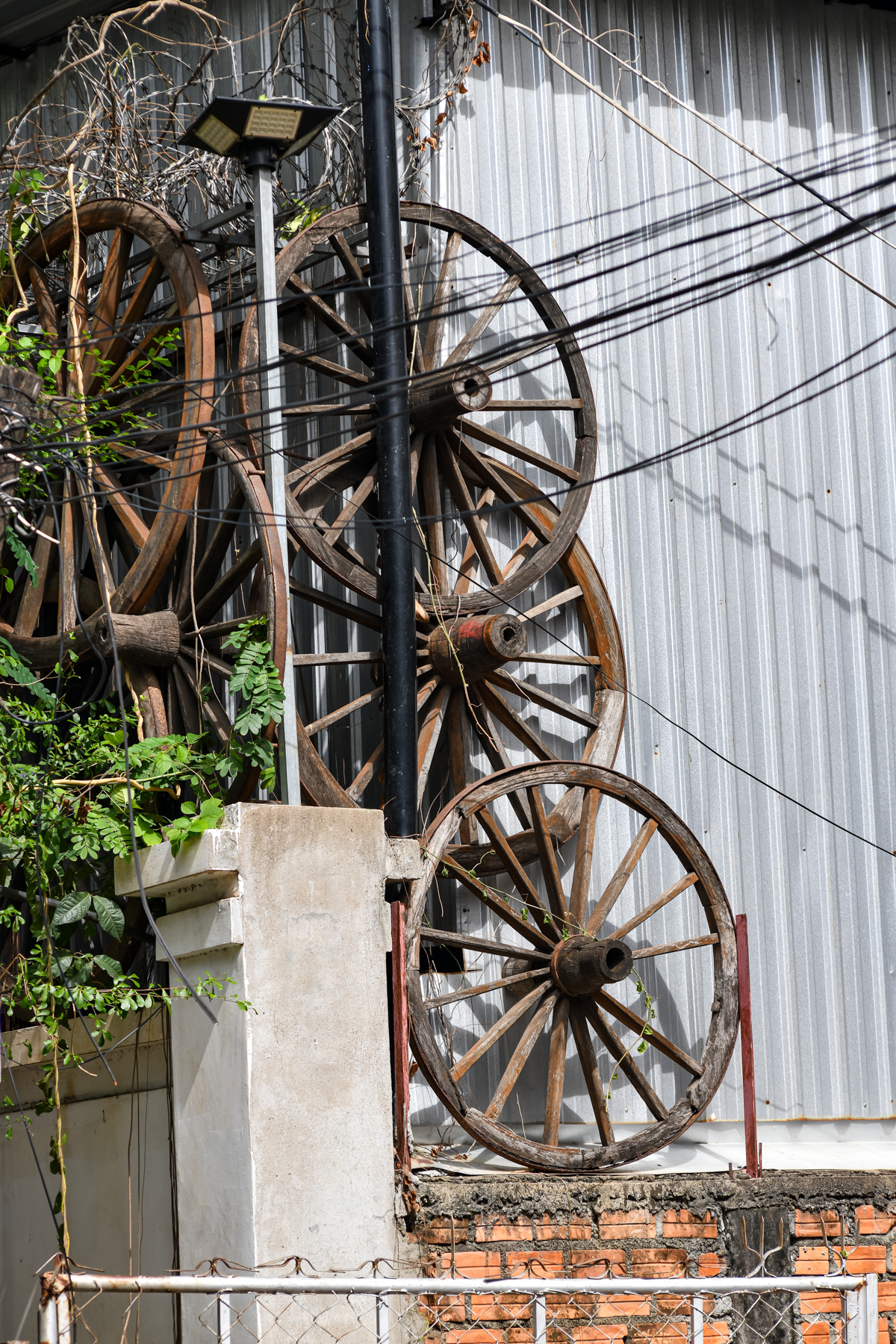
The old wooden wheels were another useful example. Wood grain, spokes, rust, vegetation, corrugated metal and the chaotic collection of overhead wires gave the combination plenty of fine detail to resolve. It did.
Would a modern professional 70–200mm produce a technically better file if we put both photographs under a microscope?
Almost certainly.
Would it make this photograph better? That’s a completely different question.
That’s where photography equipment discussions so often go wrong.
We confuse technical superiority with photographic superiority. They aren’t the same thing.
A lens can measure better without making a more interesting photograph. Another lens can have imperfections and still render the world in a way that suits the photographer using it.
I don’t need my 70–210mm to beat a modern 70–200mm f/2.8 in a laboratory. I need it to make photographs I want to keep. On this outing, it did exactly that. The architectural pictures were particularly revealing.
The D850’s resolution combined with the longer focal lengths allowed me to pick pieces out of the city rather than simply describe everything in front of me.
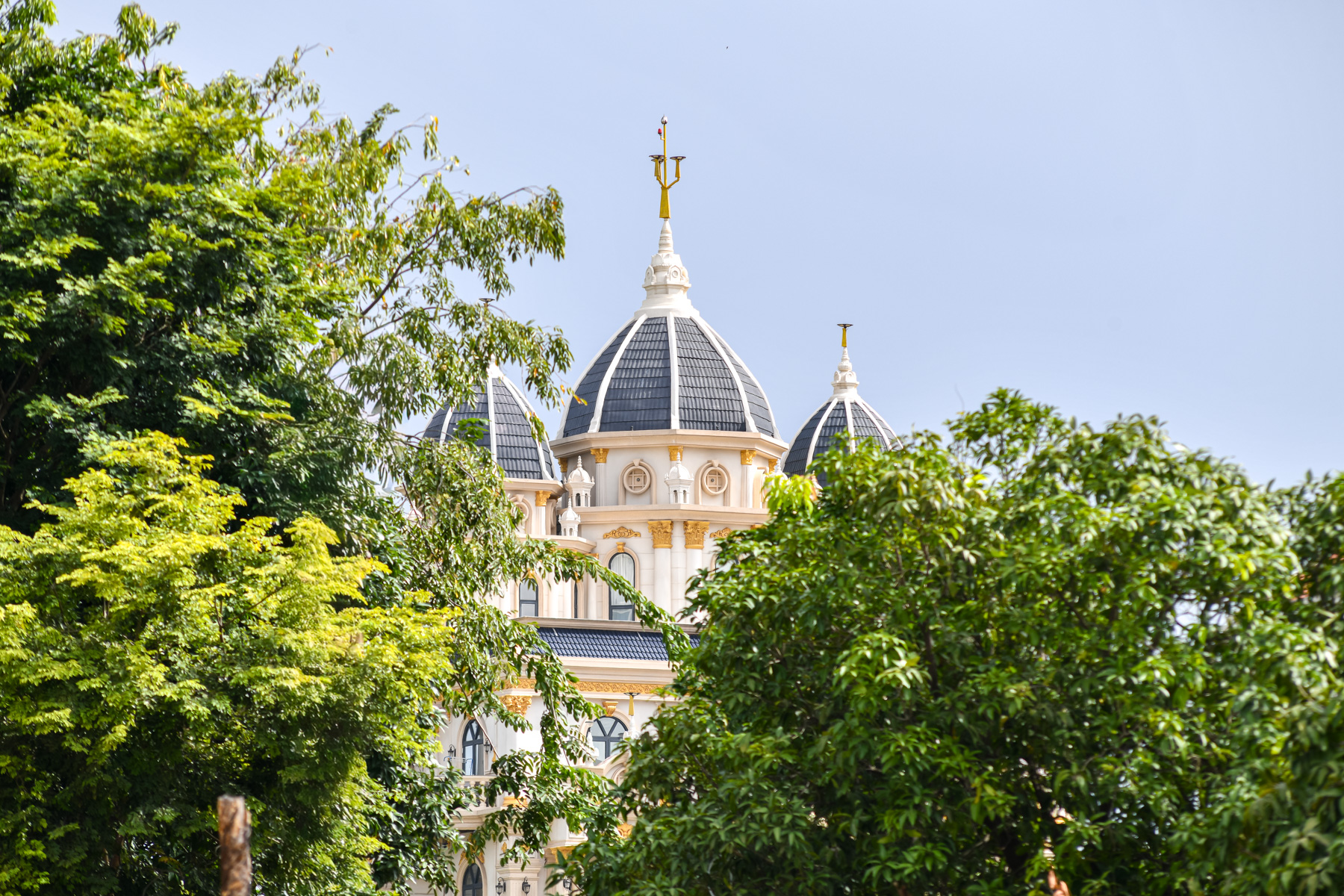
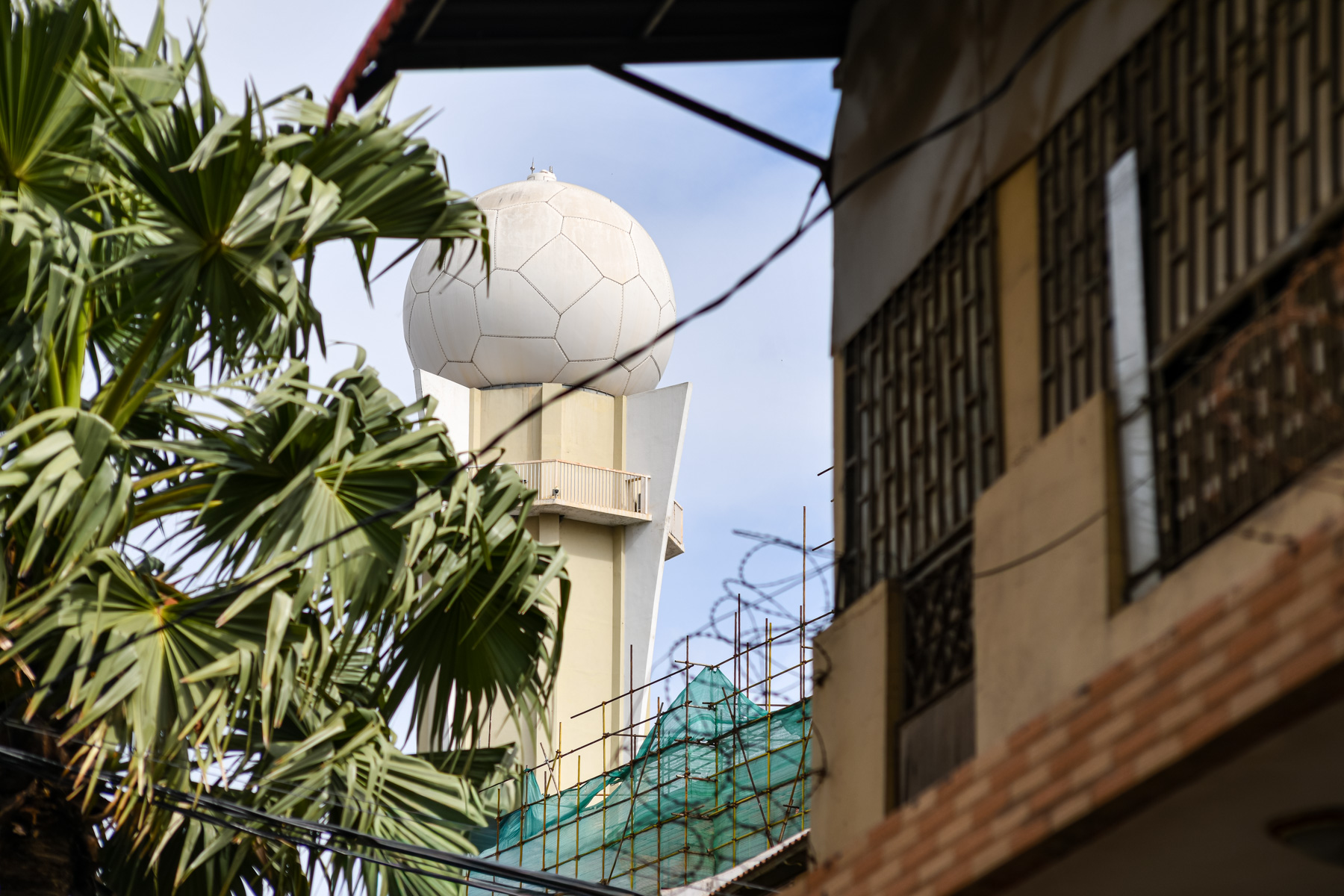
A dome appears through foliage.
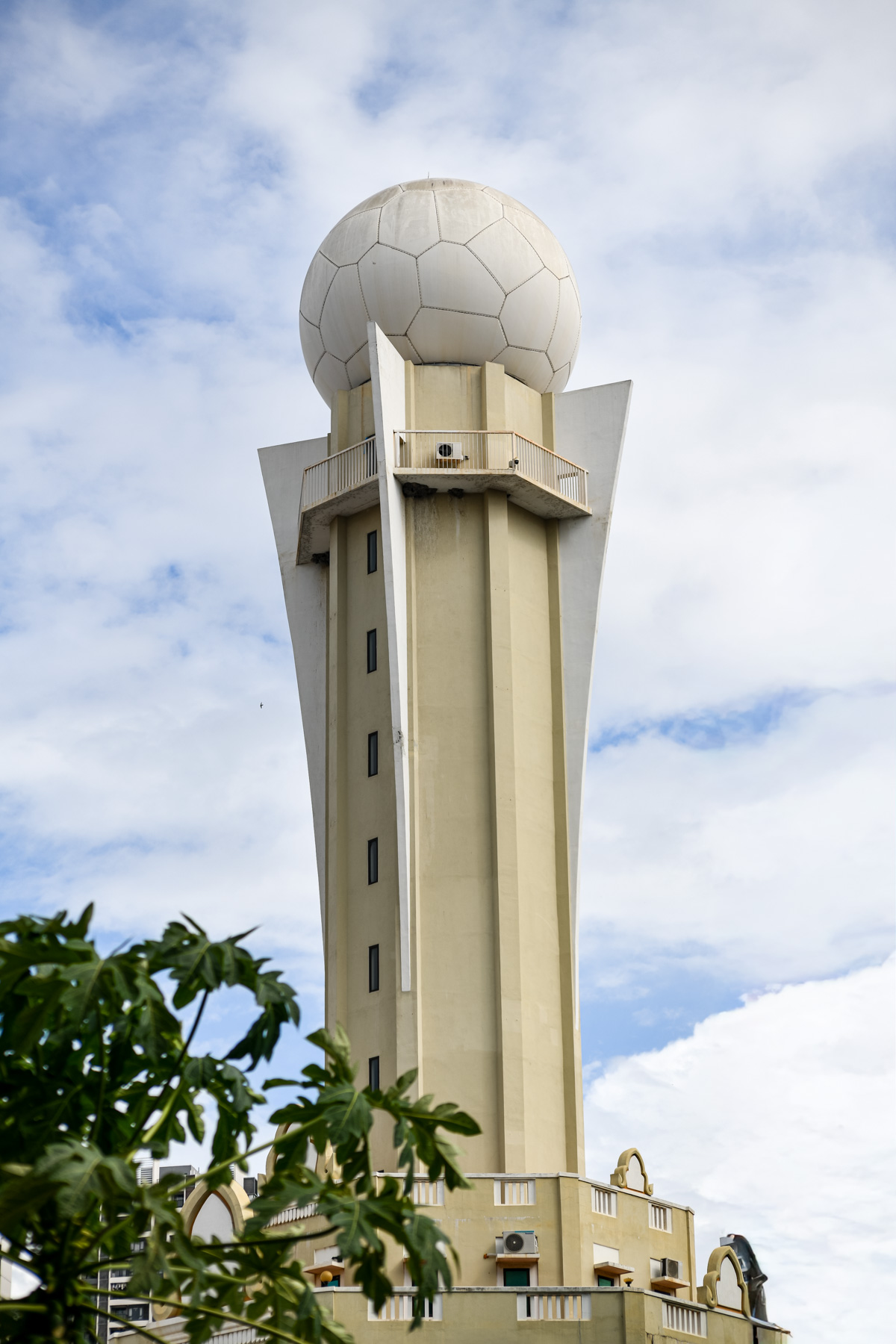
A tower rises above surrounding buildings.
Old wooden wheels become a pattern of circles and spokes against industrial metal.
And then there is the changing city itself.
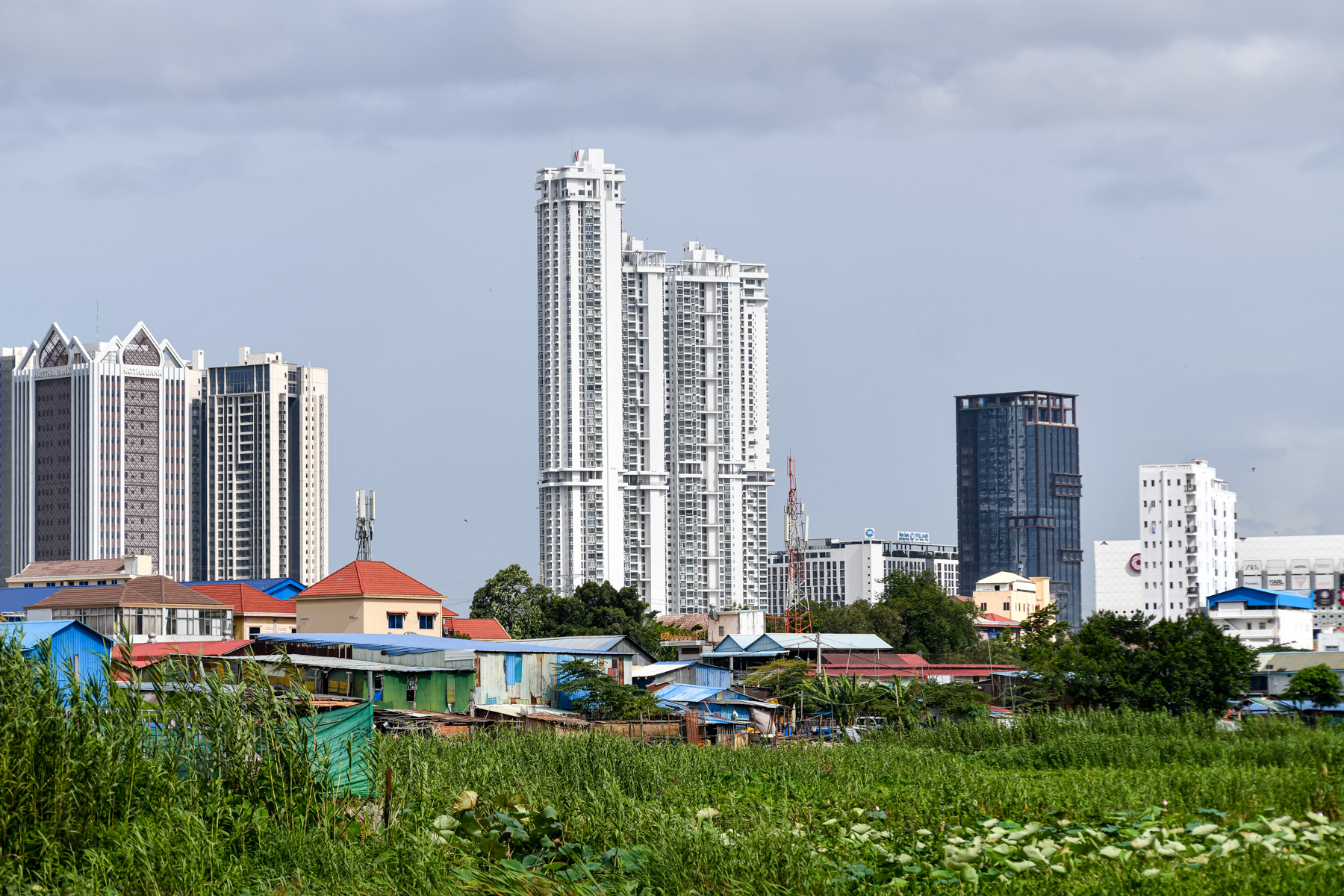
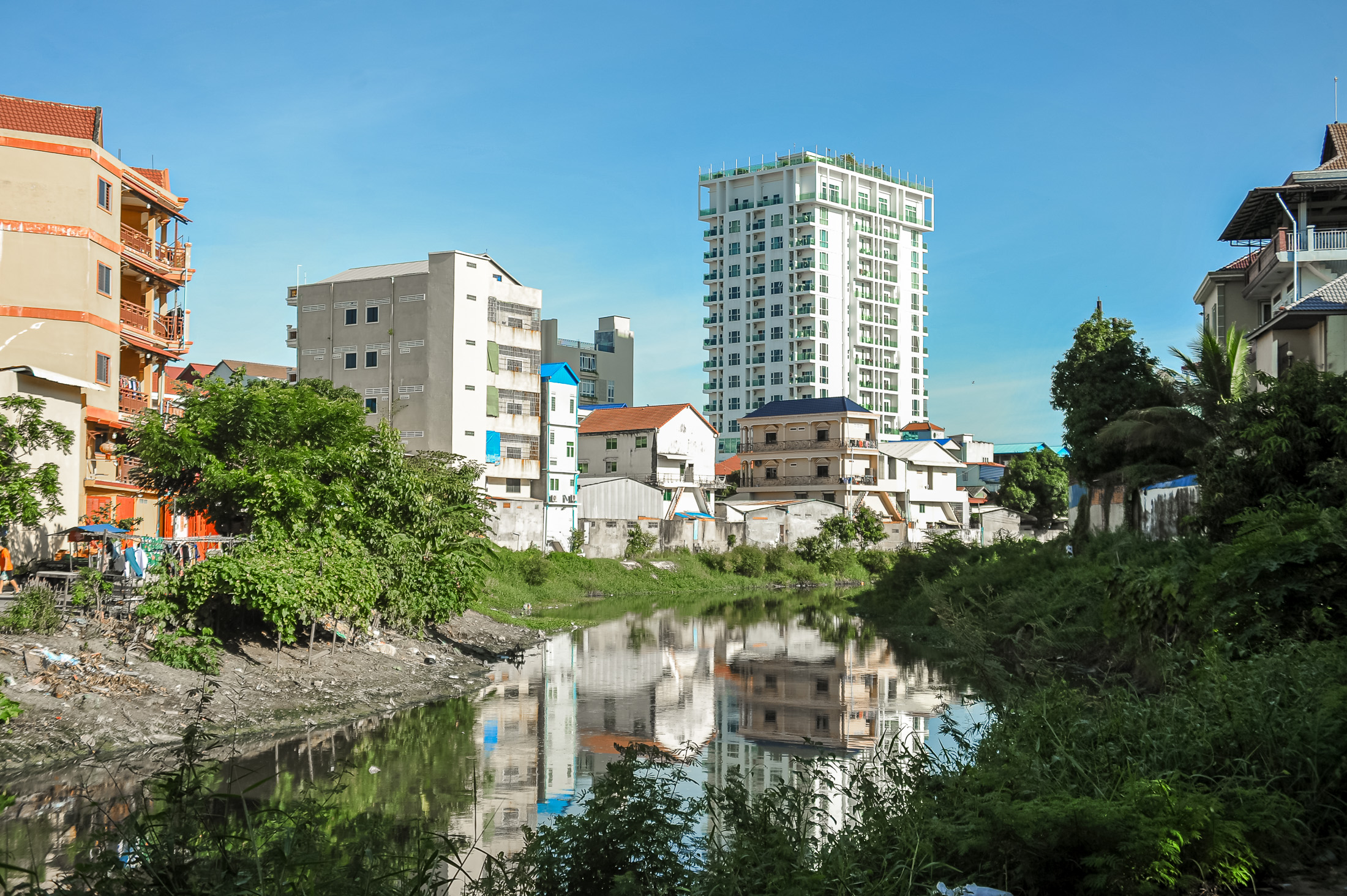
The photograph looking across the greenery and low buildings towards the modern towers says something that has always interested me about photographing Phnom Penh.
Cities accumulate rather than simply replace themselves. The old and new sit beside each other. Sometimes comfortably. Sometimes not.
A telephoto zoom is particularly good at showing that because compression pulls those layers together.
The foreground, modest buildings and high-rise development become part of the same visual argument.
This isn’t something I need an f/2.8 professional zoom to discover.
The $35 lens sees it perfectly well.
But people are where I really wanted to test the combination. I’ve always enjoyed using longer lenses for street photography.
There is sometimes a rather tiresome idea that proper street photography must be made with a 28mm or 35mm lens while standing practically on top of the subject. I’ve never subscribed to that. Different lenses make us see differently. A wide lens encourages you to enter the scene. A longer lens allows you to observe it, isolate elements and simplify the background.
Neither approach is superior.
They’re different languages.
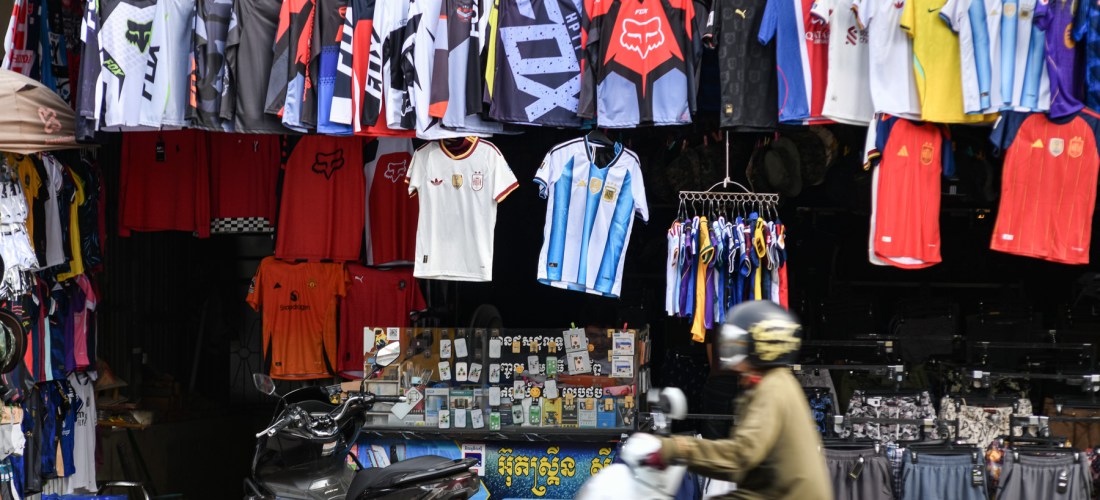
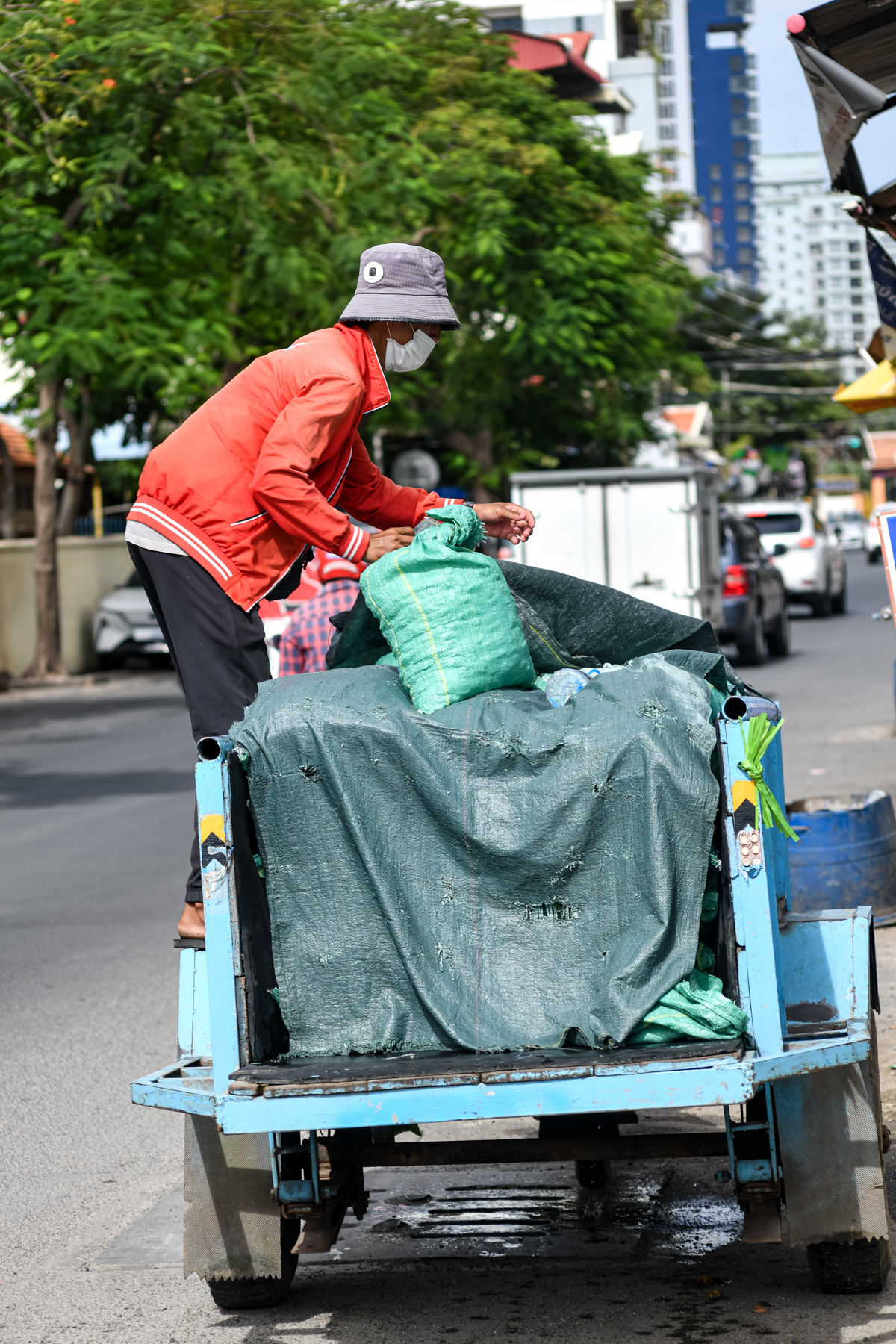
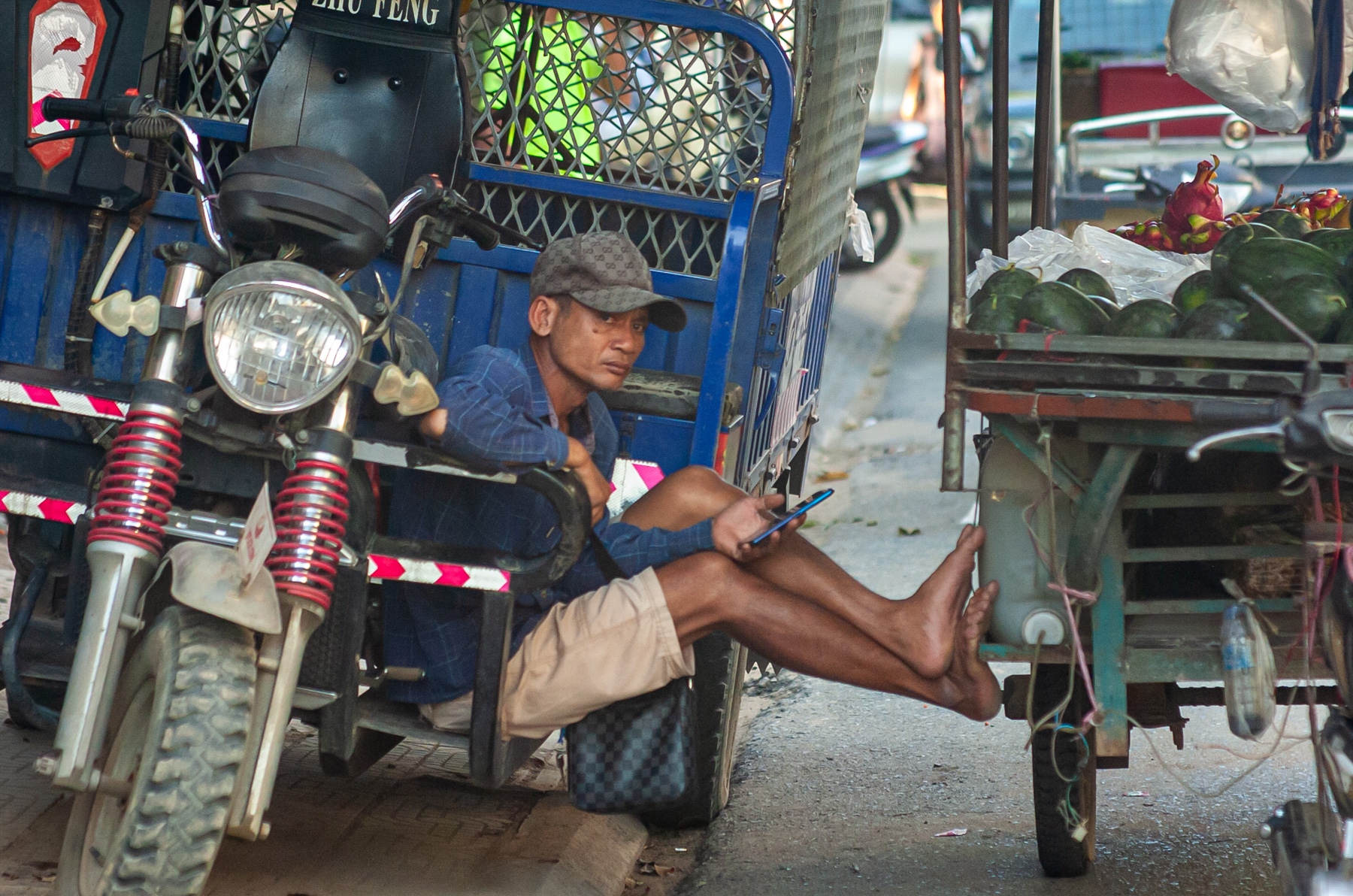
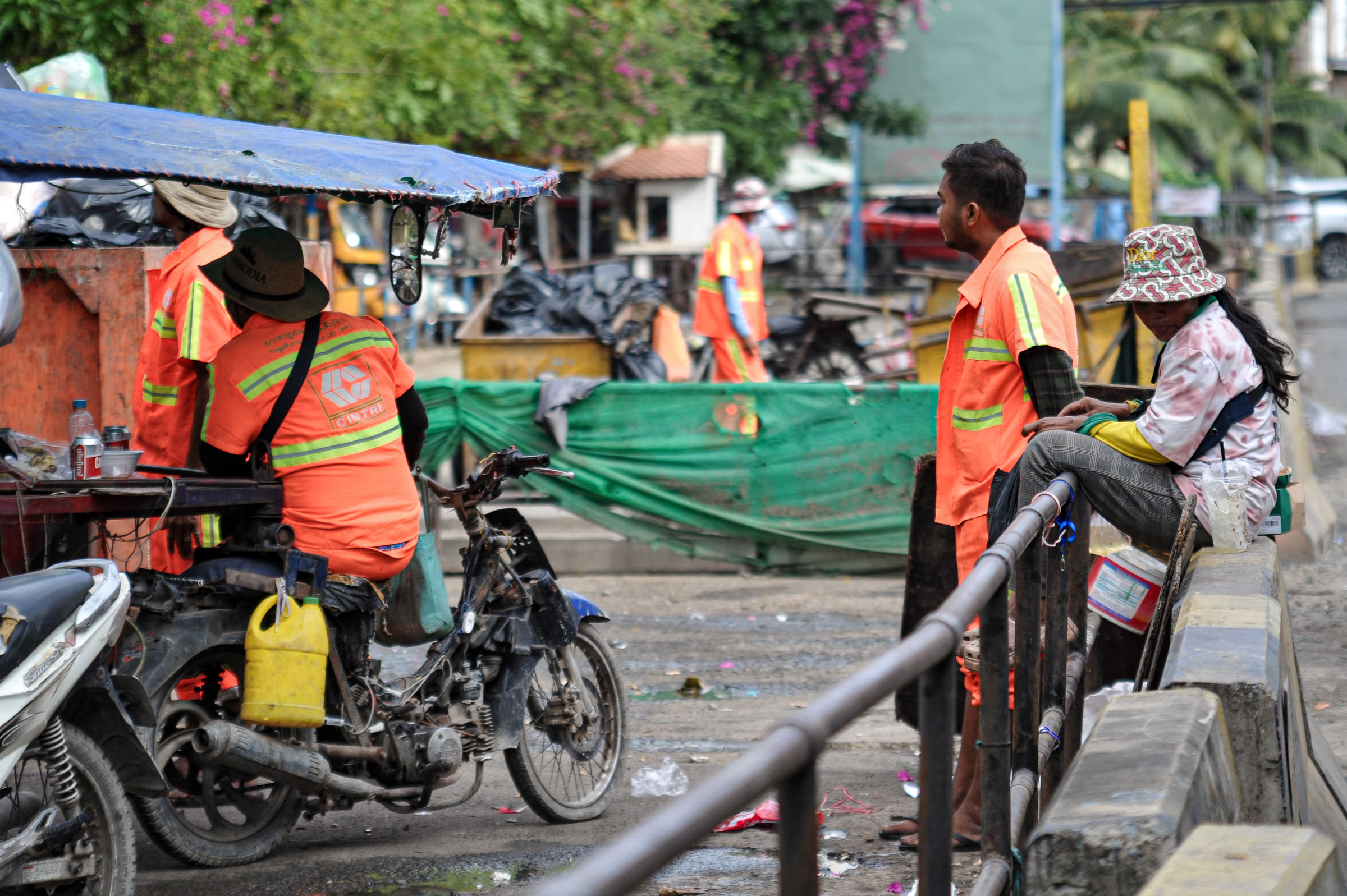
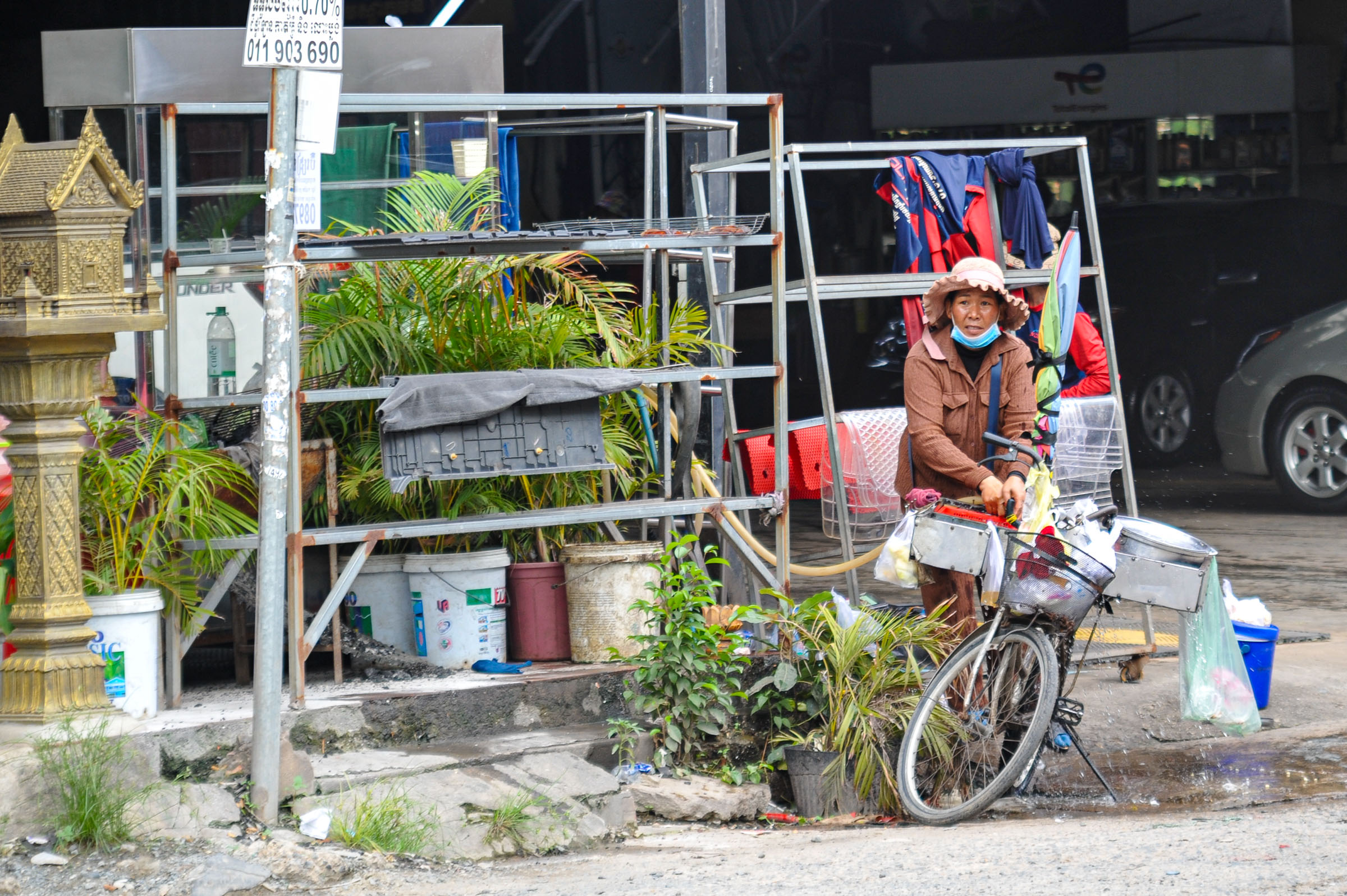
With the 70–210mm I can stand away from the immediate action and watch. The photograph of the man working from the back of the small vehicle demonstrates exactly why I enjoy this. The red jacket immediately separates him from the greens and blues around him. The longer lens compresses the background without completely removing the environment. We know we’re on a street. We know he’s working. But the frame isn’t drowning in irrelevant information.
That’s what a telephoto can do extremely well.
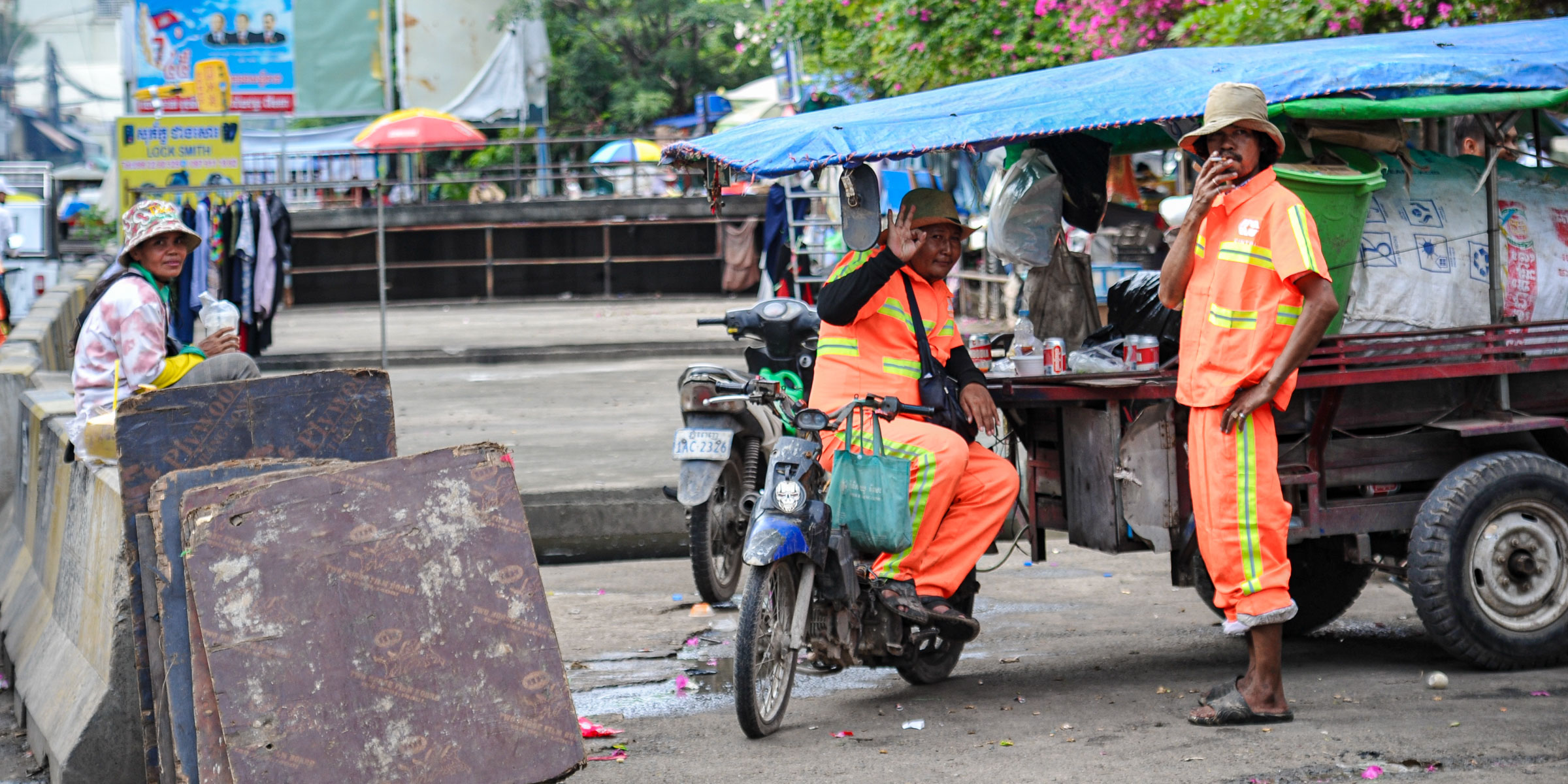
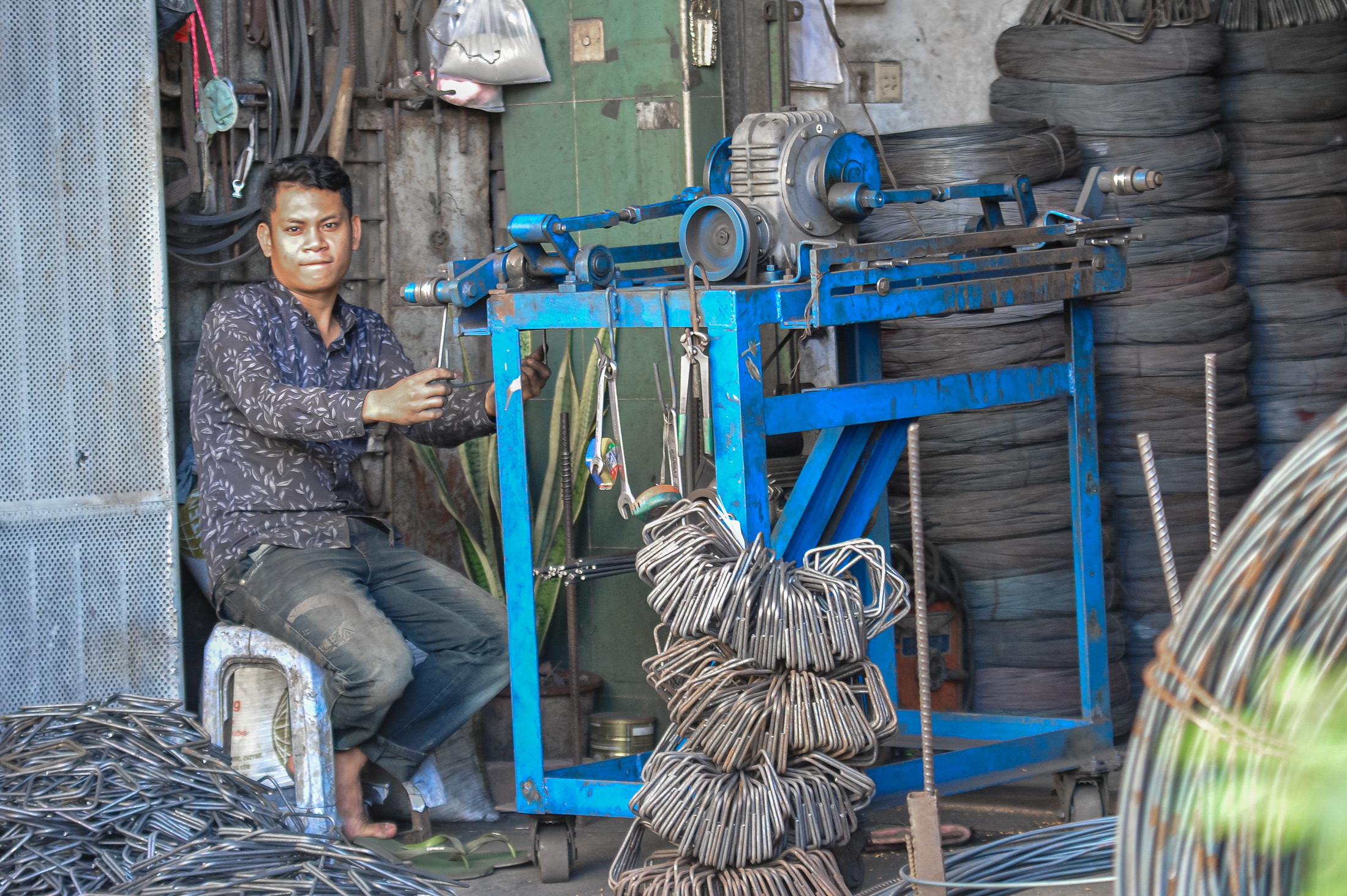
The photograph of the two workers gave me another answer. The lens renders people nicely. That’s important to me. There is detail in the faces, certainly. The D850 isn’t short of resolution. But the result doesn’t feel clinically sharp. There’s a difference between detail and cruelty.
Modern lenses can sometimes be astonishingly revealing. That’s magnificent for some subjects and less flattering for others. This old Nikkor gives me enough. Actually, considerably more than enough.
And there’s a natural quality to the rendering that I like. The two men aren’t lens-test subjects. They’re people. That’s where my attention stays.
The 70–210mm range also encourages something I particularly enjoy when walking around with a camera: finding photographs inside photographs.
At longer focal lengths you begin noticing small relationships in the distance. A tower framed between buildings. Palm leaves intruding into architecture. Scaffolding against a geometric structure. Overhead wires crossing an otherwise orderly composition.
The lens becomes a way of editing the world before pressing the shutter.
Instead of asking “What can I fit into the frame?” I’m asking:
“What can I remove?”
That’s one of the reasons telephoto lenses can be so effective for street and urban photography.
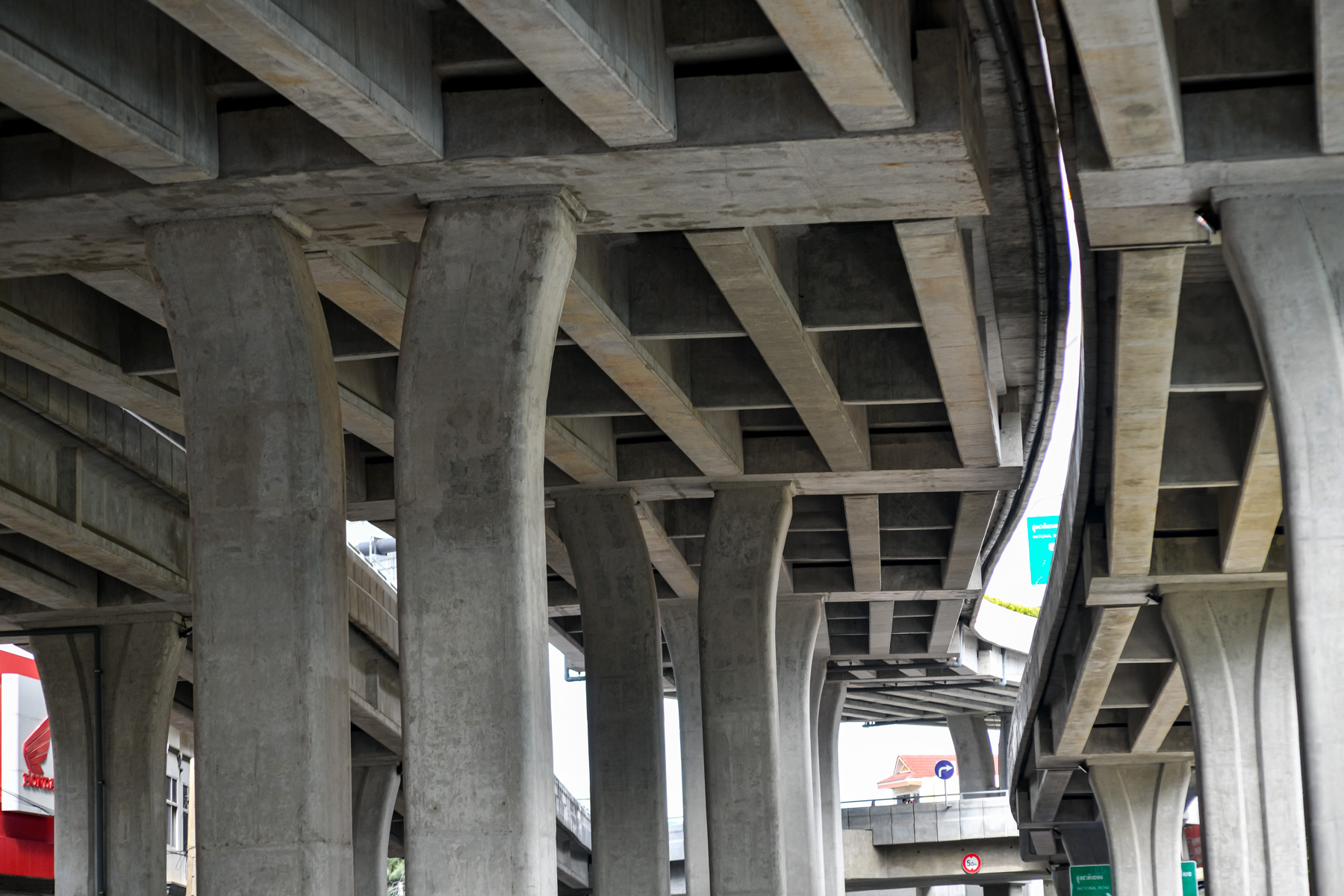
Even something as brutally functional as the underside of a flyover becomes interesting. Concrete pillars repeat into the distance. Lines converge. Light appears between enormous grey structures. There’s almost no conventional subject.
It’s geometry. Weight. Repetition. And perspective.
Again, the old lens handles it perfectly well.
No drama. No complaints. No desperate plea from the D850 for something more expensive.
Just a photograph.
There are limitations, naturally.
The 70–210mm has no vibration reduction.
At the long end, that matters on a 45.7-megapixel camera.
The D850 is unforgiving of sloppy technique. Slight camera movement that might disappear into a 12-megapixel D700 file can become rather obvious when you’ve got this much resolution.
So shutter speed matters. I’d rather increase the ISO than let the shutter speed fall too far. Noise can be dealt with. Motion blur usually can’t.
The autofocus is also from another generation. This is screw-drive autofocus, powered by the motor inside the D850 body. It makes noises. Things move. You can actually hear the bloody camera doing something and it actually uses more battery power, so an extra battery in the pocket is a wise move.
How wonderfully old-fashioned. But it focuses. And that’s really all I require.
There are other optical imperfections if you go looking for them. I’m sure I could find chromatic aberration. I’m sure the corners aren’t as good as the centre at every aperture and focal length. I’m sure there are situations where flare would expose the limitations of the older coatings.
Give me enough time and a large enough computer monitor and I’ll undoubtedly discover all sorts of reasons why I desperately need to spend another thousand dollars.
I’m not going to.
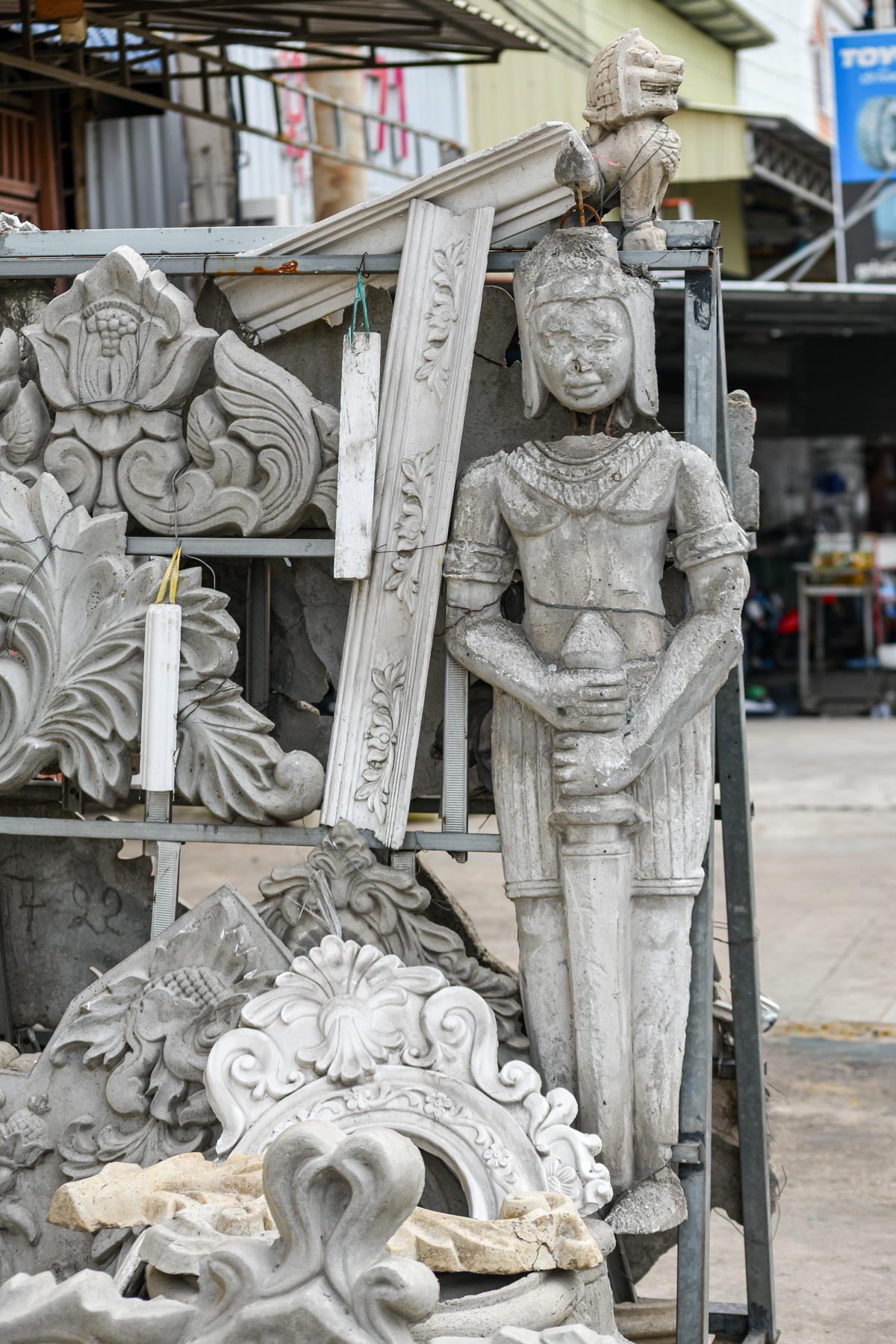
Look at the photograph of the stone figures. Texture. Separation. Fine detail. Tonal variation.
The photograph works.
Test concluded.
Colour was another pleasant surprise.
The lens doesn’t produce the dull, washed-out results that people sometimes associate with older zooms.
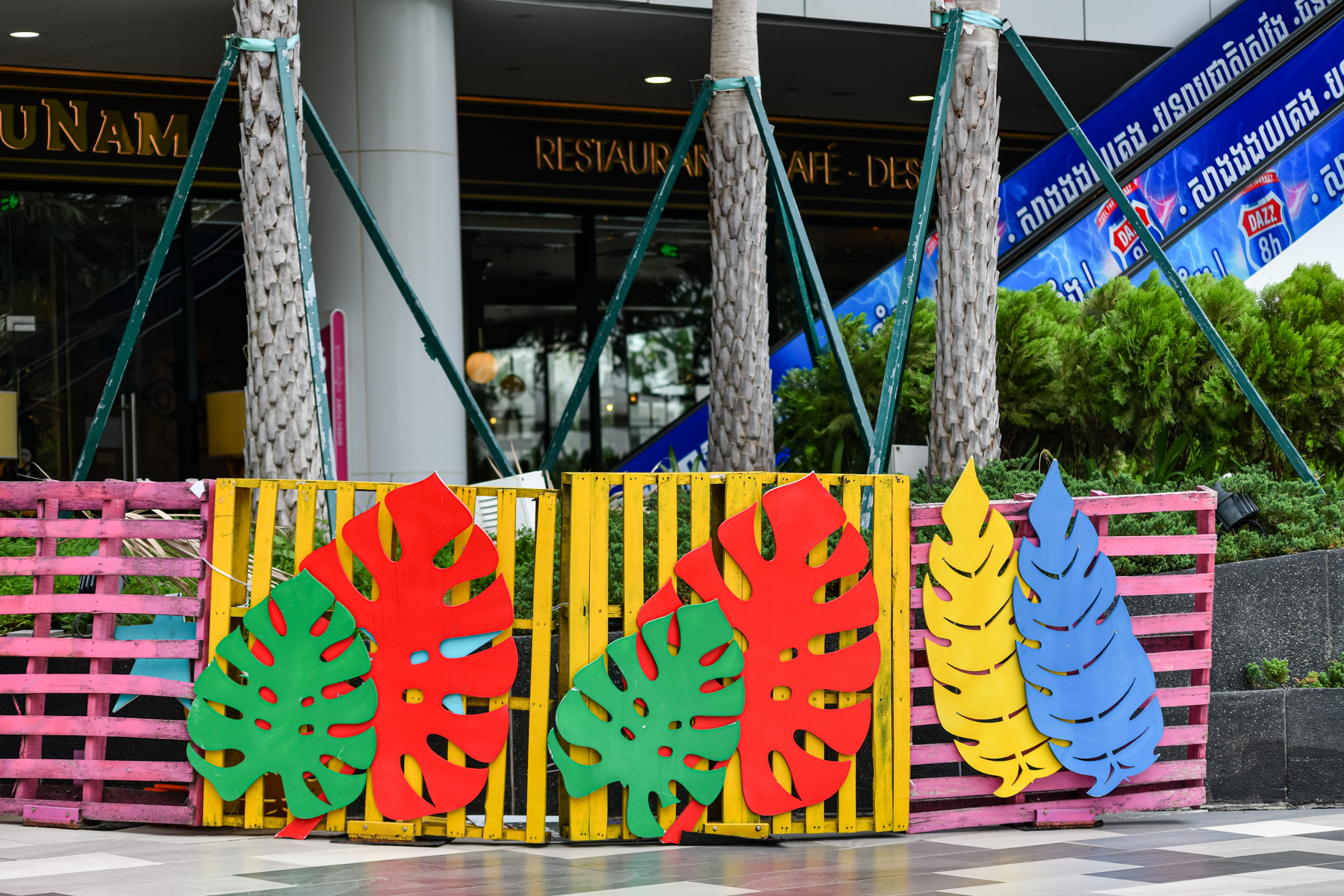
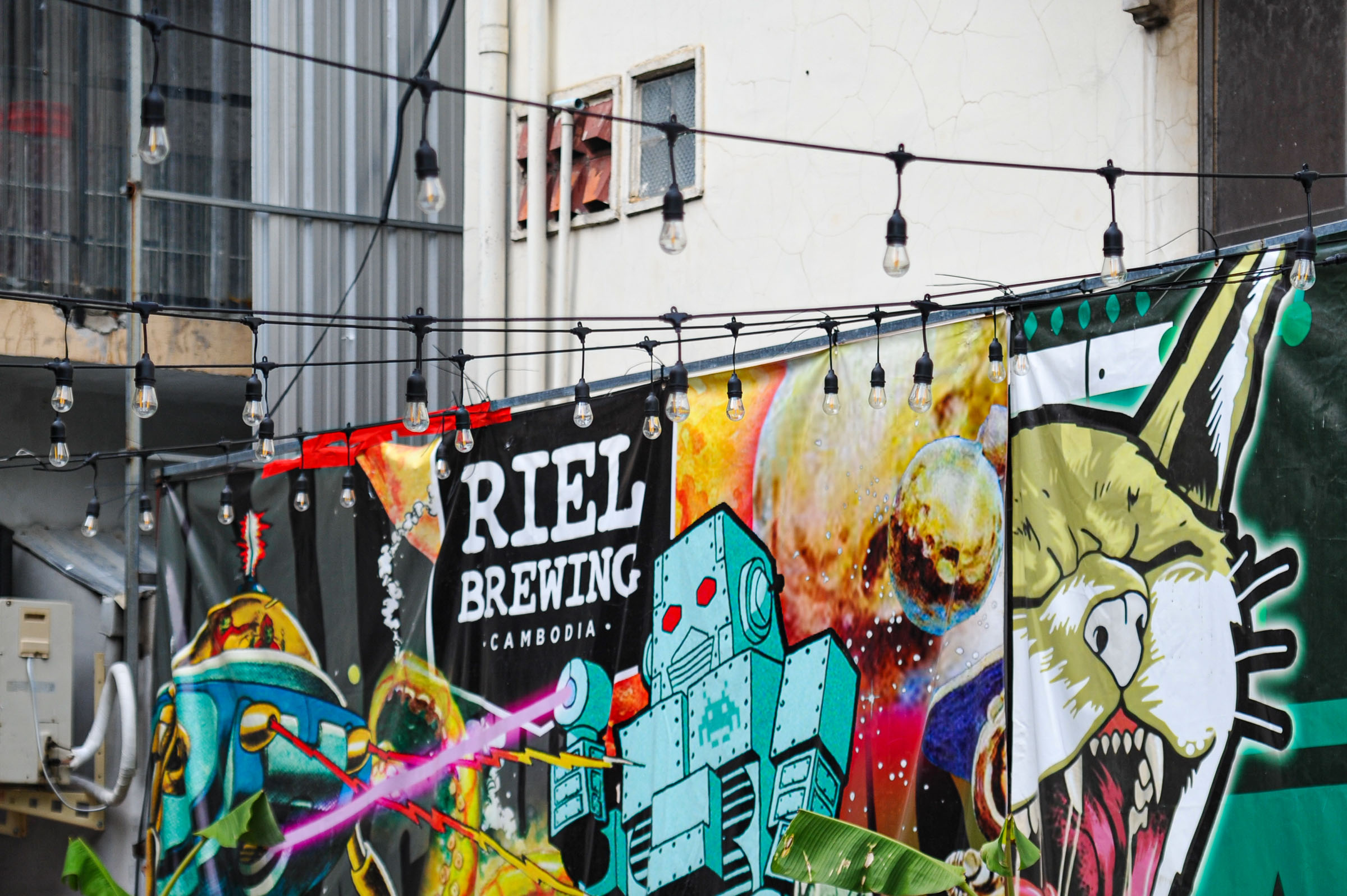
Reds are red. Greens are green. Blues are blue. The colourful street decoration positively jumps out of the frame.
Some of that is obviously the D850 sensor. Some comes from processing.
That’s how digital photography works. But the lens isn’t getting in the way.
And that’s perhaps the highest compliment I can give a piece of photographic equipment.
I stopped thinking about it.
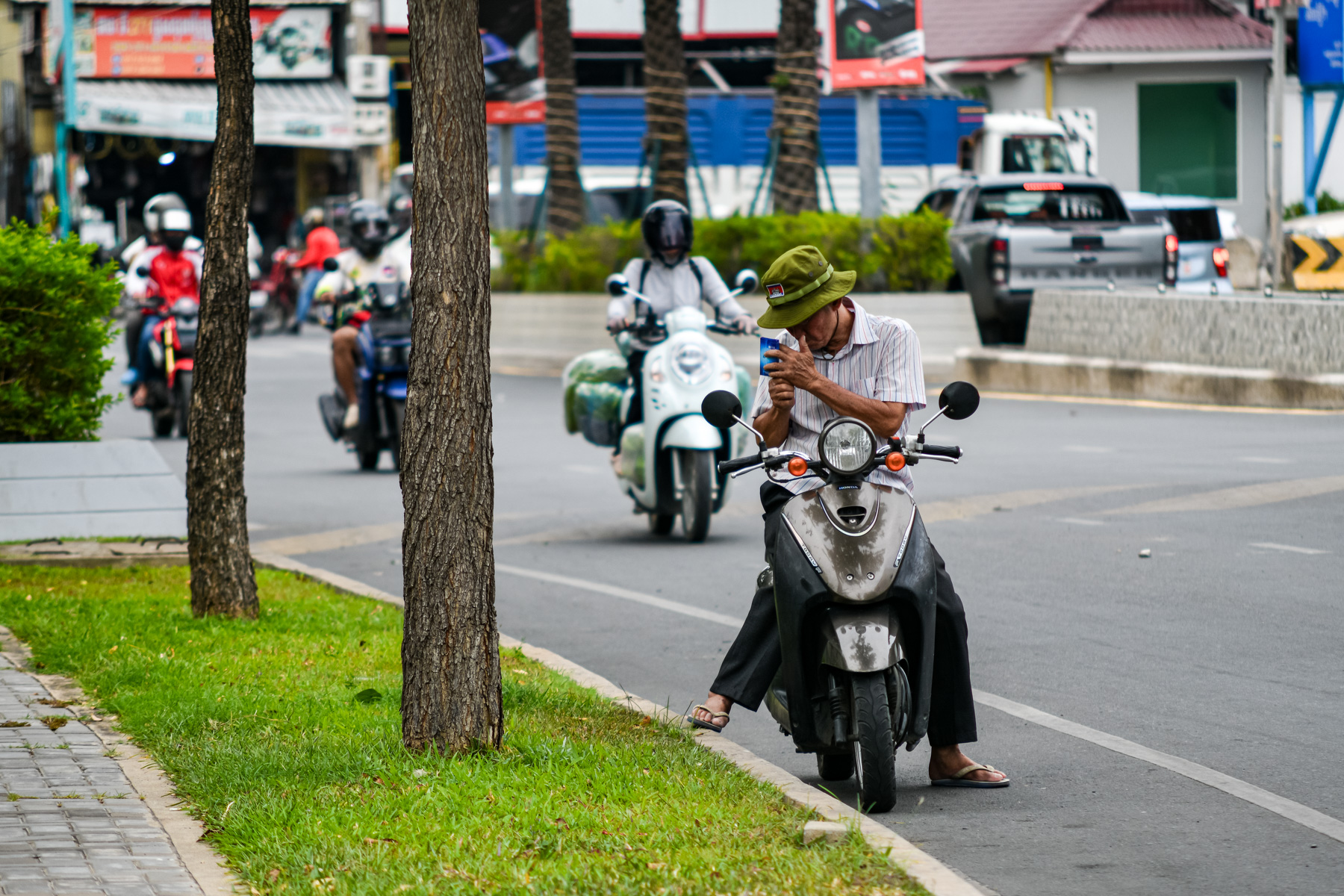
This photograph probably says more about the experiment than any technical test could.
A man sits astride his scooter beside the road, absorbed in something he’s doing with his hands.
Behind him the traffic continues. Motorcycles approach. Cars pass. The city carries on.
The longer lens isolates that tiny pause within all the movement. That’s why I carry a camera.
Not to determine whether a lens resolves 45 megapixels. To notice things.
And once again we’re back to the thing I’ve learned repeatedly over the years. Equipment matters. But equipment matters because of what it allows you to see.
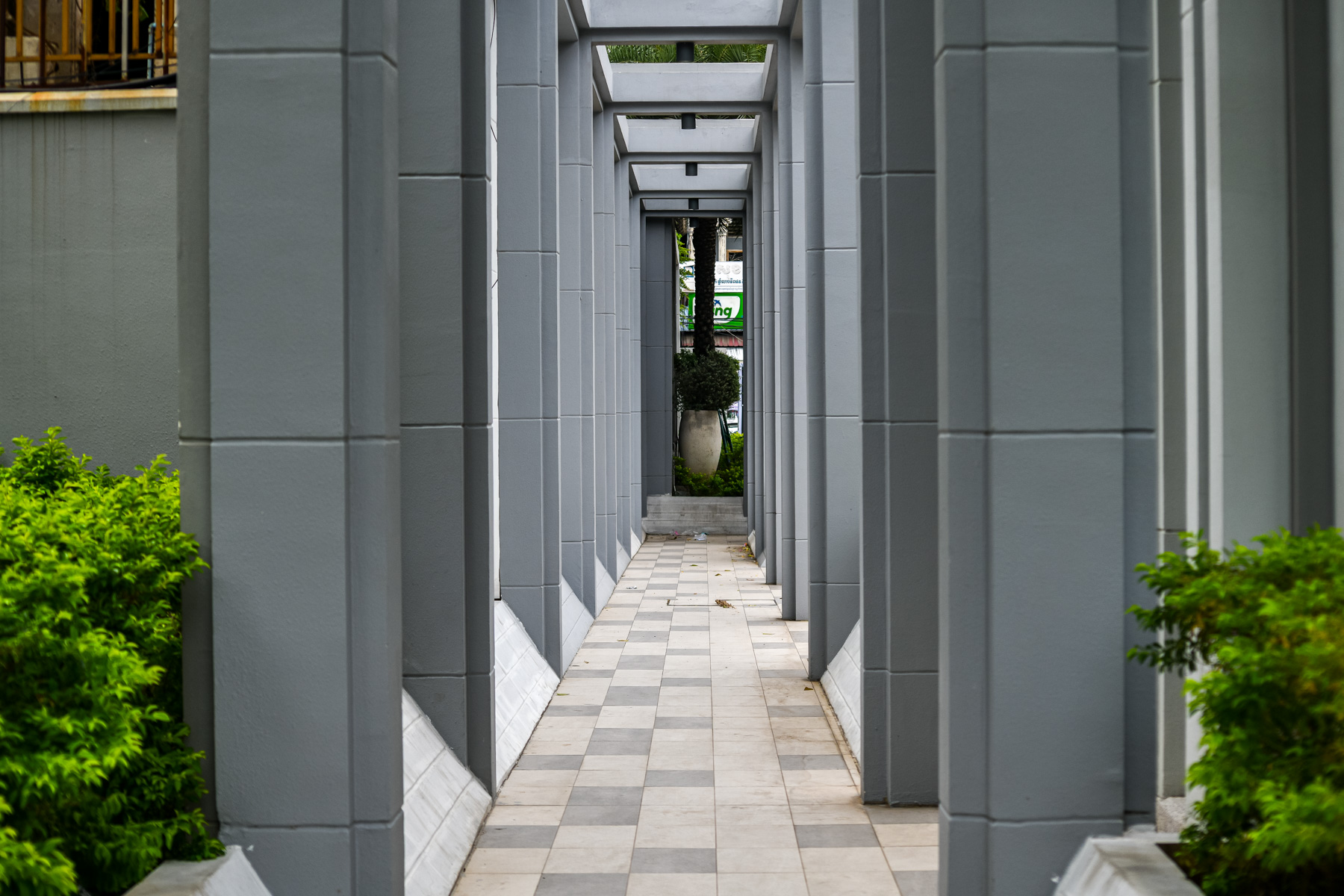
The repeating grey columns make another photograph that the longer lens handles beautifully. Lines narrow towards the centre, layers stack against one another and the frame becomes almost abstract.
I didn’t need a new lens to see it.
I needed to look.
There is an enormous difference.
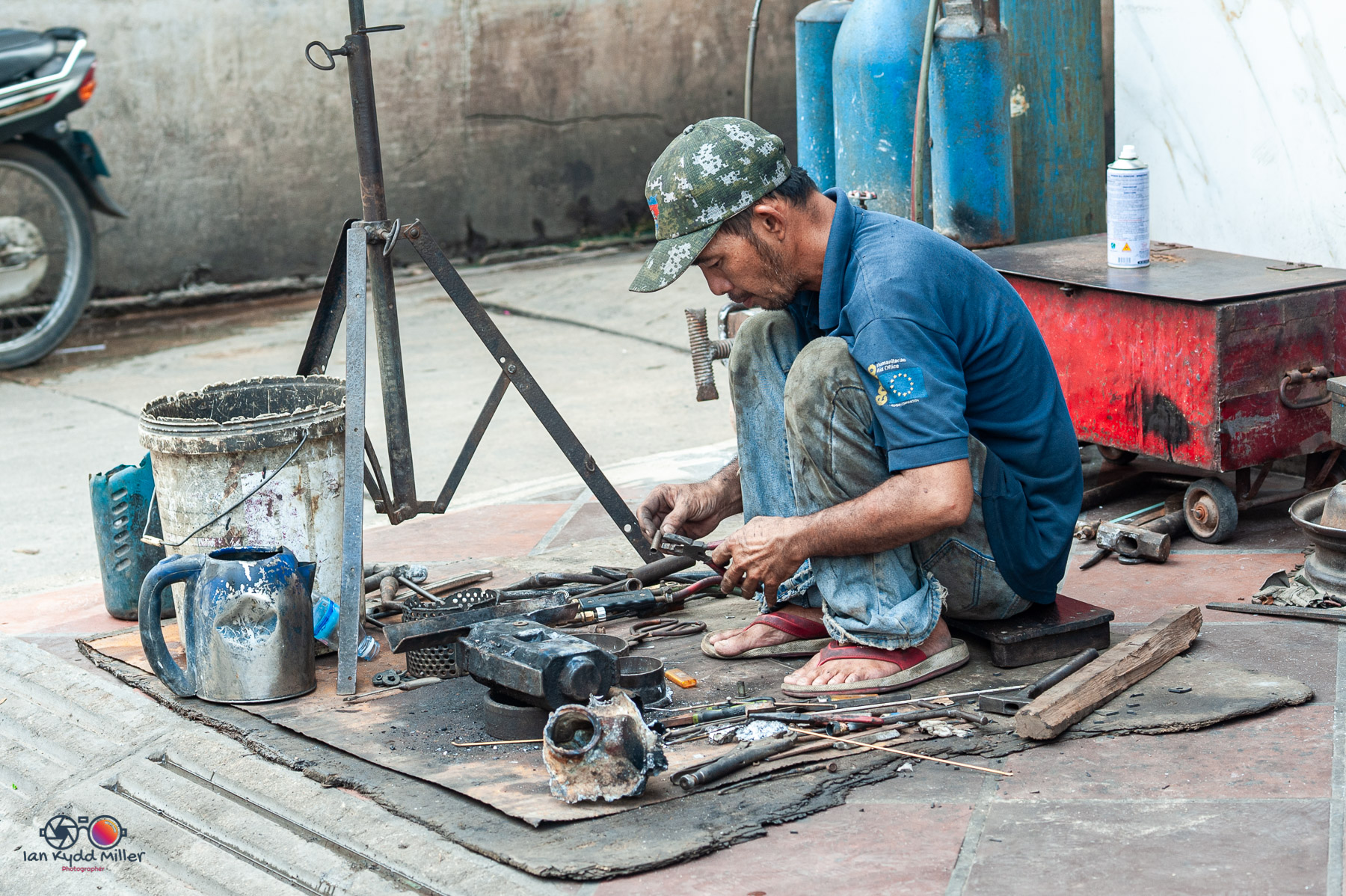
The photograph of the craftsman is probably my favourite demonstration of what this old lens can actually do.
Here is precisely the sort of subject I photograph naturally. A man working. Tools scattered around him. A hammer in one hand. Metal in the other.
A red shirt separating him immediately from the cluttered workshop.
There is enough compression to organise the chaos without destroying the environment. And there is plenty of detail.
Look at the hands. The hammer. The rods. The texture of the wooden block. The dirt on the trousers. The objects scattered across the floor.
The lens has recorded all of it.
The tighter frame works even better for judging the rendering.
His face is clear. His expression is there. His hands tell us what he’s doing. Everything I need from the photograph is present.
So what exactly would spending another thousand dollars have added? Perhaps technically quite a lot.
Photographically? I’m not convinced it would have added anything.
And that’s the point.
This was never really an experiment about whether an old Nikon zoom could satisfy a 45.7-megapixel sensor.
It was an experiment about whether we sometimes ask completely the wrong question.
Instead of:
Is this lens sharp enough?
Perhaps we should ask:
Does it make photographs I care about?
Instead of:
Is this camera too old?
Ask:
Does it still do what I need?
Instead of:
Should I upgrade?
Try:
What would I actually photograph differently if I did?
Those questions can save you an extraordinary amount of money.
More importantly, they can get you back to photography.
My D850 cost $380.
My AF Nikkor 70–210mm f/4–5.6 cost $35.
Together:
$415.
For that I’ve got 45.7 megapixels, full-frame image quality, excellent autofocus from the camera body, a useful 70–210mm range and a combination capable of producing every photograph shown here.
That’s absurd value. But after this outing, the money is almost beside the point. The important discovery is that I enjoyed using the combination. The D850 felt good. The old lens felt familiar.
I stopped thinking about equipment and started looking at Phnom Penh.
People. Buildings. Shapes. Colours. Little moments.
Exactly what a camera is supposed to make me do.
So did my $35 Nikkor survive being attached to the mighty Nikon D850?
Wrong question.
Did I make photographs with it that I’m happy with?
Yes.
That’s the only test that matters. The D850 didn’t expose the old lens as obsolete. It exposed just how much life was still left in it. Thirty-five dollars.
I have been taking photographs for more than 45 years, and in all that time I have bought precisely one camera brand-new.
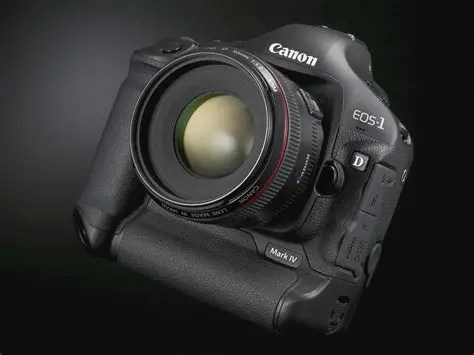
A Canon EOS-1D Mark IV.
That’s it.
Every other camera has, in one way or another, already had a life before it reached me.
Some photographers might find that strange. Photography is an industry built around the excitement of the new. New cameras arrive accompanied by countdowns, rumours, previews, launch events and endless YouTube videos explaining why the perfectly capable camera we owned yesterday has apparently become hopelessly inadequate overnight.
I’ve never been particularly interested in playing that game.
Not because I don’t appreciate technology. I do.
Modern cameras are astonishing.
But I’ve learned something rather useful over the years:
Let somebody else chase the technology. I’ll chase the photographs.
Buying used started partly because it made financial sense.
Good photographic equipment has never been cheap, particularly professional equipment. But photographers are peculiar creatures. We will spend thousands on a camera and then, three or four years later, sell it for a fraction of what we paid because another camera has appeared with a few more megapixels and an autofocus system capable of recognising the left eyeball of a swallow at 200 metres.
That’s fine by me.
I’ll wait.
Depreciation is one of the used-camera buyer’s greatest friends.
A professional camera doesn’t suddenly stop being professional when its replacement appears. It simply becomes cheaper.
The photographer who bought it new absorbs the frightening part of the depreciation.
I arrive later.
The Nikon D700 is perhaps one of the best examples.
When it appeared, it was a serious professional tool. Its full-frame sensor was superb for the period, its autofocus was dependable, the body was built properly and photographers used it to make pictures that appeared in newspapers, magazines, books, exhibitions and probably on more wedding albums than anyone could count.
Today it’s old. Twelve megapixels. No sophisticated video. No eye-detection autofocus. No electronic viewfinder. No artificial intelligence trying to work out whether I’m photographing a human, a bird, a dog or somebody’s motorcycle.
And yet I still love using it.
More importantly, it still makes excellent photographs. That fact tends to get lost whenever we talk about camera technology. A new camera may be better than an old camera. That doesn’t automatically make the old camera worse.
My recently acquired Nikon D850 demonstrates the madness particularly well.
It cost me $380.
There’s a reason. The shutter count is over 300,000.
If you spend too much time reading camera forums, that number might have you reaching for smelling salts. But the camera is externally in A1 condition. It sounds right. It works.
So I bought it.
The D850 was once one of the most desirable DSLRs in the world. It has a 45.7-megapixel full-frame sensor, excellent dynamic range, formidable autofocus and enough image quality for almost anything I’m ever likely to ask of it.
None of that disappeared because the shutter counter passed 300,000. And none of it disappeared because Nikon subsequently concentrated on mirrorless cameras.
I paid $380 and started taking photographs. If the shutter dies eventually, I’ll deal with it then. That’s the advantage of buying equipment at this end of the depreciation curve.
I’m not frightened of it.
Then there’s the lens currently sitting on the front.
An AF Nikkor 70–210mm f/4–5.6.
Cost?
$35.
I’ve already used it on the D700 and know it can produce excellent results.
Now I’m going to see what happens when I put that $35 lens in front of the D850’s 45.7-megapixel sensor.
Total investment:
$415.
A Nikon D850 and an autofocus 70–210mm zoom. There’s something wonderfully ridiculous about that. But it also illustrates why I’ve spent so much of my photographic life buying used equipment. I don’t need equipment to be new. I need it to work.
There is another advantage that has become increasingly important to me.
Freedom.
Buying an expensive new camera can sometimes make you strangely protective of it. You notice every mark. You worry about scratches. You buy covers and protectors. Rain appears and suddenly you’re wondering whether you should put the camera back into the bag. You start treating the tool as though its purpose is to preserve its resale value.
I’ve never wanted to photograph that way. A used camera already has a history. Someone has already put the first scratch on it. Thank you very much. That’s one less job for me. Now I can get on with using the bloody thing.
I don’t abuse equipment.
There’s a difference between using something and deliberately mistreating it. I look after my cameras. But cameras accompany me into the real world. They get carried. They get dusty. They get sweaty. They get knocked occasionally. Paint wears. Rubber becomes shiny. Little marks appear around the edges. To me, those aren’t necessarily defects. They’re evidence.
They say:
This camera has been somewhere.
I rather like that.
Buying used also teaches you something about what really matters.
When you aren’t chasing the newest equipment, you stop thinking quite so much about specifications.
Instead, you start thinking about suitability.
Does the camera fit my hand? Do I trust the autofocus? Can I operate it without thinking? Do I like the files? Does the viewfinder allow me to concentrate on what’s happening in front of me? And perhaps the most important question:
Do I want to carry it?
A camera that makes you want to go outside is worth considerably more than a technically superior camera sitting in a cupboard.
I’ve owned and used enough equipment to understand that the relationship between photographer and camera is difficult to measure.
Some cameras simply feel right. The D700 is one. There are others. You pick them up and within minutes you’re no longer thinking about the camera. You’re looking.
That’s when equipment becomes useful.
The camera industry doesn’t particularly benefit from people thinking this way. It needs us to believe we’re perpetually one generation behind. More resolution. More speed. Better autofocus. Higher ISO. More dynamic range. More computational photography.
And again, none of these things is bad.
Progress is good.
But technological progress and photographic progress are not the same thing.
You can improve your camera without improving your photography.
That’s an uncomfortable thought in an industry that would much rather sell you another body than suggest you spend a year properly learning the one you’ve already got.
The Canon EOS-1D Mark IV remains the odd one out in my history.
The one I bought new.
And I’m glad I did.
It was a magnificent professional camera and buying it new gave me the experience of owning a serious tool from the beginning of its working life.
But apparently once was enough. Because I never developed the habit. Instead, I’ve spent decades wandering around the second-hand market looking for cameras that other photographers have decided they no longer need. And I’ve benefited enormously from their impatience.
Someone wants the latest model? Wonderful. Sell me the old one.
Someone needs another ten megapixels? Excellent. I’ll take the supposedly obsolete camera.
Someone has decided DSLRs are finished because mirrorless has taken over?
Even better.
Now we’re talking about prices I like.
There is, of course, some risk. Buying used means checking equipment properly.
Shutters wear. Autofocus systems can be damaged. Sensors can be scratched. Card slots fail. Batteries die. Old lenses can develop fungus or haze.
You need to know what you’re looking at.
But after enough years around cameras, you develop a feel for these things.
Pick it up. Look through it. Press the buttons. Turn the dials. Listen to the shutter. Take photographs. Examine the results. A camera will often tell you quite a lot if you’re prepared to pay attention.
And sometimes you take a gamble.
My $380 D850 is one. Over 300,000 shutter actuations? Fine. At that price, I’ll take the bet.
Perhaps my attitude has changed with age as well. When I was younger, equipment represented possibility. Maybe the next camera would make me better. Maybe the next lens would change everything.
After 45 years, I know better.
Cameras don’t find photographs. Photographers do.
The equipment matters, certainly. Anyone claiming otherwise is being silly. The right lens can change how you see a situation. A better sensor can allow you to work in conditions that would once have been impossible. Reliable autofocus can mean getting a picture rather than missing it.
But eventually equipment reaches a level where good enough really is good enough.
Photography doesn’t begin when you have the best camera. Photography begins when you stop thinking about the camera. That’s probably why old equipment appeals to me. There’s no expectation attached to it. Nobody is asking whether my ten-year-old DSLR justifies its purchase price. Nobody cares whether my $35 lens resolves 45.7 megapixels.
Good.
Neither do I.
I want to know whether it resolves the expression on somebody’s face.
Whether it catches the light falling across a street. Whether it isolates a gesture. Whether, when I look at the photograph later, I feel something. If it does those things, the equipment has succeeded.
So I’ll continue buying cameras the way I always have. Late. Used. Depreciated. Occasionally battered. Preferably cheap. I’ll let somebody else enjoy opening the box and peeling the protective plastic from the screen.
They can watch the reviews.
They can debate the specifications.
They can upgrade when the replacement arrives.
And a few years later, when that once revolutionary camera has somehow become yesterday’s technology, perhaps I’ll buy it from them. For considerably less.
Then I’ll put an equally unfashionable lens on the front and take it onto the street. Because after all these years, I’ve finally worked out which upgrade matters most.
It isn’t another camera. It’s another photograph.
Let somebody else chase the technology.I’ll chase the photographs.
There is something wonderfully absurd about using a Nikon D2Hs in 2026.
Four megapixels.
Not forty-four. Not twenty-four. Not even twelve.
Four.
In an age when photographers discuss resolution as though megapixels were ammunition, the Nikon D2Hs turns up carrying its little 4.1-megapixel LBCAST sensor and couldn’t give a damn.
And neither do I.
I have used enough cameras over the years to understand that specifications and photographs are not the same thing. They never were. Cameras have become astonishingly capable, but somewhere along the road we started confusing the ability to record more information with the ability to make better pictures.
The D2Hs is a useful reminder of the difference.
Nikon introduced the D2Hs in 2005 as an evolution of the D2H, aimed squarely at working professionals — particularly sports photographers and photojournalists.
Everything about it says professional camera. Pick one up and the first thing you notice is the weight. This isn’t some little mirrorless thing hanging politely from two fingers. The D2Hs weighs roughly a kilogram before you’ve attached a lens. Add a decent piece of Nikon glass and you’ve got something substantial hanging around your neck.
Personally, I rather like that. A camera should feel like a camera.
The D2Hs has a built-in vertical grip, proper controls and buttons you can operate without digging through menus. There is a solidity to it that modern cameras sometimes lack. It feels less like a consumer electronic device and more like a piece of equipment.
The sort of thing designed to be thrown into a press photographer’s bag, knocked against a doorway, dragged through miserable weather and expected to work when somebody presses the button.
And it does. That’s the thing about these old Nikon professional bodies. They inspire confidence.
The shutter has that wonderful mechanical authority older professional Nikons possess. Press it and the camera responds immediately.
No ceremony. No discussion. No asking whether you’d perhaps like the camera’s artificial intelligence to identify a human, animal, bird, vehicle, aeroplane or possibly a particularly photogenic garden shed.
You focus. You frame. You press the shutter. Photograph taken.
What a revolutionary idea.
The D2Hs can shoot at eight frames per second, which was seriously quick when it appeared and remains quick enough for almost anything most photographers are likely to encounter.
But I’m not particularly interested in spraying eight frames every second. Street photography isn’t machine-gunning people. I’m more interested in the responsiveness that accompanies that speed. There is very little sensation of delay between seeing something and recording it.
That matters enormously when photographing people.
Expressions disappear. Hands move. Eyes change direction. Somebody steps into the light and then steps out again. The photograph exists for perhaps half a second. You either recognise it or you don’t.
The D2Hs gets out of the way.
And then we arrive at the elephant sitting in the room.
4.1 megapixels.
By today’s standards that’s laughable.
Your telephone probably has considerably more resolution.
A modern Nikon D850 gives you 45.7 megapixels. You could fit the resolution of the D2Hs into the D850 more than eleven times over.
But here’s the question that matters: How many megapixels does a good photograph require? Nobody has ever given me a convincing answer. Because there isn’t one.
A photograph succeeds because of light, timing, composition, gesture, expression, atmosphere and subject.
Resolution comes considerably further down the list.
Give me four megapixels of something worth looking at over forty-five megapixels of absolutely nothing.
Every time.
There is another advantage to having only four megapixels.
You have to compose the bloody picture.
Modern high-resolution cameras provide enormous cropping freedom. With a D850 I can make a photograph fairly loose and discover another photograph hiding somewhere inside it afterwards.
That’s useful.
I’ve never subscribed completely to the purist nonsense that cropping is somehow cheating. If removing something from the edge makes the photograph better, I’ll remove it. The finished picture matters more than obeying somebody else’s rules.
But enormous resolution can make us lazy.
With the D2Hs, there simply isn’t much room for heroic cropping.
Four megapixels doesn’t leave enough meat on the bone.
So you move. You look. You decide what belongs inside the frame before pressing the shutter.
That is rather refreshing.
It encourages the photographer to work instead of expecting Lightroom to rescue the composition later.
And perhaps that’s why I still enjoy cameras like this.
They demand something from you.
Modern cameras are increasingly designed to remove difficulties. Autofocus finds the eye. Exposure finds the face. Stabilisation compensates for movement. Enormous dynamic range rescues exposure errors. Huge files allow drastic cropping.
All extremely useful.
But photography isn’t improved simply by removing every possibility of failure.
Sometimes difficulty teaches you something.
Sometimes limitations make you pay attention.
The D2Hs certainly has limitations.
High ISO performance isn’t remotely comparable with a modern camera. Dynamic range is limited. The rear LCD is tiny. Autofocus technology has moved several generations beyond it. CompactFlash cards now feel like archaeological objects.
And four megapixels means exactly what it says.
You cannot pretend this camera competes technically with modern equipment. It doesn’t.
But that’s precisely why comparing it purely through specifications misses the point.
A twenty-one-year-old professional camera doesn’t have to outperform a 2026 camera to remain useful. It merely has to make photographs. And the D2Hs does.
Beautifully.
There is also something about the files that I like.
I’m cautious about describing old sensors as having some mystical “film-like” quality because photographers have a terrible habit of romanticising old equipment.
But older digital sensors do have characteristics of their own.
The D2Hs files aren’t clinically enormous. They don’t invite endless pixel inspection. Used properly, particularly in decent light, they can produce colour and tonality that are extremely pleasant.
And for pictures of people, that’s enough.
More than enough.
I don’t need to count somebody’s pores.
I want the face. I want the expression. I want the relationship between the person and their surroundings. I want the moment.
That is photography.
For street work I’d happily put a modest prime on the D2Hs and walk for several hours.
A 35mm makes sense if I want something approaching the traditional normal perspective on its DX sensor.
A 50mm becomes roughly a 75mm-equivalent field of view and gives me something I have always enjoyed: a little distance without becoming completely detached from the person I’m photographing.
After decades of photography, I increasingly find myself returning to that simplicity.
When you’re younger, equipment can become terribly important. You imagine the next camera might somehow unlock something.
A faster lens. A better sensor. More autofocus points. More resolution. Another body. Another upgrade.
Then, if you’re fortunate, somewhere along the road you realise something rather liberating.
The camera was never the difficult part.
Seeing is difficult.
Recognising a photograph among all the visual rubbish surrounding us is difficult.
Understanding people is difficult.
Knowing when to approach and when to leave somebody alone is difficult.
Learning how light changes a face is difficult.
Knowing when not to press the shutter is difficult.
Those things take years.
A camera can be mastered in an afternoon. Photography can take a lifetime.
That is why an old professional DSLR like the D2Hs still makes sense to me.
It doesn’t promise to make me a better photographer.
It simply asks me to be one.
Would I recommend somebody spend serious money on a D2Hs today?
No.
There are too many newer cameras available cheaply that are technically superior in virtually every measurable way.
But if you find a good D2Hs for sensible money? That’s different. Put a lens on it. Charge the enormous battery. Find a CompactFlash card. Ignore the megapixel count.
Then go outside. Because something interesting happens when you’re walking around with an old camera.
After twenty minutes you stop thinking about how old it is. After an hour you stop thinking about specifications. Eventually you’re simply looking.
And once that happens, the camera has done its job.
I have always believed that old cameras possess a certain character. Perhaps that’s sentimental. After all, they’re machines: metal, glass, plastic, electronics and rubber.
But photographers develop relationships with their equipment. We remember where cameras have been. The people photographed with them. The journeys. The failures. The pictures that worked.
A battered old professional Nikon carries something modern equipment cannot manufacture.
History.
Some D2Hs bodies will have spent their lives photographing football matches. Others covered elections, demonstrations, weddings, fires, accidents, wars or ordinary newspaper assignments that nobody remembers anymore.
Thousands upon thousands of shutter releases. Then eventually they became obsolete. The agencies upgraded. The professionals moved on. The cameras appeared in secondhand shops and online auctions for a fraction of what they once cost.
And twenty years later some old photographer picks one up. Charges the battery.Looks through the viewfinder. Presses the shutter.
CLACK.
Still works.
There is something rather satisfying about that.
Photography has spent the past two decades racing forward. More pixels. More dynamic range. Better autofocus. Electronic shutters. Computational photography. Artificial intelligence.
And I’m not against any of it.
Technology moves forward. It should.
But photographers don’t have to throw away everything that came before simply because something ‘better’ has arrived.
Sometimes yesterday’s camera remains perfectly capable of making today’s photograph.
The Nikon D2Hs is one of those cameras. Four megapixels. Twenty-one years old. Heavy. Noisy. Technically obsolete.
And still capable of producing a photograph that can stop somebody in their tracks.
Because the important component was never inside the camera.
It was standing behind it.
The Nikon D2Hs has four megapixels and not a damn thing to prove.
Put a Nikon D700 beside a Nikon D850 and start comparing specifications and the D850 wins almost everywhere.
It has 45.7 megapixels against the D700’s 12.1. It has vastly greater resolution, considerably more cropping room, a more sophisticated autofocus system, better high-ISO performance, better dynamic range, faster processing, video, live view that is actually useful, and files capable of making enormous prints.
The D850 is quite simply one of the finest DSLRs Nikon ever made.
I own one. I like it enormously.The pictures it produces can be bloody magnificent.
And yet, when I’m going out specifically to photograph people on the street, there is another camera I still find myself wanting to pick up.
The Nikon D700.
That doesn’t make much sense on paper. Fortunately, I don’t take photographs on paper.
The D850 is a camera I can admire. When I open one of its files on the computer, particularly a properly exposed RAW file made with a good lens, there is an extraordinary amount of information sitting there. You can go into the photograph. And then go further. And further still.
Details appear that I barely noticed when I pressed the shutter. Skin, hair, fabric, signs in the distance, little elements within the scene — they’re all there.
If I’ve composed slightly loose, I can crop. Sometimes I can crop brutally. There’s enough resolution available to effectively discover another composition inside the original photograph.
For printing, the D850 is wonderful. There is a richness to a good D850 file that reminds you just how far digital photography developed during the DSLR era. This isn’t an old camera that is merely “still good enough.” It is an exceptionally capable camera. Full stop.
But there is another side to photography that specifications don’t measure very well. What does the camera feel like when you’re actually making the picture? That’s where the D700 comes back into the argument.
The D700 arrived in 2008.
By modern standards, 12.1 megapixels sounds almost comical. Phones advertise more. Modern full-frame cameras routinely offer 24, 33, 45, 60 megapixels and beyond. But here’s the awkward question. How many megapixels does a good photograph need?
Twelve megapixels didn’t suddenly become worse because 45 megapixels arrived. A properly exposed D700 file is still capable of producing a lovely print. It is more than adequate for the web, social media, magazines, photo essays and most of the ways photographs are actually viewed.
And for street photography, I’ve never found myself walking home thinking: If only that moment had another thirty-three million pixels. I have certainly walked home wishing I’d reacted half a second faster.
That’s different.
The D700 feels like a street camera to me. Not because Nikon designed it specifically for street photography. They didn’t. It is big. It is heavy. It is conspicuous. Nobody is going to mistake somebody carrying a D700 for an invisible photographer.
But invisibility has never been the whole point of street photography anyway. The important thing is familiarity. Pick up a camera often enough and eventually your hands know it better than your conscious mind does. That’s when a camera becomes useful. I don’t want to look at the controls. I don’t want to wander through menus. I don’t want to think about which clever autofocus mode the camera has decided I should use. I want to see something, raise the camera, frame it and press the shutter.
The D700 encourages that kind of photography.
There is something wonderfully uncomplicated about it.
Perhaps the 12-megapixel sensor is actually part of the attraction.
The D850 makes me aware of precision.
Forty-five megapixels notices everything.
Slightly missed focus?
There it is.
A little camera movement?
There it is.
A lens that isn’t quite as sharp in the corner?
There it is.
The D850 is capable of enormous quality, but it also invites inspection. And inspection can become a disease.
We enlarge photographs to 100% and start examining eyelashes. We compare corners. We worry about microcontrast. We discuss whether one lens resolves slightly more detail than another.
Meanwhile the photograph itself is sitting there asking:
Is anybody actually going to look at me?
The D700 takes some of that nonsense away. Twelve megapixels. That’s what you’ve got.
Now make a photograph. I rather like that bargain.
And then there are the files themselves.
I am wary of romanticising old digital cameras. There’s an increasing tendency to talk about early DSLRs as though their sensors contained some mystical ingredient that modern manufacturers have forgotten how to produce.
They didn’t.
A D850 file gives me far more information to work with than a D700 file.
But information and character aren’t necessarily the same thing.
There is something about the D700 files that I continue to enjoy.
Particularly photographs of people.
Particularly monochrome.
The files aren’t enormous. They don’t encourage endless manipulation. I can work them, certainly, but I don’t feel compelled to excavate every last piece of information from the shadows and highlights.
Sometimes a photograph benefits from having limits.
Street photography certainly does. The street isn’t a studio. Things aren’t perfect. People move. Light changes. Backgrounds are messy. Somebody walks into the frame. Someone else walks out. The expression disappears. The decisive moment turns out to be indecisive.
That’s precisely why I love it.
Street photography is imperfect because life is imperfect.
The D700 somehow feels comfortable in that world.
The D850, meanwhile, is the camera I would choose when image quality becomes the overriding consideration.
If I know I’m going somewhere specifically to make photographs that I may want to print large, the D850 makes enormous sense.
If I’m photographing portraits where I have some control over the situation, D850.
If I’m working carefully with good light and want every scrap of detail available, D850.
If I suspect I’ll need serious cropping room, definitely D850.
It is an extraordinary photographic instrument.
But street photography asks something slightly different of me. It asks me to react. To anticipate. To watch. To become interested in people rather than equipment. And strangely, the older D700 helps me do that.
There is also something else that becomes important after you’ve been taking photographs for decades.
Confidence.
Not confidence in the sense of believing every photograph you take is brilliant. Most aren’t.
I mean confidence in the equipment. The feeling that when something happens, the camera will respond in exactly the way you expect. That matters enormously.
New cameras are impressive.
Familiar cameras are fast.
Not necessarily fast in frames per second.
Fast between the eye and the finger.That’s the speed that matters on the street.
When I know where everything is without thinking, the camera effectively disappears.
The D700 can do that for me.
And once the camera disappears, I can concentrate on the photograph.
Would I claim the D700 is a better camera than the D850?
No. That would be silly.
The D850 is objectively superior in almost every measurable photographic specification.
But I think photographers sometimes confuse better camera with better camera for me, for this particular job.
Those aren’t the same thing.
A Formula One car is considerably faster than an old Land Rover.
I’d still rather have the Land Rover if the road disappears.
Tools have purposes. And photographers have preferences.
After enough years, those preferences become more important than specifications.
There is a tendency in photography to assume that buying something newer automatically means abandoning what came before.
I have never really understood that.
My D700 didn’t stop working when the D800 appeared.
The D800 didn’t suddenly become incapable when the D810 arrived.
And none of them became useless when Nikon produced the D850.
Cameras don’t deteriorate because another camera receives a better review.
They remain exactly as capable as they were the day before.
What changes is expectation.
And expectation is largely manufactured for us.
Every few years we’re told that the camera we’ve been happily using has somehow become inadequate.
Not enough resolution. Not enough dynamic range. Not enough autofocus points. Not enough frames per second. Not enough technology.
Perhaps.
But enough for what?
That’s the question an old photographer eventually learns to ask.
For me, the D850 and D700 don’t really compete.
They complement one another.
The D850 is the camera that reminds me just how extraordinary digital image quality has become.
The D700 reminds me that extraordinary image quality isn’t the same thing as an extraordinary photograph.
One gives me enormous files.
The other gives me enough.
And enough is one of the most underrated words in photography.
Enough resolution.
Enough autofocus.
Enough dynamic range.
Enough camera.
Once you’ve got enough, everything beyond that becomes optional.
Then the responsibility comes back to the photographer.
Where it belongs.
So tomorrow, if I were walking out specifically to photograph the streets, which one would I take?
The D700.
Not because it’s better. Not because I’m nostalgic. And certainly not because I believe 2008 technology possesses some magical quality that Nikon subsequently lost.
I’d take it because I know it.
Because I trust it.
Because 12 megapixels is enough for what I’m trying to do.
Because I like what comes out of it.
And because when I’m carrying it, I tend to think less about the camera and more about the people in front of me.
The D850 makes photographs of astonishing technical quality.
I wouldn’t willingly give mine up.
But the D700 still has something the specification sheet cannot quantify.
It feels right.
And after more than four decades of making pictures, I’ve learned not to dismiss that feeling.
There is a difference between the camera you admire and the camera you reach for.
The D850 is the camera I admire when I look at the photograph.
The D700 is the camera I love while I’m making it.
Perhaps that’s why the old Nikon keeps finding its way back into my hands.
There comes a point in a photographer’s life when numbers begin to matter less.
Megapixels. Frames per second. Dynamic range. Autofocus points. Shutter counts.
I’ve spent more than 45 years taking pictures, and I’ve lived through enough generations of cameras to know that we photographers have a peculiar ability to worry about things that aren’t actually stopping us from making photographs.
And then I bought a Nikon D850 for $380.
There had to be a catch.
There was.
The shutter count was north of 300,000.
For some photographers, that number would be enough to put the camera straight back on the shelf. Nikon rated the D850 shutter mechanism for 200,000 cycles, so 300,000 sounds rather like buying a car with 300,000 miles on the clock.
Except cameras aren’t cars. And shutter ratings aren’t death sentences.
The camera was sitting there looking almost ridiculously good. Externally I’d describe it as A1. It hadn’t been knocked about, the body wasn’t scarred from years of abuse, and nothing immediately suggested a camera that had already made more than 300,000 exposures.
I picked it up. That familiar Nikon solidity was there. Then I pressed the shutter. It sounded good. Not tired. Not hesitant. No strange metallic noises or anything suggesting the mechanism was preparing to throw itself across the room. Just that wonderfully purposeful D850 shutter. Clack.
A photograph. And suddenly I wasn’t terribly interested in the number anymore.
I’ve owned and used enough cameras over the years to understand that mechanical things eventually wear out. A shutter can fail at 50,000 exposures. Another can carry on well beyond its manufacturer’s rated life. Two hundred thousand actuations doesn’t mean that the D850 shutter self-destructs at exposure number 200,001.
It is a durability rating, not an appointment with the undertaker.
My camera has already proved the point rather convincingly. It’s passed 300,000.
The interesting question isn’t how many photographs the camera has already taken.
It’s how many photographs it still has left in it.
And nobody knows. Perhaps the shutter will fail next week.
Perhaps it will make another 100,000 exposures. That’s the gamble. But at $380, it’s a gamble I’m perfectly comfortable taking.
There was a time when I might have thought differently.
When you’re younger and buying equipment represents a substantial investment, you tend to protect it. Every scratch hurts. Every little mark on the baseplate feels like a personal tragedy. You buy protective screens. Protective filters. Protective cases.
Then you put your expensive camera inside an expensive bag designed to protect the protective things protecting the camera.
Eventually you realise something.
Cameras are supposed to be used.
That’s particularly true of the Nikon D850.
When Nikon introduced the D850 in 2017, it was one of those rare cameras where almost everything came together.
The 45.7-megapixel full-frame sensor delivered extraordinary detail. Dynamic range was superb. Autofocus was inherited from Nikon’s professional D5 generation. It could shoot quickly enough for serious action photography while simultaneously producing files capable of enormous prints.
It wasn’t really a specialist camera. It was a camera that could do almost everything.
Landscape photographers loved it. Studio photographers loved it. Wedding photographers used it. Wildlife photographers used it. Photojournalists used it.
And people like me discovered that despite its size, it could make a formidable street camera.
Nearly a decade later, none of those abilities have disappeared.
That’s something we sometimes forget.
A camera doesn’t become worse because something newer has appeared.
The photographs coming out of a D850 today are every bit as good as the photographs that came out of one when photographers were queuing to buy them new.
Technology moves forward.
Image quality doesn’t move backwards.
And 45.7 megapixels is still an enormous amount of information.
In fact, for most of what I photograph, it’s far more than I actually need.
The great advantage of my particular D850 is that I don’t have to worry about it. That’s worth more than people realise.
I didn’t spend several thousand dollars on it. I spent $380. If I put another scratch on the bottom plate, I won’t lose sleep. If the rubber gets polished from my hands, good. If the paint eventually wears around the edges, even better. That’s what cameras are supposed to look like. They’re tools.
I’ve always had a fondness for old cameras precisely because they develop character. A camera that’s been used carries something of its history with it.
And this D850 certainly has a history. Three hundred thousand photographs.
Think about that for a moment. I have no idea what those photographs were. Perhaps weddings. Perhaps portraits. Perhaps products photographed in a studio. Maybe somebody used it for time-lapse work. Perhaps there are thousands upon thousands of photographs of things completely forgotten now.
I’ll probably never know.
But somebody pressed that shutter more than 300,000 times. Now it’s my turn. There’s something I rather like about that.
The obsession with shutter count has grown alongside the used-camera market.
Mention that you’re looking at a used DSLR and one of the first questions you’ll hear is:
“What’s the shutter count?”
Fair enough.
It’s useful information.
If two otherwise identical D850 bodies are sitting beside each other at the same price and one has made 20,000 exposures while the other has made 300,000, I’d take the 20,000-exposure camera.
I’m an old photographer. I’m not completely daft. But price changes everything. At $380, I’m not comparing this camera with a pristine low-mileage D850. I’m asking a different question.
How much photography can I get for $380?
And the answer is potentially quite extraordinary.
For less than the cost of many modern lenses, I’ve got one of the finest DSLRs Nikon ever produced.
A professional-grade body. A magnificent sensor. Excellent autofocus. Superb handling. An enormous optical viewfinder.
Files with enough latitude to take considerable punishment in processing.
And, perhaps most importantly, a camera that makes me want to go out and take photographs. That’s the bit specifications can’t measure.
I’ve reached an age where I’m increasingly uninterested in owning cameras simply because they’re new.
I’ve watched photography travel from film to early digital cameras, through the DSLR revolution and now into the mirrorless age.
Every generation arrives accompanied by claims that everything before it has suddenly become obsolete.
It never quite happens.
My old Nikon D700 can still make wonderful photographs. So can a D800. So can a D810.
So can the professional Nikon bodies that once sat in newspaper offices and photographers’ bags around the world.
And the D850 sits very close to the summit of that entire DSLR era.
Perhaps it is the summit.
It arrived when Nikon had decades of experience building professional SLRs and nearly two decades of experience making serious digital SLRs.
Everything Nikon had learned seemed to end up inside it. The ergonomics. The viewfinder. The autofocus. The metering. The sensor. The durability.
It feels like the final flowering of a particular philosophy of camera design.
Put your eye to the viewfinder and you’re looking through the lens. Not at a tiny television.
At the world.
There’s still something wonderfully direct about that.
I don’t know when the shutter in my D850 will eventually stop. That’s part of the deal.
If it happens, I’ll make a decision.
If replacing the shutter makes financial sense, I’ll replace it.
If it doesn’t, I’ll have had my money’s worth. But I’m certainly not going to spend whatever life remains in the shutter worrying about its death. That would be rather ridiculous. Imagine buying an old Leica and refusing to use it because operating the shutter might wear it out. Or buying a classic car and never driving it because the engine has already done too many miles.
Objects designed to work should work. Cameras designed to take photographs should take photographs. So this D850 is going into the bag. It’ll walk the streets. It’ll get hot. It’ll get dusty. It’ll probably acquire a few marks. And every time I press that shutter, the supposedly frightening number will increase.
300,001.
300,002.
300,003.
Good. Keep going. Because after all these years, I’ve realised that the shutter count that really matters isn’t the number already on the camera. It’s the number of photographs still inside the photographer. That’s the count I’m interested in now.
And at $380, this battered-in-spirit but beautiful-in-the-hand Nikon D850 and I have made a rather simple agreement.
There is a peculiar disease among photographers. I have suffered from it myself for years.
We convince ourselves that we need another lens.
A 24mm for when things get tight. A 35mm because it is supposedly the perfect street lens. A 50mm because everybody ought to own one. An 85mm for portraits. A zoom because changing lenses is inconvenient. And perhaps a telephoto because, well, you never know.
Before long we’re heading out to take photographs carrying enough equipment to document the invasion of a small country.
Then, after walking around all day with several kilos hanging from our shoulders, we get home and discover that most of the pictures were taken with one lens.
Eventually an old photographer begins to see the absurdity of it.
So here is my alternative.
One Nikon D850. One AF-S Nikkor 50mm f/1.4G. Nothing else.
Well, perhaps a spare battery.
I’m old, not stupid.
The Nikon D850 is hardly anybody’s idea of a small camera. It is a substantial DSLR, built in that wonderful Nikon tradition of cameras that feel as though they could survive considerably more punishment than their owners.
And I like that.
I’m not looking for a camera that disappears into a jacket pocket. I want something that sits properly in my hands. Something with a real grip, proper buttons and dials, and an optical viewfinder through which I can simply look at the world.
The D850 gives me that, together with a 45.7-megapixel FX sensor capable of producing quite extraordinary files.
But here’s the important bit.
I don’t need to think about any of it.
After enough years using Nikon DSLRs, the controls become familiar. Aperture. Shutter speed. ISO. Focus point. Exposure compensation.
Everything else can largely bugger off.
The camera is there to make photographs.
Then we put the little 50mm f/1.4G on the front.
And suddenly this enormous photographic machine becomes beautifully simple.
The AF-S Nikkor 50mm f/1.4G is an interesting lens because it isn’t one of Nikon’s modern optical monsters.
It dates from 2008. It has eight elements in seven groups, weighs only about 280 grams, focuses down to 45cm and uses a nine-bladed rounded diaphragm. Its Silent Wave Motor provides autofocus, while M/A mode allows immediate manual adjustment.
In other words, it is refreshingly ordinary.
And I mean that as a compliment.
On the D850’s FX sensor, 50mm gives us that classic normal perspective. Not dramatically wide. Not compressed like a telephoto.
Just 50mm.
You look. You frame. You photograph. There is nowhere to hide.
Your feet are the zoom
The first thing that happens when you spend an entire day with a prime lens is that you stop thinking about lenses.
At the beginning you might see something and think:
I wish I had the 35mm.
Twenty minutes later:
An 85mm would be handy here.
Ignore it. Keep walking.
Something rather interesting eventually happens. Your brain begins adjusting to 50mm.
You start seeing pictures in 50mm before the camera reaches your eye.
You know roughly what will be in the frame. You know how close you need to get. You begin moving instinctively.
Want the person larger? Walk closer.
Want more environment? Walk backwards.
Can’t walk backwards because there’s a wall behind you?
Good.
Find another photograph.
That limitation is part of the exercise.
Modern photography has become obsessed with eliminating limitations. I increasingly think limitations are good for us. They make us think.
And 50mm makes you participate
This is particularly important when photographing people.
With a long lens, I can stand well away from somebody and photograph them almost anonymously.
With a 50mm, I can’t.
If I want somebody to occupy a significant part of the frame, I have to get reasonably close. I have entered their world. That changes the photograph.
There’s an intimacy to 50mm street photography that I like. I’m not right under someone’s nose, as I might sometimes feel with a very wide lens, but neither am I standing across the road pretending I wasn’t there.
I’m part of the scene.
For the sort of photography I enjoy — people, faces, gestures, little human moments and the environment around them — that feels right.
About that f/1.4
Naturally, the great attraction of this particular 50mm is written around the front of the lens.
1:1.4.
That’s fast.
It means I can keep working when the light begins to disappear. It means I can isolate somebody against a distracting background. And that rounded nine-blade diaphragm can produce very pleasant out-of-focus areas. Nikon itself positions the lens for low-light work, portraits and general photography.
But here’s something I’ve learned. Just because I’ve bought an f/1.4 lens doesn’t mean I have to photograph everything at f/1.4.
There seems to be a modern fascination with obliterating backgrounds.
Eyes sharp. Ears blurred. Nose blurred. Background transformed into expensive-looking soup.
Very impressive.
But sometimes I actually want to know where the person is.
For street photography especially, the background frequently provides the story.
So I’ll happily use this lens at f/2.8, f/4, f/5.6 or f/8.
I want the aperture that makes the photograph work.
Not the aperture that proves what is engraved on the lens barrel.
The D850 will expose your mistakes
There is another reason I like this combination.
The D850 doesn’t flatter sloppy technique.
That enormous resolution records an extraordinary amount of detail, which means that when focus is right and the camera is steady, the results can be beautiful.
But miss focus slightly? You’ll know.
Use a shutter speed that’s a little too slow? You’ll know.
Get lazy with technique? Oh, you’ll definitely know.
And I rather like that.
A camera should occasionally remind the photographer that he is still involved in the process.
The D850 is capable of extraordinary image quality, but it doesn’t magically create good photographs.
Neither does the 50mm f/1.4G.
That’s still my job.
Leave the bloody camera bag at home
This might actually be the most important part.
Don’t put the D850 and 50mm into a bag containing another four lenses.
Because then the temptation remains.
Take the D850. Attach the 50mm. Put a spare battery and memory card in your pocket. Walk out of the door. That’s it.
For the next few hours, 50mm is the only focal length in existence.
It is remarkably liberating. No lens changes. No sensor dust. No wondering whether the photograph might look better at 35mm. No staring into a bag while the interesting human moment happening three meters away disappears forever.
Just photography.
One camera, One lens changes the way you work
The longer you use the combination, the less you notice it. And that’s when things become interesting.
The camera stops being the subject. You start noticing light.
A face appearing through a doorway. Someone sitting alone at a café.
A child running through a shaft of afternoon sunlight. Two people arguing. Someone laughing. A hand resting on a shoulder. A tired face on a bus.
The ordinary theatre of the street. These are the things that matter. Not whether Nikon has released something newer. Not whether another lens resolves another hundred lines on somebody’s laboratory chart. Not whether my autofocus system contains the latest artificial intelligence.
Did I see the picture?
That’s the question.
Could I really live with just this?
Photographically?
Yes.
The D850 and 50mm f/1.4G could cover an astonishing amount of what I enjoy photographing.
Street. Portraits. Environmental portraits. Travel. Documentary work. Family. Night photography. Details. Even landscapes, if I stop believing landscapes must automatically be photographed with wide-angle lenses.
Would there occasionally be photographs I couldn’t make?
Of course. That’s life. I’ve missed photographs while carrying three lenses as well. Usually because I was fiddling with the bloody equipment.
After decades around cameras, perhaps the greatest luxury isn’t owning more equipment. It’s needing less.
When I was younger, another lens represented another possibility. Now I increasingly see it differently. Every additional lens is another decision. And every second spent thinking about equipment is a second I’m not looking at what is happening around me.
So give me the Nikon D850. Put the AF-S Nikkor 50mm f/1.4G on it. One battery in the camera. Another in my pocket. An empty memory card. Good walking shoes. And send me out onto the street.
No zoom. No second body. No bag full of alternatives.
If the photograph is too far away, I’ll walk towards it.
If I’m too close, I’ll walk backwards.
And if neither works, I’ll wait for another photograph. Because there is always another photograph. You just have to be looking.
There is a particular pleasure in leaving the house with one camera and one lens.
No bag stuffed with primes. No second body. No agonising over whether I might need a 24mm, an 85mm or something longer. Just a full-frame Nikon with an old AF Nikkor 35–135mm f/3.5–4.5 attached.
Then I go for a walk.
The 35–135mm AF comes from a very different period of Nikon photography. Introduced in the late 1980s, it belongs to the first generations of Nikon autofocus lenses, when AF was still something rather exciting rather than something photographers simply expected.
There is no AF-S motor inside it. On compatible Nikon DSLRs, autofocus is driven mechanically by the motor in the camera body — the famous Nikon screw-drive system.
It isn’t silent.
It isn’t particularly elegant.
You can actually hear the bloody thing focusing.
I rather like that.
Put it on a full-frame Nikon DSLR with a built-in AF motor — something like a D700, D800, D810, D3 or similar body — and you’ve got an autofocus combination that may be old-fashioned but remains thoroughly capable of taking photographs.
More importantly, on full frame the focal range makes enormous sense.
35–135mm.
Forget specifications for a moment and think about what those numbers actually mean when you’re walking around with a camera.
At 35mm you’ve got a proper documentary focal length.
It is wide enough to photograph the street, markets, cafés, buildings, groups of people and environmental portraits without the dramatic perspective of an ultra-wide lens.
Thirty-five millimetres is also wide enough to give a person somewhere to exist. That’s important to me.
Street photography isn’t always about isolating a face. Often the surroundings explain the person. The shop they’re sitting outside, the food they’re selling, the people around them, the light falling through an alleyway — these things can be as important as the subject.
At 35mm I can include that information.
Turn the zoom ring a little and I’m around 50mm.
Now things become quieter. Perspective feels natural. I’m looking rather than announcing that I’m using a wide-angle lens.
Keep going.
Seventy millimetres. Eighty-five. One hundred.
These are wonderful focal lengths for photographing people.
And then there’s 135mm.
Now I can stand back. Not hide. Not photograph people from half a mile away pretending I’m invisible. Just give somebody a little breathing room.
That makes the 35–135 particularly interesting as an everyday lens for the sort of photography I enjoy.
I have always liked photographing people, and I have never believed that street photography requires sticking a 28mm lens eighteen inches from a stranger’s nose.
Some photographers work brilliantly that way. Good luck to them. It isn’t a rule.
At 85mm, 105mm or 135mm I can watch relationships developing between people without immediately changing those relationships simply because I’ve walked into the middle of them.
Then, five minutes later, I can zoom back to 35mm and photograph the whole street. That flexibility is what makes this old Nikkor such a useful walkabout lens.
Of course, somebody will immediately point out the obvious problem.
“But 35mm isn’t very wide.”
No, it isn’t. And I’m not sure I care.
Modern photographers have become accustomed to zooms beginning at 24mm. A 24–70mm feels normal. A 24–120mm seems almost ideal as a general-purpose full-frame lens.
On paper, a 24–120mm is certainly more versatile.
But photography doesn’t happen on paper.
For the way I tend to see photographs, 35mm is wide enough most of the time.
And the price I pay for losing 24–34mm is that wonderful reach out to 135mm.
For photographing people, I’ll happily make that exchange.
There is another reason I like this focal range on full frame.
It makes me move.
If 35mm isn’t wide enough, perhaps I need to take three steps backwards.
If 135mm isn’t long enough, perhaps I need to get closer.
Zoom lenses sometimes make photographers lazy. We stand in one place and compose entirely by twisting a ring.
A limited zoom range doesn’t completely remove that temptation, but it reminds me that my feet remain part of the photographic equipment.
The lens itself is unmistakably from old Nikon. It feels like a lens.
Metal, glass, mechanical movement and enough weight to remind you that you’re carrying something built during an era when Nikon expected its equipment to spend years being knocked around by working photographers.
Nobody would mistake it for a modern lightweight plastic kit zoom.
On a substantial full-frame Nikon DSLR, though, that isn’t necessarily a bad thing.
Put it on something like a D700 or D810 and the combination feels balanced. Neither camera was designed around the idea that photographic equipment should disappear into a coat pocket.
These are proper cameras. The 35–135 feels at home on them.
Optically, I’m not going to pretend an old zoom from this period magically defeats thirty-odd years of optical development. It doesn’t.
Modern lenses can be sharper, particularly towards the edges. They can control flare, chromatic aberration and distortion better. Modern autofocus is faster and quieter. Modern stabilisation can rescue shutter speeds that would have been risky when this lens was designed.
All true.
But here’s the question that matters:
Does the 35–135mm make good photographs?
Yes. Absolutely. Especially stopped down a little, it is capable of producing perfectly respectable sharpness, contrast and colour.
And there’s something else.
Older lenses sometimes render photographs differently from modern optics designed to pursue technical perfection. Contrast can be gentler. Out-of-focus areas can have their own character. The transition between sharp and unsharp isn’t necessarily the same as the latest computer-designed lens.
I hesitate to call that magic, because photographers use that word far too easily.
Let’s call it character.
I like lenses with character.
The variable f/3.5–4.5 aperture is hardly spectacular by modern standards, but neither is it terribly slow for a general-purpose zoom.
At the wide end, f/3.5 is perfectly usable.
At 135mm, f/4.5 still allows some useful subject separation, particularly when you’re reasonably close to the subject and the background is further away.
And remember what we’re putting it on.
A full-frame digital Nikon. With modern ISO capability, even on an older DSLR, losing a stop or two compared with a fast prime isn’t the disaster it once was.
If the light drops, raise the ISO. That’s what the bloody button is there for.
There is no VR, of course. Photographers managed for decades without it.
Watch your shutter speed. Hold the camera properly. Brace yourself when necessary.
Take another frame. It’s remarkable how much photographic technique can compensate for technology we haven’t got. That may sound like an old photographer grumbling about modern conveniences.
It isn’t. I like modern conveniences.
VR is excellent. Modern autofocus is extraordinary. Eye detection borders on witchcraft compared with what we used years ago.
I’ll use any technology that helps me make the photograph. What I won’t accept is the idea that because newer technology exists, older equipment somehow stops working.
It doesn’t.
A lens doesn’t know what year it is.
The 35–135mm was capable of making good photographs thirty years ago. It’s capable of making them now.
And today it has another enormous advantage. Nobody wants the thing. Well, almost nobody.
(I picked up my perfect copy from Japan for $38 US plus postage)
The photographic world constantly chases the latest lenses, which means older AF Nikkors can sometimes be bought for remarkably little money.
That makes lenses like the 35–135 fascinating.
You’re getting a genuine Nikon full-frame zoom covering some of the most useful focal lengths in photography for the sort of money that barely buys a modern camera accessory.
It isn’t fashionable. Good. Fashion has never taken a decent photograph.
For me, the real appeal remains simplicity.
Imagine an ordinary day walking through Phnom Penh.
At 35mm I photograph a tuk-tuk driver sitting beside his machine, but I want enough of the street around him to explain where he is.
A little later I see two people talking across the road.
Maybe 85mm.
Further along, somebody is sitting alone in beautiful light.
135mm.
Then I turn a corner and suddenly the whole street opens in front of me.
Back to 35mm.
I haven’t changed lenses once. I haven’t opened a camera bag. I haven’t exposed the sensor to dust. More importantly, I haven’t interrupted the process of looking.
That matters enormously.
The older I get, the more I think good photographic equipment is equipment that gets out of the way.
Not necessarily physically.
A D700 or D810 with a 35–135 attached isn’t exactly invisible.
I mean mentally.
When I don’t have to think about which lens to use, I can think about what I’m photographing.
The little moment when somebody’s expression changes.
The second when two unrelated elements suddenly line up.
That’s photography.
Not the lens.
The lens merely needs to let me get there.
And 35–135mm gets me there surprisingly often.
Would I recommend it to somebody who wants the fastest autofocus available?
No.
Would I recommend it to somebody photographing professional sport?
Probably not.
Would I choose it for architecture where I desperately need 24mm?
Obviously not.
Would I tell somebody that it is technically better than Nikon’s best modern zooms?
Of course not.
But as an inexpensive everyday autofocus lens on a full-frame Nikon DSLR?
Now we’re talking. It covers the heart of the focal lengths I actually use.
Thirty-five for context. Fifty for normality. Eighty-five for people. One hundred and five for a little distance. One hundred and thirty-five for observation.
That’s a remarkably useful toolbox inside one old lens.
There was a period when I thought having the right equipment meant being prepared for absolutely everything.
I’ve gradually reached the opposite conclusion. Being prepared for everything often means carrying too much. Too many lenses create too many decisions.
And every decision about equipment is a few seconds when I’m not watching what’s happening in front of me.
So give me one full-frame Nikon. Put the old 35–135mm AF on the front. Maybe one spare battery in my pocket. And leave the rest at home.
If I miss a photograph because I didn’t have a 20mm lens, so be it.
If something is too far away for 135mm, I’ll walk towards it.
There will always be another photograph.
That’s perhaps one of the great advantages of becoming an old photographer. Eventually you realise you don’t have to photograph everything. You just have to be ready for the things that interest you. The AF Nikkor 35–135mm f/3.5–4.5 gives me enough.