
An Old Photographers reflection
A face does not become less human because it belongs to somebody on the other side of a wall.
That ought to be an ordinary statement. Yet an extraordinary amount of political effort goes into persuading us otherwise. We are given categories before we are allowed to see people. Enemy. Threat. Security risk. By the time a photograph reaches us, somebody has often supplied instructions for whom we should pity and whom we should fear.
I make pictures of people. That does not give me special authority on the Middle East. It does make me suspicious of language that turns a whole population into a problem to be managed.
Looking at Israel’s treatment of Palestinians, I understand why people reach for the word fascism. Extreme nationalism, the belief that one people’s rights take precedence over another’s, and the weakening of restraints on government power deserve to be examined plainly. But calling Israel another Nazi Germany can let the historical comparison swallow the present evidence. Palestinian suffering deserves attention in its own right.
Jewish people are not collectively responsible for the Israeli government. Nor does the history of Jewish persecution confer innocence on that government. Both statements are necessary. Neither cancels the other.
There is a comforting idea that suffering makes people wiser and more compassionate. Sometimes it does. Sometimes it leaves fear, suspicion and a determination never again to be powerless. There is no automatic moral education in being hurt. What matters is what people, institutions and political leaders choose to do afterwards.
My reading is that Israeli leaders have repeatedly made political use of that fear. The need for security becomes an argument for permanent control. Criticism becomes easier to portray as hostility. The possibility of another attack is used to narrow the discussion of what may be done to prevent it.
The Hamas-led atrocities of 7 October were real. The murder of civilians and the taking of hostages require no qualification to be condemned. Neither gives a government permission to make another civilian population answer for the perpetrators.
And the occupation did not begin that morning.
In July 2024, the International Court of Justice concluded, in an advisory opinion, that Israel’s continued presence in the occupied Palestinian territory was unlawful. It also found systemic discrimination in the restrictions imposed on Palestinians. Those are findings about an established system of government and control, not simply the excesses of a single military operation. www.icj-cij.org
To my mind, that prolonged inequality is central. Once unequal rights become routine, people learn to live around them. The checkpoint becomes background. The restriction becomes procedure. The person delayed, displaced or denied permission becomes somebody else’s administrative difficulty.
A photograph can show a particular person caught in that machinery. It cannot, by itself, explain the machinery. We owe the subject more than an emotional response to a powerful frame. We need to ask who controls the road, who can return home, and whose account will be believed.
The political intention is sometimes explicit. In September 2025, Netanyahu ruled out a Palestinian state west of the Jordan and promised further settlement expansion. It is difficult to describe that as merely a temporary response to danger. It is a programme for deciding another people’s future without granting them equal authority over it. www.gov.il
Within Israel, the struggle over judicial independence has also exposed the danger of a government seeking fewer restraints. Huge protests against the proposed overhaul showed that this course was contested by Israelis themselves. Opposition is part of the picture too. Cropping it out would make the argument simpler and less honest. www.reuters.com
That applies to the Israeli human rights organisation B’Tselem, which concluded in July 2025 that Israel was committing genocide in Gaza. The government rejects that accusation. Whatever judgement a reader reaches, the organisation’s work makes one thing clear: Jewish identity does not dictate support for state violence. www.btselem.org
I do not need a Palestinian face to resemble somebody in my family before I recognise a claim on my attention. Nor should an Israeli civilian have to pass a test of political agreement before their death matters.
The standard has to survive our preferences. Otherwise it is only loyalty dressed as principle.
When I look at a photograph, I try to begin with what is actually there. A face. A gesture. The space someone is permitted to occupy. Then come the questions the frame cannot answer.
Who put the wall there? Who benefits from keeping it? Who has to live in its shadow?
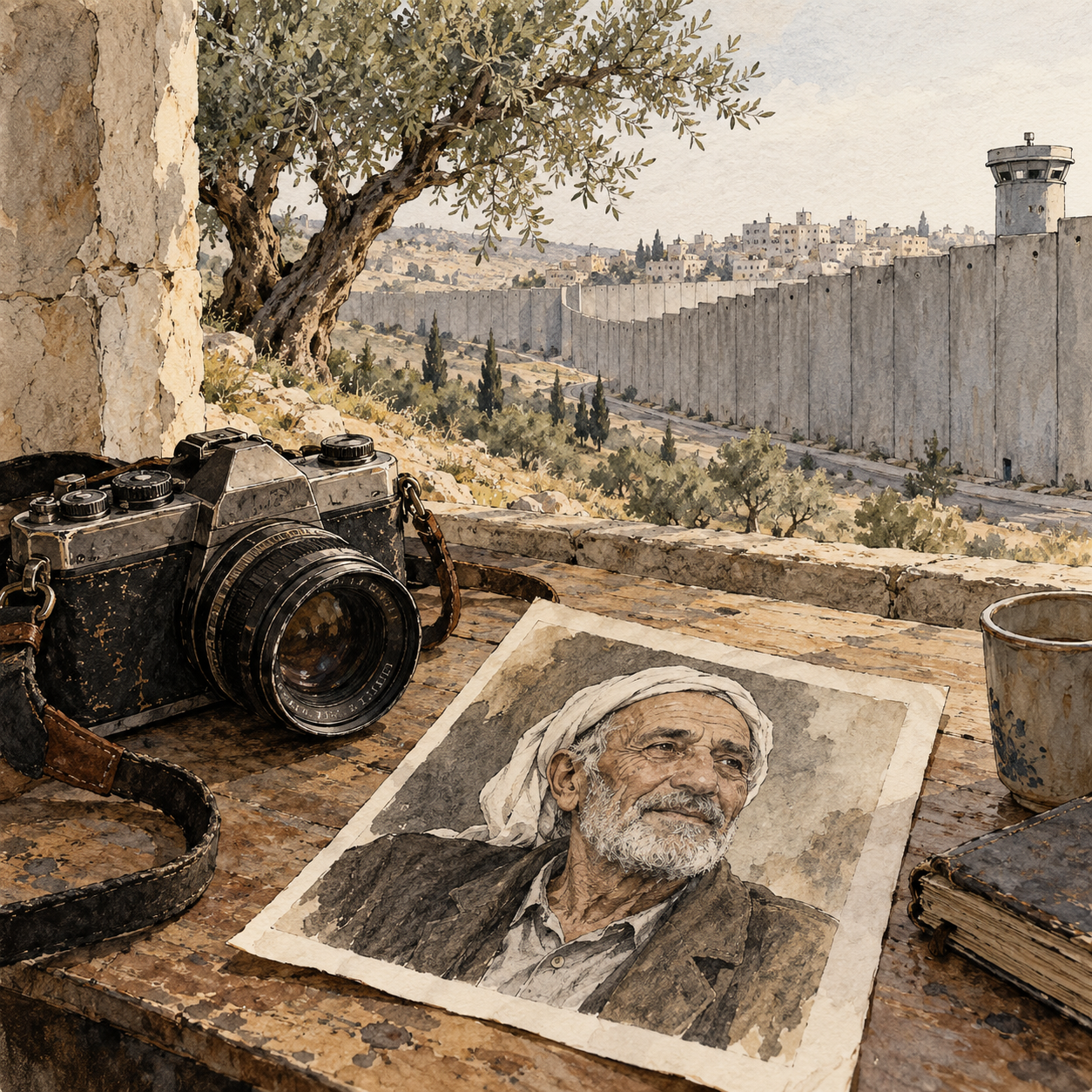
Accompanying illustration: AI-generated editorial artwork depicting an invented scene.

