
An Old Photographer discussion
There is a particular frustration in going out with a camera and coming home having barely used it. You walked the streets. The light was reasonable. There were people everywhere. Yet very little persuaded you to lift the camera to your eye.
Afterwards, you begin the interrogation. Have I become lazy? Have I photographed this place too often? Have I finally run out of things to say?
After more than 45 years of making pictures, I can still find myself wondering where the appetite has gone. Photography has occupied too much of my life for an empty morning to pass entirely without comment. I remember outings when the next picture seemed to arrive before I had finished with the last. A quiet spell can make that earlier enthusiasm feel a long way off.
The sensible response begins with giving the lull some attention. What, exactly, has become difficult? Leaving the house? Carrying the camera? Finding a subject? Deciding whether anything you have made is worth keeping? Those are different problems, and each suggests a different change.
Sometimes the task we set ourselves has simply become too large. “Go out and make some good photographs” sounds straightforward until you consider everything hidden inside it. Find something interesting. Respond quickly. Compose it properly. Get the expression. Keep the background under control. Then bring home something that justifies the effort.
It is quite an assignment to attach to a morning walk.
For a while, I would make the assignment smaller. Choose a single thing to notice. People waiting between customers. Hands arranging a display. Someone listening while another person speaks. The way a doorway frames a conversation. These give your attention somewhere specific to settle.
Take the idea seriously enough to return to it, but keep it loose enough to follow an unexpected photograph. A subject is there to start you looking. It need not dictate everything you do.
Familiar streets can contribute to the trouble. Once you know a route well, you begin to recognise it in advance. You know where the market becomes crowded, where the light strikes a wall and where somebody usually sits. Recognition can become so efficient that you stop examining what is actually in front of you.
Before deciding that you have exhausted a neighbourhood, change your appointment with it. Visit earlier. Arrive when people are opening their stalls. Return when the day’s business is winding down. Walk the route in the opposite direction. A shopfront you normally approach from one side may give you a different arrangement of light and background from the other.
Sometimes a different part of the city will help. Choose somewhere manageable, with enough room to stop and watch. A modest change of surroundings can give you fresh decisions to make without turning the outing into an expedition.
There is also a great deal to be said for sitting down.
Walking gives you variety, but it also moves you away from developing situations. At a cafe or a market edge, you can watch a small area long enough to learn its rhythm. You see who comes and goes, where people pause and how the light travels across the space. You have time to notice the background before somebody enters it.
Give yourself twenty minutes. Let the coffee get cold if necessary. That would be unfortunate, although probably less expensive than buying another lens.
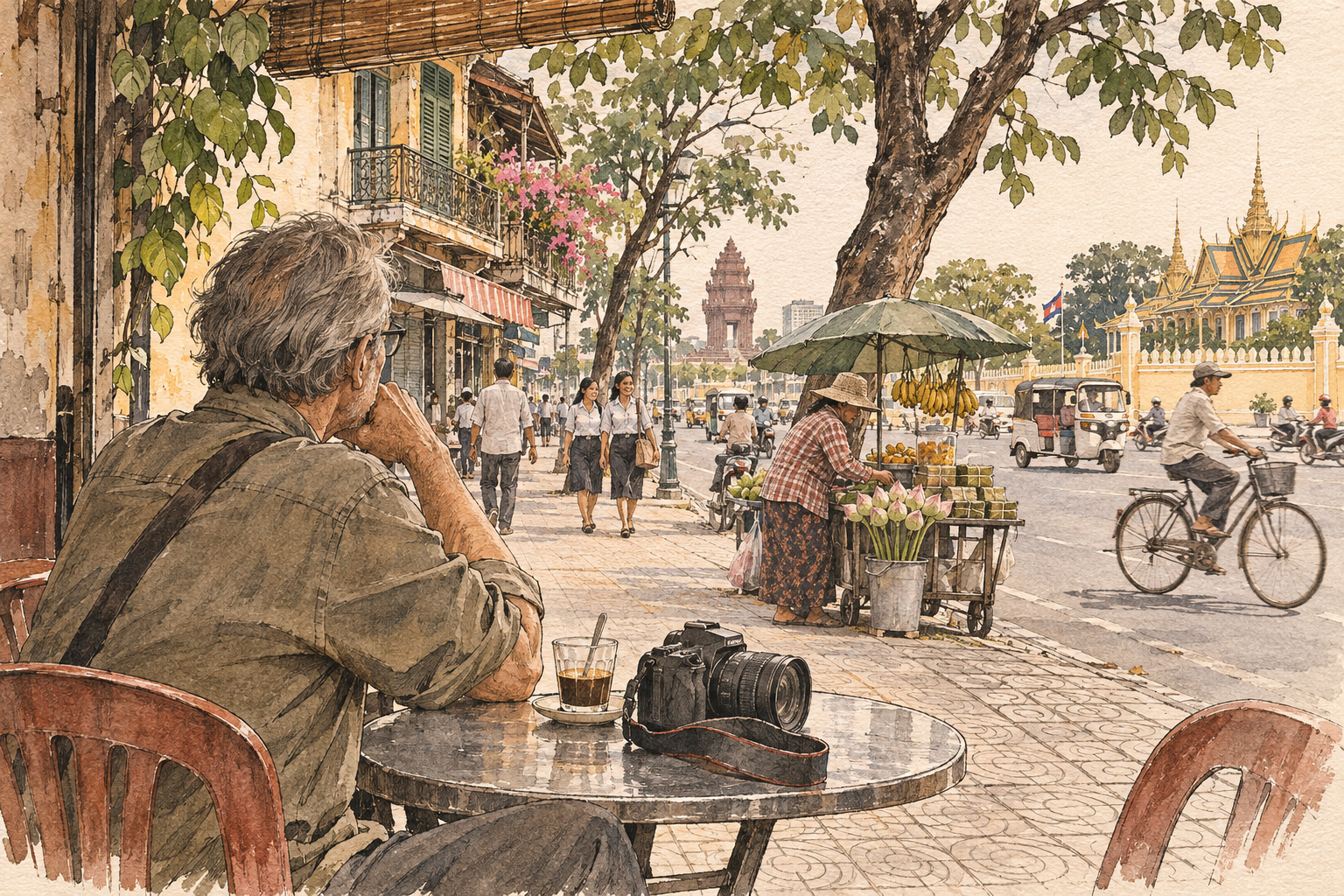
Accompanying illustration — a fictional photographer observing a Phnom Penh street from a cafe. AI-generated editorial artwork.
Equipment deserves a little thought, chiefly because it determines how easy the outing will be. I have plenty of affection for my old Nikon D700. Familiarity with a camera saves a considerable amount of fiddling. I know how it sits in my hands, and that makes it a comfortable starting point when enthusiasm is in short supply.
Choose a lens that suits the way you want to work that day. An 85mm gives me a working distance I enjoy for street photography. Someone wanting more of the surrounding scene may prefer a wider lens. The useful question is whether the combination encourages you to carry it and raise it when a picture begins to form.
If weight has become an obstacle, take something lighter. A small camera or a phone can make an outing easier to begin. Removing a practical difficulty is often more productive than arguing with yourself about motivation.
During a lull, the edit can become another source of discouragement. You return home, open the files and dismiss the lot within minutes. Perhaps you had expected a breakthrough. Perhaps you are comparing an ordinary Tuesday morning with the best photographs from several decades.
That comparison deserves scrutiny. A lifetime’s favourites have survived years of selection. Today’s files have barely reached the screen.
Give the new pictures some time. Look once for obvious mistakes, then return later to examine expressions, relationships and small details. Ask which frame makes you pause. You may find something worth developing even when the outing has produced no finished photograph.
Looking through older work can also help, especially the pictures surrounding a familiar favourite. Contact sheets show the attempts, the changes of position and the frames where something almost happened. They restore a little honesty to our memory of how photographs get made.
A picture rejected years ago may interest you now. Your eye may settle on a gesture you once overlooked, or on a person at the edge of a frame. Your interests have had time to change. Let the old work reveal that change.
Then print something.
Printing has always been part of my process. A photograph on paper asks for a different kind of attention. You can put it on a table, walk past it and return without opening an application or scrolling through a hundred competing images.
Choose a modest size. Leave the print where you can see it for several days. Notice whether your interest lasts, where your eye goes and whether some small part of the picture begins to trouble you. Those observations can suggest what to look for next time you go out.
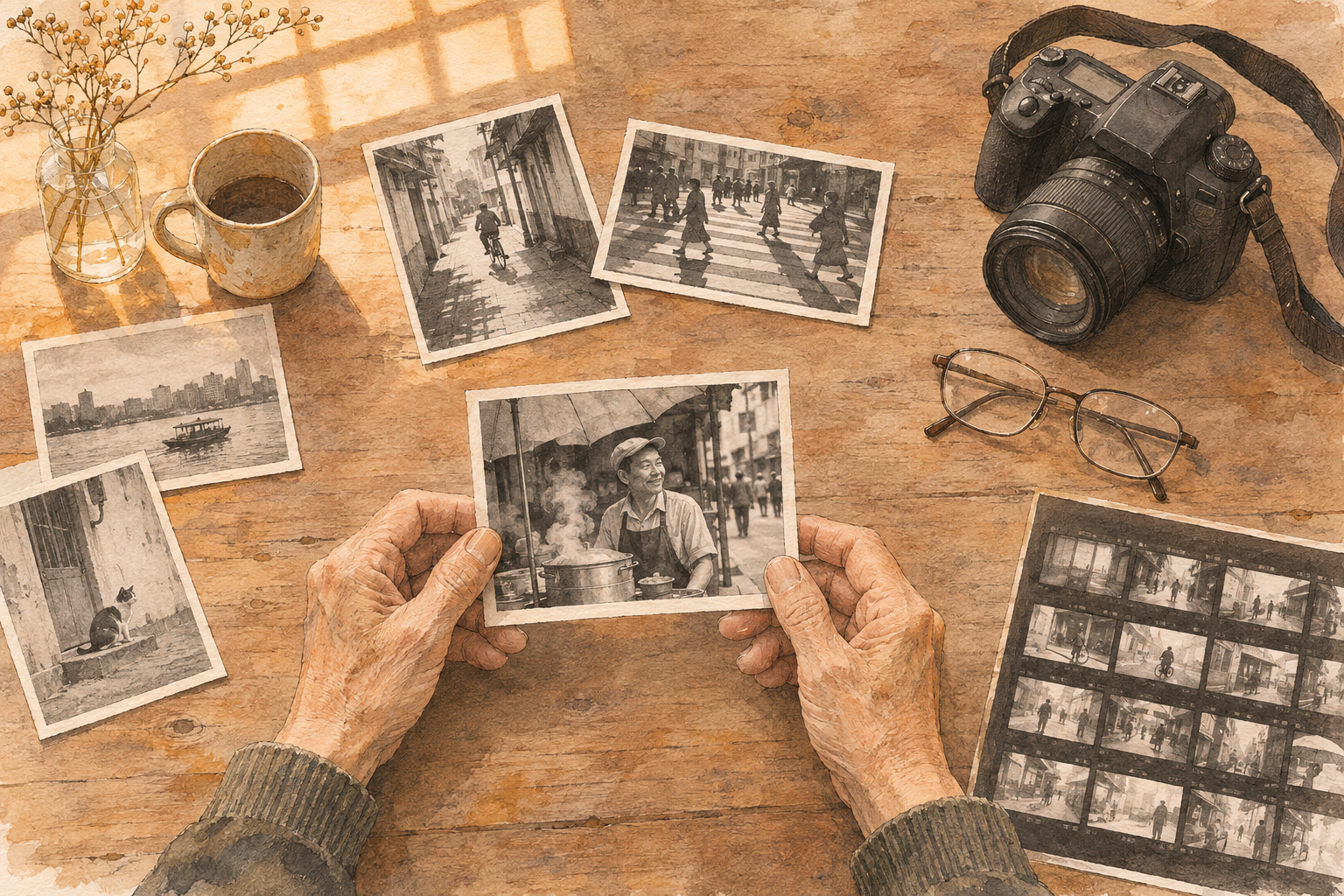
Accompanying illustration — reviewing small prints and contact sheets at a table. AI-generated editorial artwork.
A small project can give that next outing a purpose. Photograph one market over several visits. Follow the working day of a willing local business owner. Make a short sequence about the places where people rest. Set an attainable end point, perhaps six photographs that belong together.
Returning gives you something to build on. The first visit helps you understand the place. Later visits let you refine your position, recognise recurring activity and develop a relationship with people who are comfortable being photographed.
That relationship needs care. Your wish to escape a creative rut gives nobody else an obligation to participate. Read people’s responses, explain your interest when appropriate and accept a refusal. If somebody is vulnerable or having a difficult moment, think carefully about what making and publishing the picture would ask of them.
A willing participant and an ordinary working day can provide plenty to photograph. Allow the interest to grow through familiarity and attention.
It also helps to give yourself some privacy while the work develops. Keep a few outings for your own consideration. Decide what you think of the photographs before inviting a stream of immediate verdicts. A small project can lose direction when every frame is judged separately for its ability to attract a response online.
There will still be days when the sensible decision is to leave the camera at home. Energy varies. Other responsibilities take up room. Photography can become another demand when you have very little available to give it.
Take a break that you can actually enjoy. Look at a book slowly. Visit an exhibition if one interests you. Spend time with somebody whose company you like. Let a walk be a walk. You can decide later whether any of it belongs in your photography.
For the next outing, keep the arrangement simple. One comfortable camera. A place you can reach easily. One subject to watch. Enough time to settle, with permission to go home when you have had enough.
If something catches your attention, stay with it for a while. Change your position. Examine the edges. Wait to see whether the relationship between the people changes. Make the picture when you have a reason to press the shutter.
Back home, ask yourself what you would like to return to. A particular stall, a patch of afternoon light, a conversation you would like to continue. Write it down before you forget. That gives your next morning somewhere to begin.

