
Three Attempts to Keep the Photographer Looking
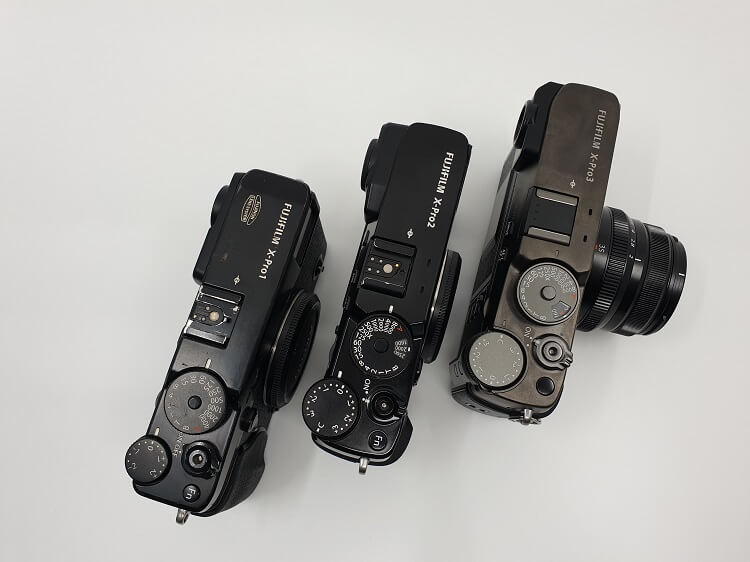
From left to right: the X-Pro1, X-Pro2 and X-Pro3. The family resemblance remained, but Fujifilm changed the experience considerably between generations.
The three Fujifilm X-Pro cameras look remarkably similar.
Place them together on a table and they appear to be variations on one stubborn idea: a rectangular camera, a viewfinder pushed into the corner and proper controls placed where a photographer expects to find them.
Pick them up and use them, however, and the differences become clearer.
The X-Pro1 was an imperfect beginning. The X-Pro2 turned the original idea into a dependable working camera. The X-Pro3 then became more opinionated, hiding its main screen and asking the photographer to accept Fujifilm’s philosophy as part of the purchase.
All three were built around the same question:
Can a digital camera provide modern convenience without constantly distracting us from the photograph?
None answered it perfectly. That is partly what makes them interesting.
The Original Idea
Fujifilm released the X-Pro1 in 2012 as the first interchangeable-lens camera in its X series. It introduced the company’s 16.3-megapixel APS-C X-Trans sensor and combined it with physical controls, film simulations and an unusual hybrid viewfinder.
It arrived when mirrorless cameras were still trying to establish what they were.
Some resembled small DSLRs. Others looked like enlarged compact cameras. The X-Pro1 took a different route. It borrowed the shape and working arrangement of a traditional rangefinder while remaining an autofocus digital camera.
It was not a rangefinder. There was no mechanical focusing patch and no direct connection between the lens and optical finder.
What it offered was a choice between an electronic viewfinder and an optical window with illuminated frame lines.
The electronic view showed what the sensor would record. The optical finder allowed the photographer to see beyond the edge of the frame.
For street work, that mattered.
A person could be seen approaching before entering the photograph. A gesture developing outside the frame did not remain hidden until it was too late. Instead of watching the world through a tunnel, the photographer retained some awareness of the surrounding scene.
That was the idea.
The reality was slower.
The X-Pro1: Beautiful Files, Hesitant Camera
The first X-Pro was not a fast machine.
Its autofocus could hesitate even in reasonable light. In darker streets it sometimes appeared to consider the situation, consult its solicitor and then decide whether focusing was worth the trouble.
Firmware updates improved it, particularly when paired with newer lenses, but they could not transform an early mirrorless focusing system into a modern one.
For portraits, travel, quiet streets and subjects that remained in approximately the same place, it worked. For children, demonstrations or rapidly changing situations, it could become frustrating.
We should not romanticise that.
There is a fashionable belief that a slow camera makes the photographer more deliberate. Sometimes it does. Sometimes it simply misses the picture.
Yet the X-Pro1’s files remain attractive. Sixteen megapixels is modest by current standards, but it is sufficient for good prints, publication and ordinary photographic work. The original X-Trans sensor omitted an optical low-pass filter, allowing it to extract convincing detail from that resolution.
Its photographs have colour and tonal transitions that many photographers still enjoy. They are often described as film-like, although that phrase has been exhausted by reviewers trying to make digital cameras sound romantic.
The X-Pro1 does not produce film photographs.
It produces pleasing digital files without making every face appear clinically inspected. That is enough.
With the small 18mm f/2 or 35mm f/1.4 lenses, it becomes a quiet and satisfying camera. The photographer learns its rhythm, focuses slightly ahead of the moment and stops expecting it to behave like something designed yesterday.
Its limitations are real, but so is its appeal.
The X-Pro2: The Working Camera
The X-Pro2 was the camera the original model had been trying to become.
Resolution increased to 24.3 megapixels. Autofocus became faster and more dependable. The body gained weather sealing, a second card slot and a more developed hybrid finder. The electronic display contained 2.36 million dots, while the optical finder offered two magnifications to suit different focal lengths.
These were substantial improvements, but the important change was not found in a specification.
The X-Pro2 felt ready for work.
It retained the rectangular shape, traditional controls and viewfinder position, but fewer of its quirks stood between the photographer and the picture. It was still slower than the best professional DSLRs of its time, yet it no longer demanded an excuse every time the subject moved.
The files were large enough to permit reasonable cropping without encouraging laziness. Image quality was entirely sufficient for professional publication and substantial prints.
Twenty-four megapixels remains enough now.

New cameras have not reduced the information contained in an older file. They have merely given photographers additional resolution, much of which is spent correcting decisions that should have been made before the shutter was released.
Cropping is a legitimate part of photography. Relying upon it as a substitute for framing is something else.
The X-Pro2 also introduced Acros, Fujifilm’s more sophisticated black-and-white simulation. It could produce restrained monochrome JPEGs with convincing tonal separation, though it could not decide whether a photograph deserved to be black and white.
No simulation can make an empty photograph meaningful.
The Most Balanced of the Three
The X-Pro2 may be the least romantic member of the family, and perhaps the best.
The rear screen remains visible. Photographs can be checked without unfolding anything. The optical finder is there when it suits the subject, while the electronic finder is available when precise framing or exposure matters more.
The camera offers a point of view without imposing a doctrine.
That makes it particularly appropriate for street work. With a compact 23mm, 27mm or 35mm lens, it is unobtrusive without pretending to be invisible. Its shutter is quiet, the body lies flat against the photographer and the essential controls can be adjusted without extensive menu work.
The combined ISO and shutter-speed dial is less convincing. Changing ISO requires lifting and turning the outer collar. It is a handsome piece of engineering that makes a simple adjustment slightly awkward.
Fortunately, Auto ISO works well.
Set an appropriate minimum shutter speed, choose the aperture and use the exposure-compensation dial as the light changes. Then stop fiddling.
The camera has done its part.
The X-Pro3: A Camera with an Opinion
The X-Pro3 arrived in 2019 with a 26.1-megapixel X-Trans CMOS 4 sensor, improved autofocus, a higher-resolution electronic viewfinder and titanium top and bottom plates.
Those were sensible improvements.
Then Fujifilm hid the screen.
The main monitor faces inward when folded against the body. On the outside is a small secondary display that can show basic settings or a graphic resembling the end of a film box. To review photographs or use the main screen, it must be folded down.
Some photographers considered this inspired. Others thought it absurd.
Both positions are understandable.
Fujifilm wanted photographers to stop looking at the last picture and return their attention to the next one. Constantly reviewing every exposure can become a nervous habit. It interrupts observation and replaces confidence with reassurance.
But checking an important frame is not a moral failure.
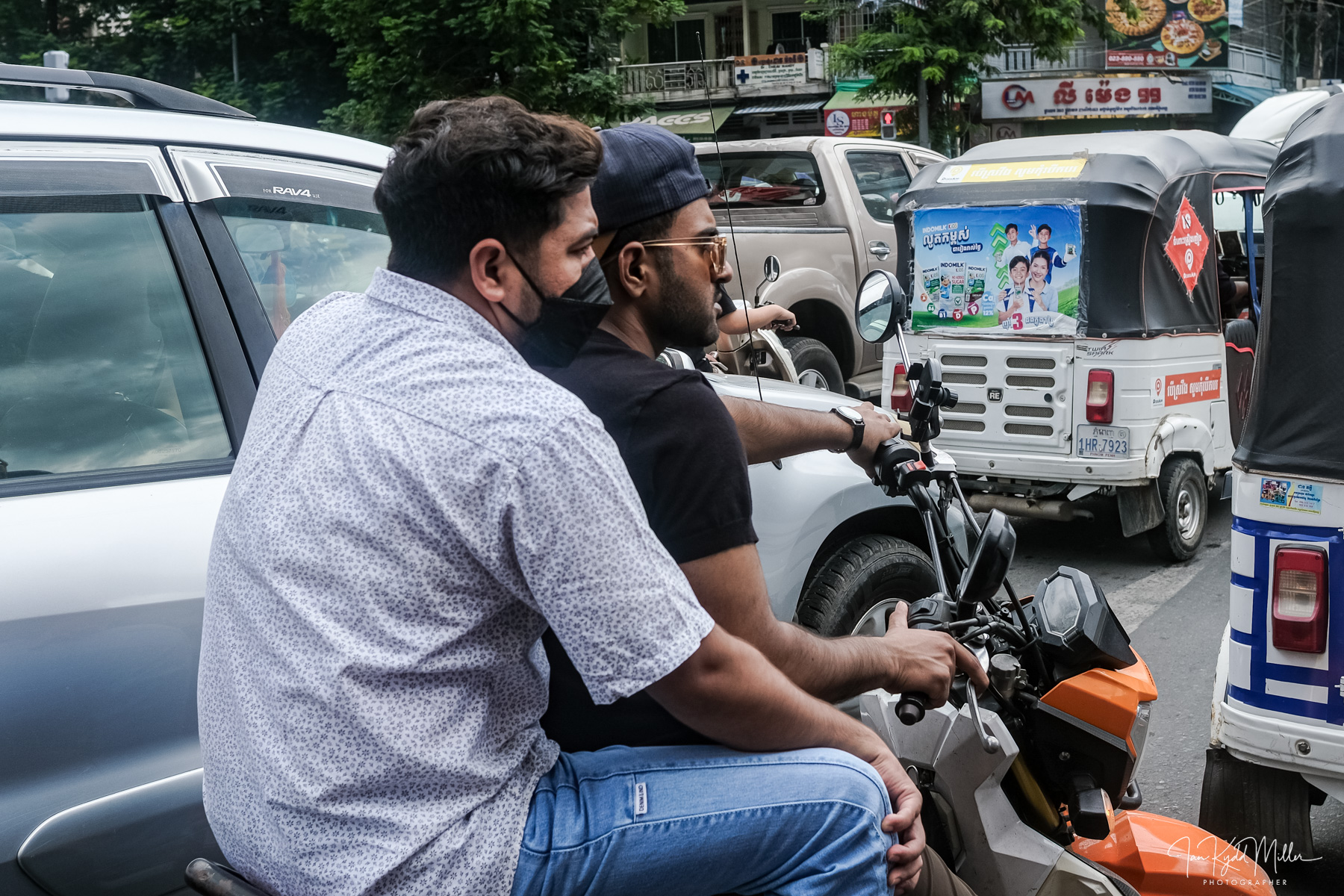
A working photographer may need to confirm focus, expression or exposure. There is no virtue in returning home with a failed photograph merely because the camera encouraged behaviour resembling 1975.
The hidden screen does not make the X-Pro3 more authentic. It simply changes the inconvenience involved in reviewing an image.
For some photographers, that inconvenience creates discipline. For others, it creates irritation.
Three Cameras, Three Temperaments
| Camera | Character | Strength | Compromise |
|---|---|---|---|
| X-Pro1 | Slow, original and imperfect | Pleasing files and the purest expression of the idea | Hesitant autofocus and dated operation |
| X-Pro2 | Practical and balanced | Best combination of hybrid finder, controls and usability | Older autofocus and no stabilised body |
| X-Pro3 | Fastest and most opinionated | Improved sensor, finder and responsiveness | Hidden screen and a design that dictates behaviour |
All three use APS-C sensors and interchangeable Fujifilm X-mount lenses. None has in-body image stabilisation. Stabilisation, where available, must come from the lens.
That matters less with short prime lenses in good light. It matters considerably more when working slowly in dark interiors or attempting to hold longer lenses steady.
The X-Pro cameras make most sense with compact primes.
A 23mm lens provides a moderately wide view suitable for busy streets and environmental portraits. The 27mm is extremely compact. A 35mm gives approximately the angle of view of a 50mm lens on full frame and encourages a slightly more selective way of looking.
Large zoom lenses can be fitted, but they interfere with the optical finder and disturb the balance of the body.
This is not because prime lenses are morally superior. They simply suit these cameras.
The Optical Finder and the Street
The optical finder is the feature that separates the X-Pro line from most other interchangeable-lens mirrorless cameras.
It permits the photographer to see outside the approximate frame, but that freedom comes with imprecision. The finder does not look through the lens. Framing changes as the camera focuses closer, and parallax becomes more important at short distances.
The photographer must accept that the bright frame is a guide rather than a promise.
That can feel untidy after years of precise electronic viewing. It can also be liberating.
Street photography rarely waits for geometrical certainty. People move. Cars enter the background. Hands rise and disappear. Expressions change before the autofocus box has finished congratulating itself.
Seeing beyond the frame helps the photographer anticipate these changes.
The electronic finder remains better for exact composition, longer lenses, close subjects and difficult exposure. There is no prize for refusing to use it.
The switch between the two finders is not a contest between traditional and modern photography. It is simply a choice of tool.
Discretion and Responsibility
The X-Pro cameras are regularly described as discreet.
They are smaller and quieter than professional DSLRs carrying large zoom lenses. Their rectangular bodies attract less attention and do not announce themselves in quite the same way.
But discreet is not invisible.
People can see the photographer. They may understand what is happening and decide that they do not want to be photographed. A small black camera does not remove responsibility, and rangefinder styling does not confer ethical permission.
The same questions apply with every camera:
What am I photographing?
Why am I photographing it?
Does the frame preserve context, or does it manufacture drama?
Am I recognising another person’s experience, or using their difficulty as decoration?
A camera cannot answer those questions. Autofocus detection will identify an eye, but it cannot decide whether the person should be photographed.
Sometimes the correct response is to make the picture.
Sometimes it is to speak first.
Occasionally it is to lower the camera.
Film Simulations and the Search for Authenticity
Fujifilm’s film simulations are one reason these cameras remain popular.
They provide useful colour and monochrome starting points, especially for photographers who want finished JPEGs rather than an evening spent moving sliders. Classic Chrome, Acros and later Classic Negative can all be effective.
They do not reproduce film exactly, nor do they need to.
A film simulation cannot provide timing, composition or emotional weight. It cannot turn weak light into strong observation. It cannot make a decorative street scene socially important.
Use the simulations because they suit the photograph.
Do not use them to manufacture nostalgia.
An old-looking JPEG of a badly observed subject remains a badly observed photograph.
Which One Would I Choose?
The X-Pro1 is the choice for someone prepared to accept slow operation because they particularly enjoy its files and original character. It is best treated as a deliberate camera rather than an inexpensive route into fast street photography.
The X-Pro3 is for photographers who understand and actively want its unusual screen arrangement. Buying it while hoping to tolerate the design would be a mistake. Its eccentricity is not an incidental detail. It is the camera’s central argument.
The X-Pro2 is the sensible choice.
It preserves the hybrid finder, traditional controls and compact working style without turning inconvenience into philosophy. It is fast enough for most ordinary street work, produces excellent files and permits the photographer to check the rear screen without performing a small ceremony.
That does not automatically make it the most interesting of the three.
It makes it the one most likely to disappear during use.
For a working camera, that is high praise.
Buying Any of Them Used
All three models are discontinued, making condition and price more important than reputation.
Check the hybrid-viewfinder selector carefully. Test both optical and electronic modes. Inspect the sensor, lens mount, command controls, card slots and battery compartment. Confirm that the frame lines respond properly when different lenses are attached.
With an X-Pro3, inspect the folding-screen mechanism and ribbon connection particularly carefully. With an X-Pro1, test autofocus in poor light rather than beneath the flattering illumination of a camera shop.
Budget for batteries. Old batteries can show a full charge and then collapse with the suddenness of a disgraced politician.
Cosmetic wear is not necessarily important. A working camera will collect marks.
But scratches are not proof of character, and age is not proof of quality.
Pay for condition and function—not somebody else’s nostalgia.
What the Three Cameras Got Right
The X-Pro1, X-Pro2 and X-Pro3 are not the fastest, most efficient or most technically complete cameras of their respective generations.
Their importance lies elsewhere.
They were designed around looking.
The corner-mounted finder leaves the photographer’s face less completely hidden. The optical view permits awareness beyond the frame. The physical controls allow the camera to be prepared before it reaches the eye. Small lenses keep the equipment from becoming the event.
The X-Pro1 established the idea but struggled to keep pace with life.
The X-Pro2 refined it into a dependable working camera.
The X-Pro3 pushed it into something more deliberate, controversial and personal.
None will make anybody a better photographer.
They cannot provide curiosity, patience, courage or empathy. They cannot tell us where to stand, when to release the shutter or when another human being deserves to be left alone.
What they can do—once learned—is become quiet.
The controls fall to hand. The viewfinder opens onto the street. The machinery recedes and attention moves outward, towards faces, gestures, light and the brief arrangements that will never occur in precisely the same way again.
The camera is not the photograph.
The best cameras eventually help us forget that they are there.