


Old Photographer Series.
The Canon 5D Mark II arrived in 2008 carrying what then seemed an extraordinary 21-megapixel full-frame sensor. Today, surrounded by cameras offering twice the resolution, rapid electronic shutters and autofocus systems capable of finding an eye in a crowd, it appears rather ordinary.
It is not ordinary.
The 5D Mark II came from a period when digital cameras were becoming genuinely mature but had not yet become computers with lenses attached. It has enough technology to do serious work, but not so much that the photographer becomes a passenger.
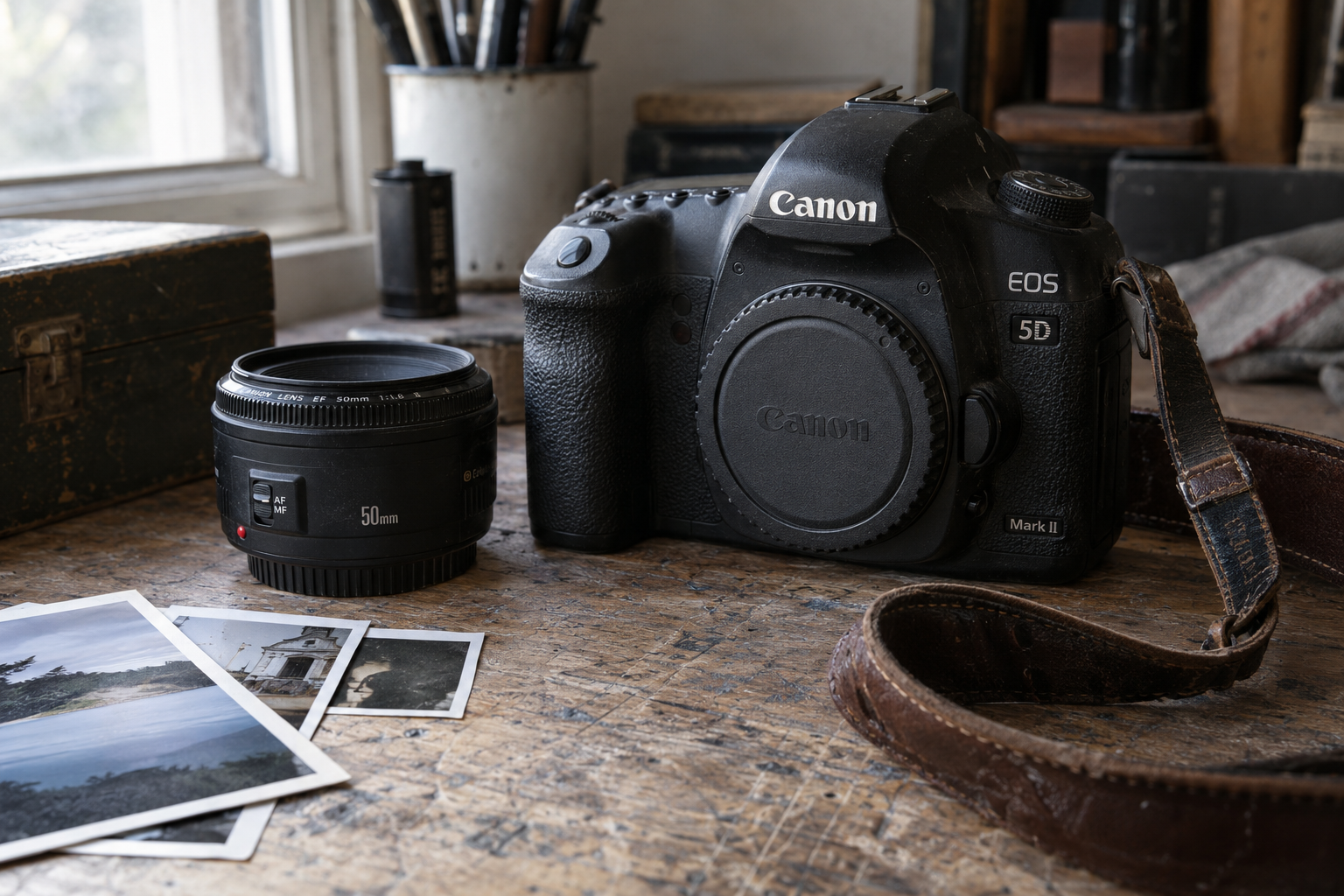
There are weaknesses. The autofocus system is primitive by modern standards, particularly away from the central point. Its continuous shooting is leisurely. The rear screen is adequate rather than beautiful, and lifting deep shadows soon reveals the limits of the sensor. Anyone expecting the camera to correct poor timing, careless exposure or uncertain focusing will be disappointed.
That is also part of its appeal.
The 5D Mark II asks the photographer to pay attention. The central autofocus point is the dependable one, so you learn to use it properly. Exposure needs to be reasonably accurate. Highlights require watching because lost detail does not return easily. With moving subjects, anticipation matters more than frame rate.
This is not punishment. It is photography.
The camera feels reassuring in the hand. The body is substantial without reaching the weight of a 1-series Canon. The controls are straightforward, the viewfinder is large enough to work through comfortably, and the rear control wheel remains one of Canon’s finest ideas. Once familiar with it, the camera can be operated without much conscious thought.





Its shutter has a proper mechanical presence. Press the button and something happens. There is no silent electronic whisper and no burst of twenty nearly identical files. One exposure feels deliberate.
The image quality still holds up remarkably well. At lower ISO settings, the files contain excellent detail, natural colour and enough tonal depth for careful processing. Skin tones are especially pleasing. There is a gentleness to the pictures that suits portraits, documentary work and photographs made in ordinary light.

The 5D Mark II does not produce the clinically perfect files of newer cameras. Its shadows can become rough and its higher-ISO images carry visible noise. Yet photographs are not improved simply by having every imperfection removed. A little texture is not fatal. Sometimes it helps a picture retain the feeling of the moment in which it was made.
With a 35mm or 50mm lens, the camera becomes a simple and capable working tool. An 85mm lens turns it into a fine portrait camera. Good Canon L-series lenses suit it, naturally, but it does not require expensive glass to make worthwhile photographs. A modest prime and careful technique will usually achieve more than an impressive lens used without thought.
The camera also changed moving-image work. Its ability to record full-frame high-definition video helped place cinematic-looking footage within reach of independent filmmakers and working photographers. That part of its history is important, although for me its lasting value remains in the still photographs.
Using one now requires a modest change of pace. Batteries, CompactFlash cards and older menus remind us that this is no longer a current machine. There is no tilting screen, no in-body stabilisation and no electronic viewfinder showing the finished exposure before the shutter is released.
You look through the viewfinder, judge the light and make the photograph.
That still works.
The Canon 5D Mark II is cheap on the used market because technology has moved forward and fashion has moved even faster. Condition matters more than age. A heavily used professional body may have lived a hard life, while a carefully owned example can still provide years of service. Check the shutter, card slot, control wheels, autofocus and sensor before buying. Beyond that, it is a straightforward and durable camera.





Would I recommend it to everybody in 2026? No. A photographer needing dependable subject-tracking, silent operation, strong low-light performance or fast action coverage should look elsewhere. Modern cameras make those jobs considerably easier.
But ease is not the only measure of a camera.
For portraits, considered street work, documentary photography and the simple pleasure of making pictures, the 5D Mark II remains entirely capable. Its limitations are clear, but they are honest limitations. You quickly learn what the camera can do and then get on with using it.
It comes from a time when a camera was expected to provide a good sensor, a clear viewfinder, dependable controls and somewhere to attach a lens. The photographer was expected to supply the rest.
The Canon 5D Mark II will not find the photograph for you. It will not rescue every mistake or produce endless variations from which one acceptable frame might be selected.

It simply waits in your hands.
When the light, subject and timing come together, it makes the picture.
That was enough in 2008.
For a photographer who still values attention over automation, it remains enough today.

