Keeping Things Clean: Lens and Camera

cameras, canon, fujifilm, Lenses, Lowepro, nikon, opinons, thoughts, photography, street, Travel

Old Photographer Series

Photographers will argue for hours about sharpness, contrast, autofocus speed and whether one lens has more character than another. Then they will pull a camera from a filthy bag, wipe the front element with the corner of a shirt and wonder why their photographs look as though they were taken through a bus window.
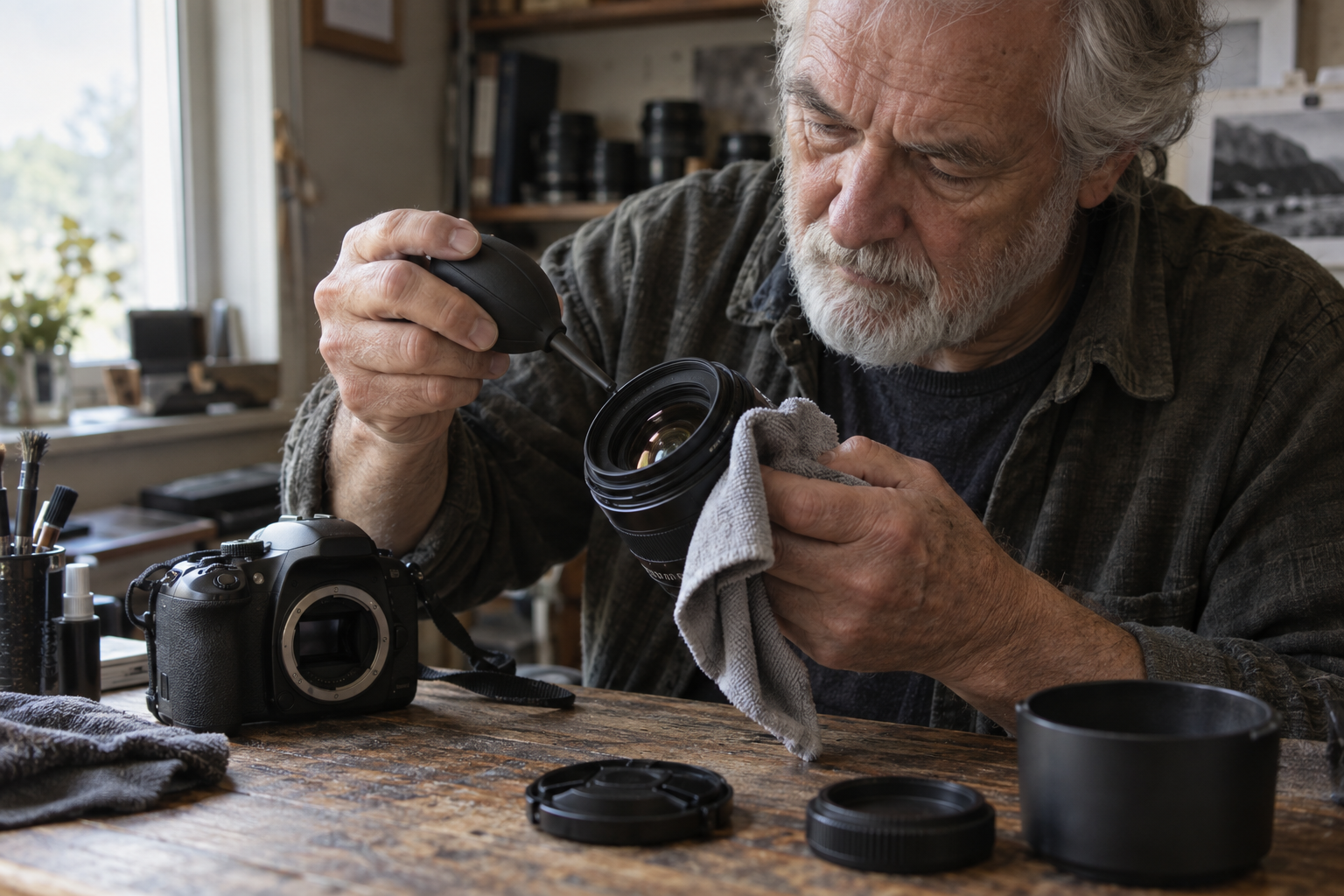

An older man carefully cleaning a camera lens with a cloth while holding a blower in his other hand. A camera is visible on the table along with various photography tools and accessories.

Keeping equipment clean is not glamorous, but neither is spending an afternoon removing dust spots from a clear blue sky.

I have never believed cameras should be treated like museum pieces. A working camera will collect dust, fingerprints, sweat and the occasional splash of something best left unidentified. That is part of using it. Cameras are tools, and tools acquire marks. There is a difference, however, between honest wear and simple neglect.

The first rule is not to clean everything unnecessarily. Constant polishing can cause more trouble than it prevents. A few specks of dust on the front of a lens will rarely affect a photograph, while enthusiastic rubbing with the wrong material can damage the coatings permanently.

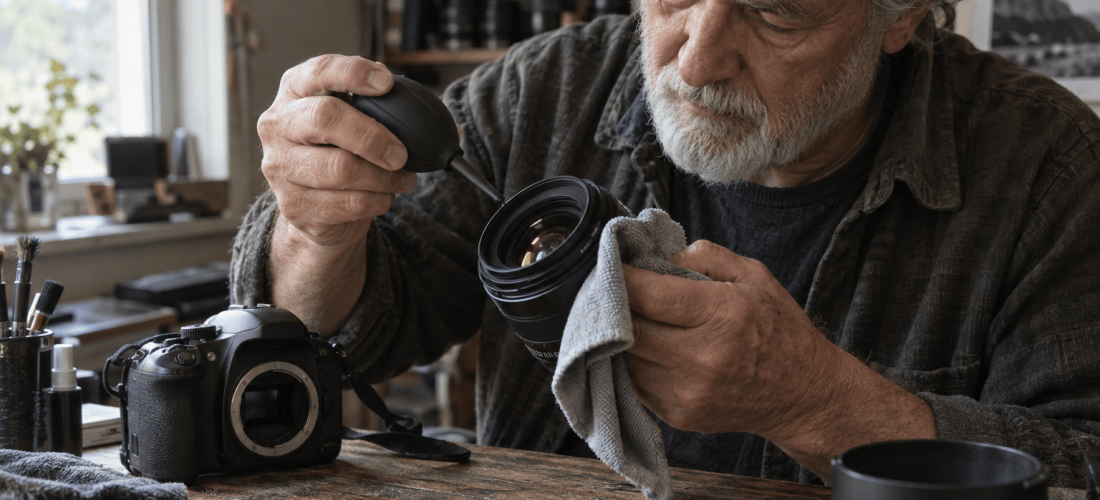
Start with a blower. Hold the camera or lens so that loose dirt can fall away, then use several gentle bursts of air. Never blow on a lens with your mouth. Saliva droplets are harder to remove than dust, and breath leaves moisture behind.
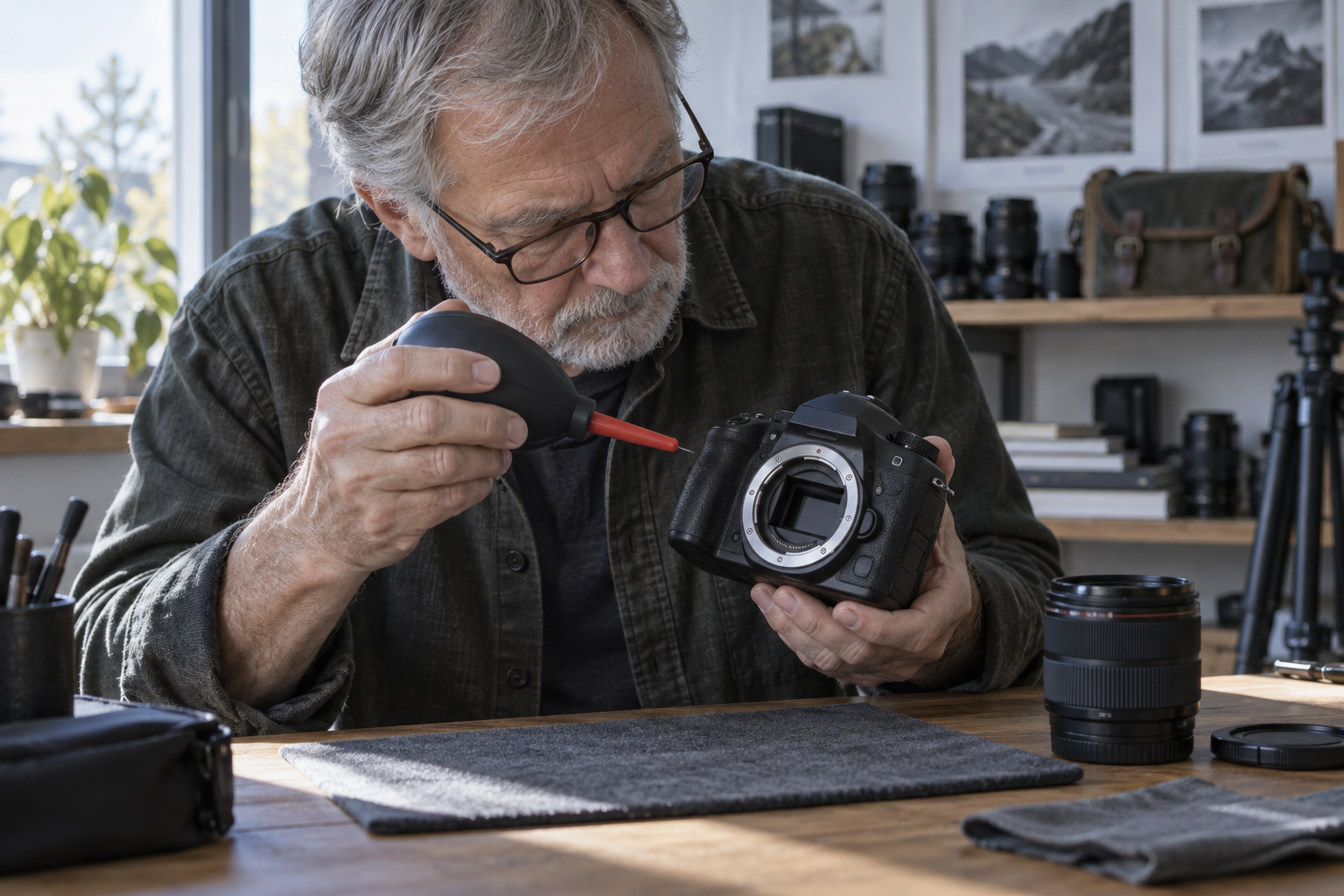

An older man cleaning a camera with a blower in a well-lit workspace, surrounded by photography equipment.

If marks remain, use a clean microfibre cloth or proper lens tissue. Apply a small amount of lens-cleaning fluid to the clothโ€”not directly to the glassโ€”and wipe gently from the centre outwards. One or two drops are enough. Flooding a lens with liquid risks sending it around the edges of the element or into the barrel.

Fingerprints should be removed reasonably quickly because skin oils can cling stubbornly to lens coatings. Dust can usually wait. Grit and sand cannot. If you have been photographing near a beach, building site or dusty Cambodian road, blow everything thoroughly before touching it with a cloth. Dragging a grain of sand across the glass is an excellent way of turning cleaning into permanent damage.
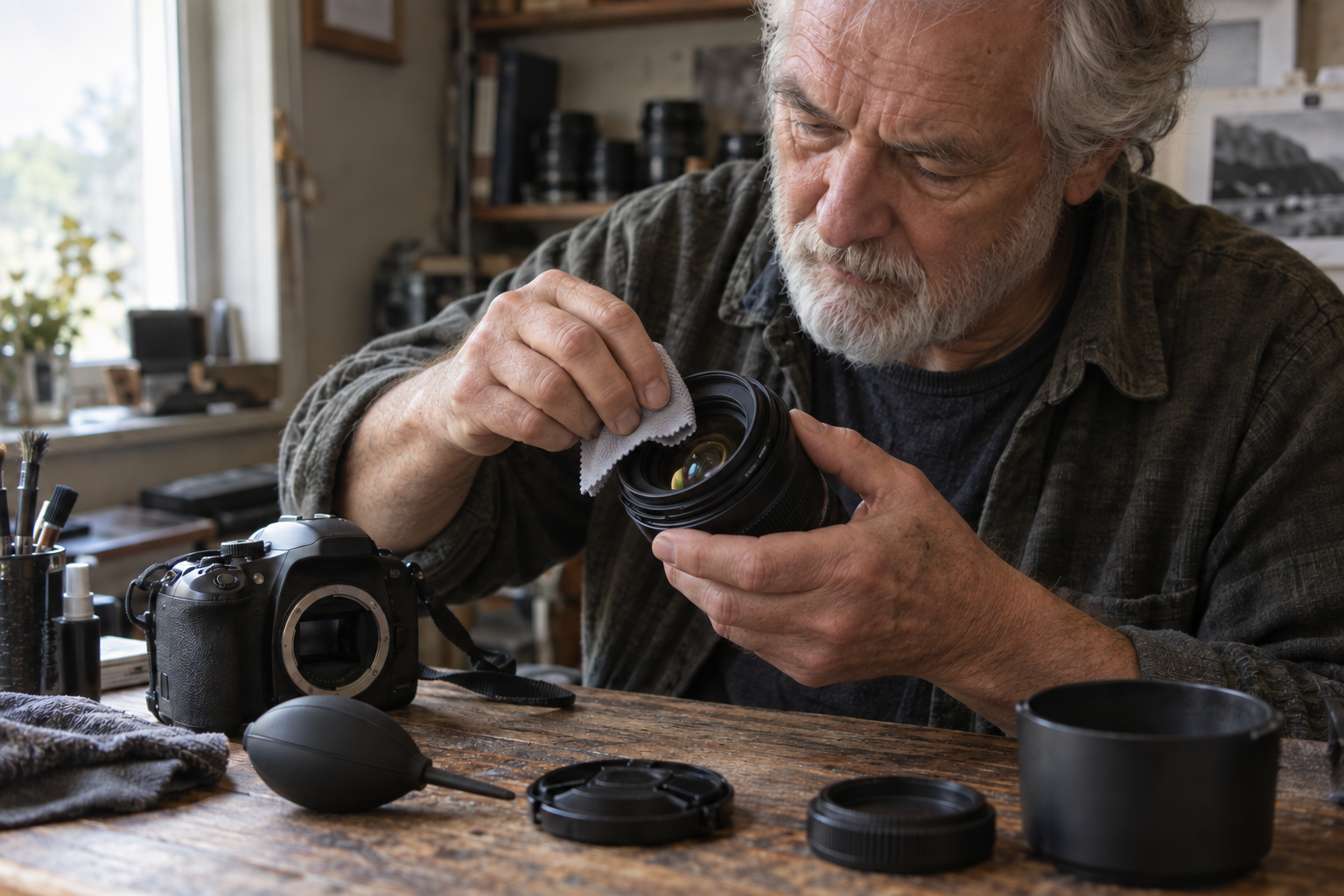

An older man carefully cleaning a camera lens with a cloth in a well-lit workshop, surrounded by camera equipment and tools.

Lens filters need the same treatment. A filthy protective filter can reduce contrast and produce flare long before the lens behind it becomes a problem. Sometimes the simplest improvement in image quality is to remove a cheap, smeared filter altogether.

The camera body can be cleaned with a soft brush, blower and slightly damp cloth. Pay attention to buttons, control wheels, the viewfinder surround and the rubber grips. These collect sweat and grease, especially in hot weather. Cotton buds can be useful around awkward edges, but they should never be poked inside the camera.

Before changing lenses, switch the camera off and have the replacement ready. Point the lens mount slightly downwards and make the change promptly, without turning it into a panic. A camera does not need to be protected from every molecule of dust, but leaving it open on a table while searching through the bag is asking for trouble.

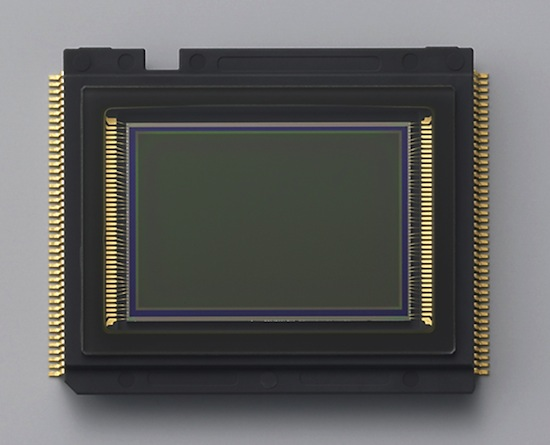
Sensor dust is different. It usually appears as dark, soft-edged spots, most clearly visible in plain areas photographed at small apertures such as f/11 or f/16. Before blaming the sensor, check whether the same spots appear in several photographs and with different lenses.
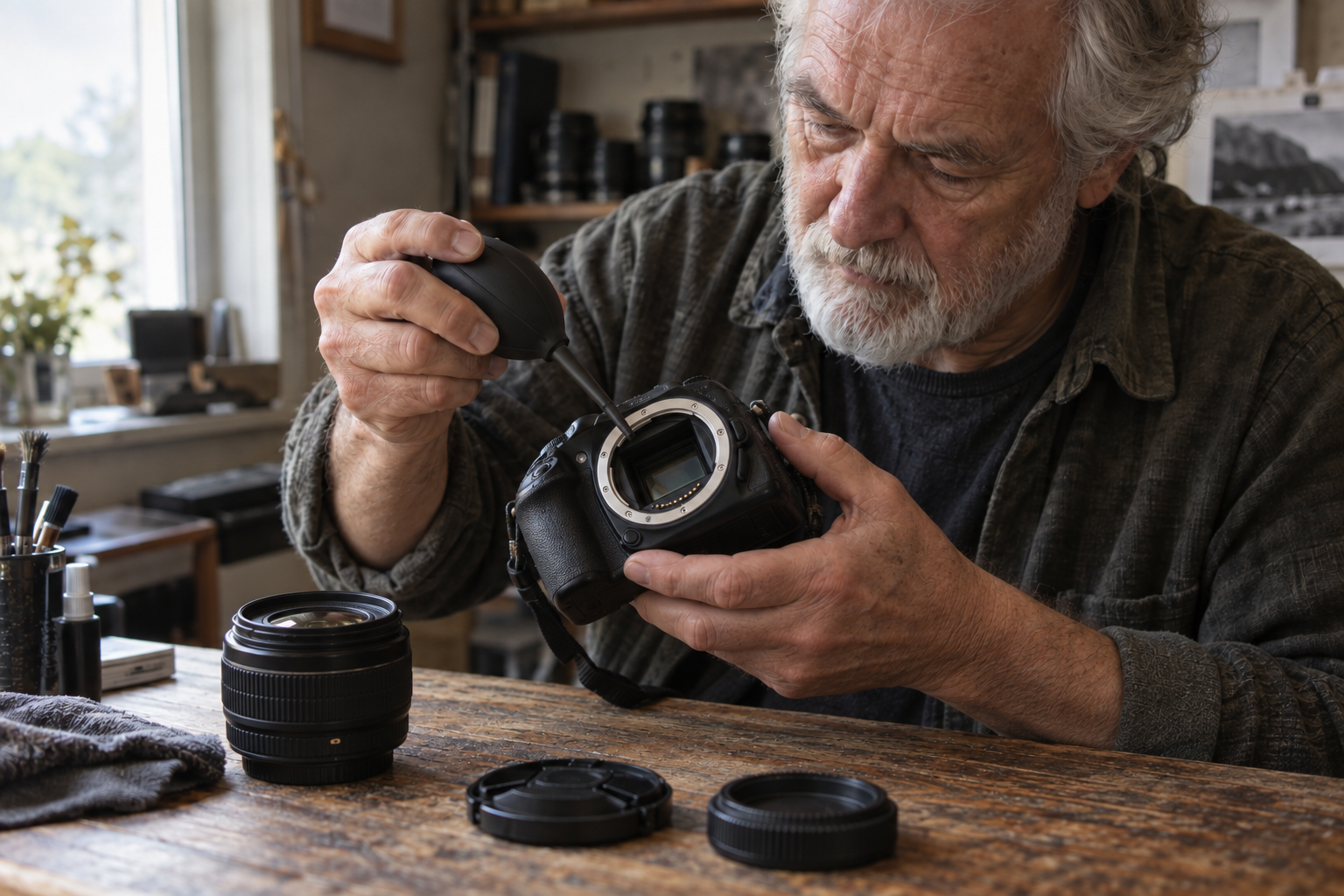

An older man carefully cleaning a camera body with a brush and blower in a well-lit workshop surrounded by photography equipment.

Use the cameraโ€™s automatic sensor-cleaning function first. If necessary, remove the lens, hold the mount downward and use a proper hand-operated blower. Do not insert the blower tip deeply into the camera, and never use compressed air. Canned air can release liquid propellant and may damage delicate internal parts.

Wet-cleaning a sensor is possible, but it demands the correct swabs, fluid and technique. If you are uncertain, let a competent camera technician do it. A professional cleaning bill is considerably cheaper than a damaged sensor or shutter mechanism.
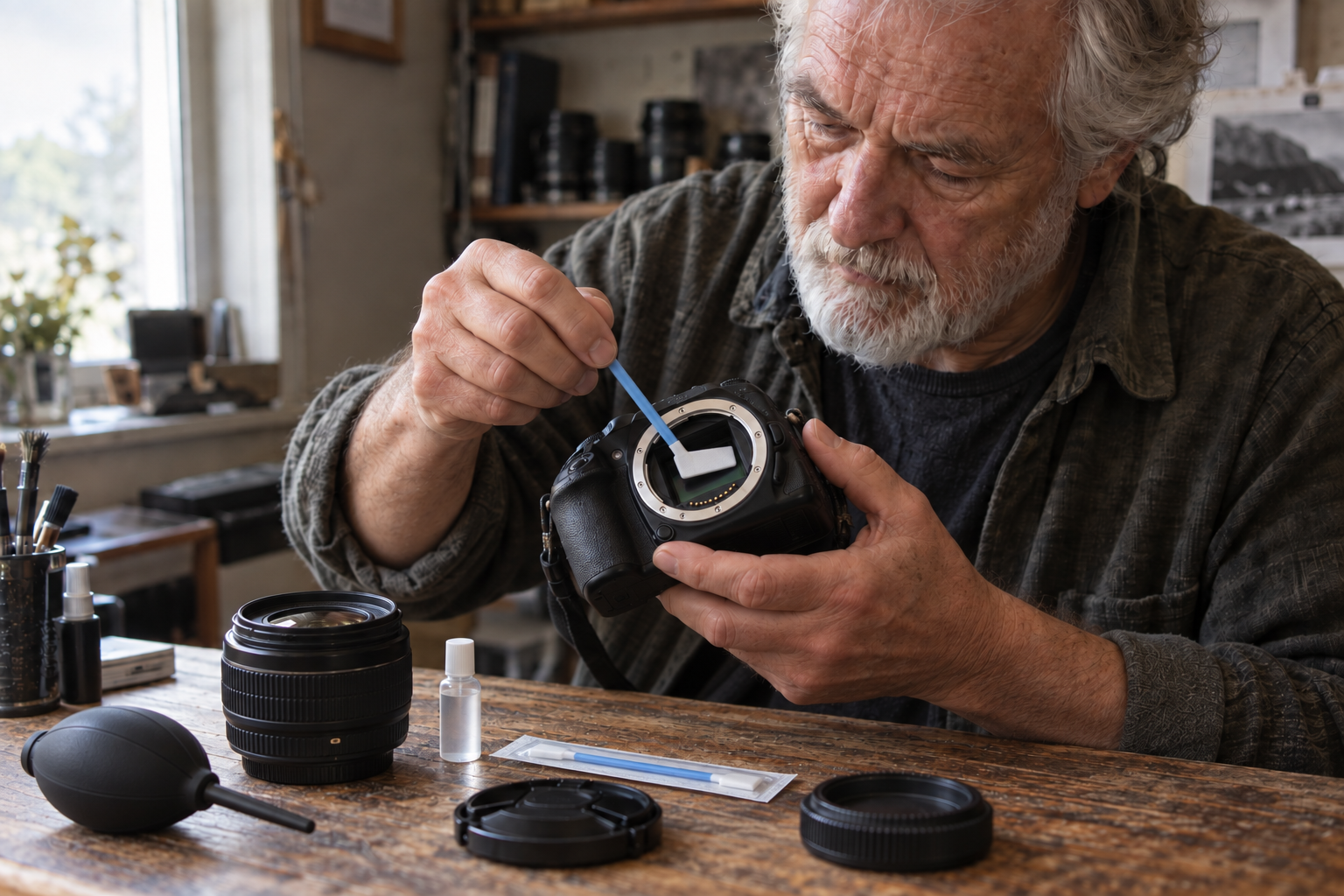

An elderly man carefully cleaning a camera with a brush and other cleaning tools on a wooden table, surrounded by camera lenses and other photography equipment in a well-lit room.

The contacts on lenses and batteries can occasionally be wiped with a clean, dry cloth. Avoid abrasives, pencils, metal tools and mysterious household chemicals recommended by somebody on the internet. Camera equipment is not a kitchen worktop.

Bags matter too. There is little point cleaning a camera and returning it to a nest of dust, grit and old biscuit crumbs. Empty the bag periodically, vacuum it gently and check the dividers. Lens caps should also be cleaned; otherwise, they simply press dirt back against the glass.
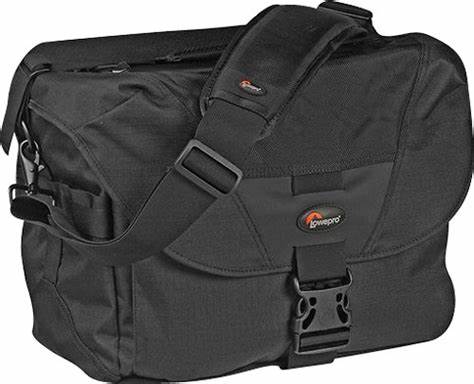
A black messenger bag designed for photography equipment, featuring a long adjustable shoulder strap and a buckle closure.

In humid climates, fungus is the greater enemy. Equipment should not be stored damp or sealed away after a wet day. Wipe it down, allow it to dry naturally and store it somewhere with controlled humidity. A dry cabinet is a worthwhile investment in Cambodia, particularly for lenses that may sit unused for weeks. Silica gel can help, but it must be renewed or dried regularly.

Do not leave lenses in direct tropical sunlight in an attempt to โ€œkillโ€ fungus. Heat can damage lubricants, adhesives, rubber and electronics. Once fungus has established itself inside a lens, professional dismantling may be required, and etched coatings cannot always be restored.

Rain, sweat and condensation also deserve attention. Weather sealing is reassurance, not invincibility. After working in rain, pat the equipment dry rather than rubbing water into openings. When moving from an air-conditioned room into hot, humid air, keep the camera inside its bag for a while so it warms gradually. This reduces condensation onโ€”and potentially insideโ€”the equipment.

My own approach is simple: clean when necessary, inspect regularly and avoid fussing. A little dust is part of photography. Grease, grit, salt water and fungus are not.

A battered camera may have character. A dirty sensor has none.

The Travelling Photographerโ€™s Essentials: Old Photographer Series.

cameras, fujifilm, Lenses, Lowepro, nikon, opinons, thoughts, photography, pictures, street, Travel

There was a time when I travelled with enough photographic equipment to open a small camera shop. Two camera bodies, several lenses, flashguns, filters, chargers, spare batteries, cleaning equipment and a tripod heavy enough to support a railway bridge.


Ageโ€”and several decades of sore shouldersโ€”has taught me differently. The travelling photographer does not need to carry everything. He needs to carry the right things and, more importantly, understand how to use them.

My first essential is a dependable camera. It does not have to be the latest model, possess the most megapixels or arrive with artificial intelligence hiding behind every button. It must simply be a camera I know and trust.

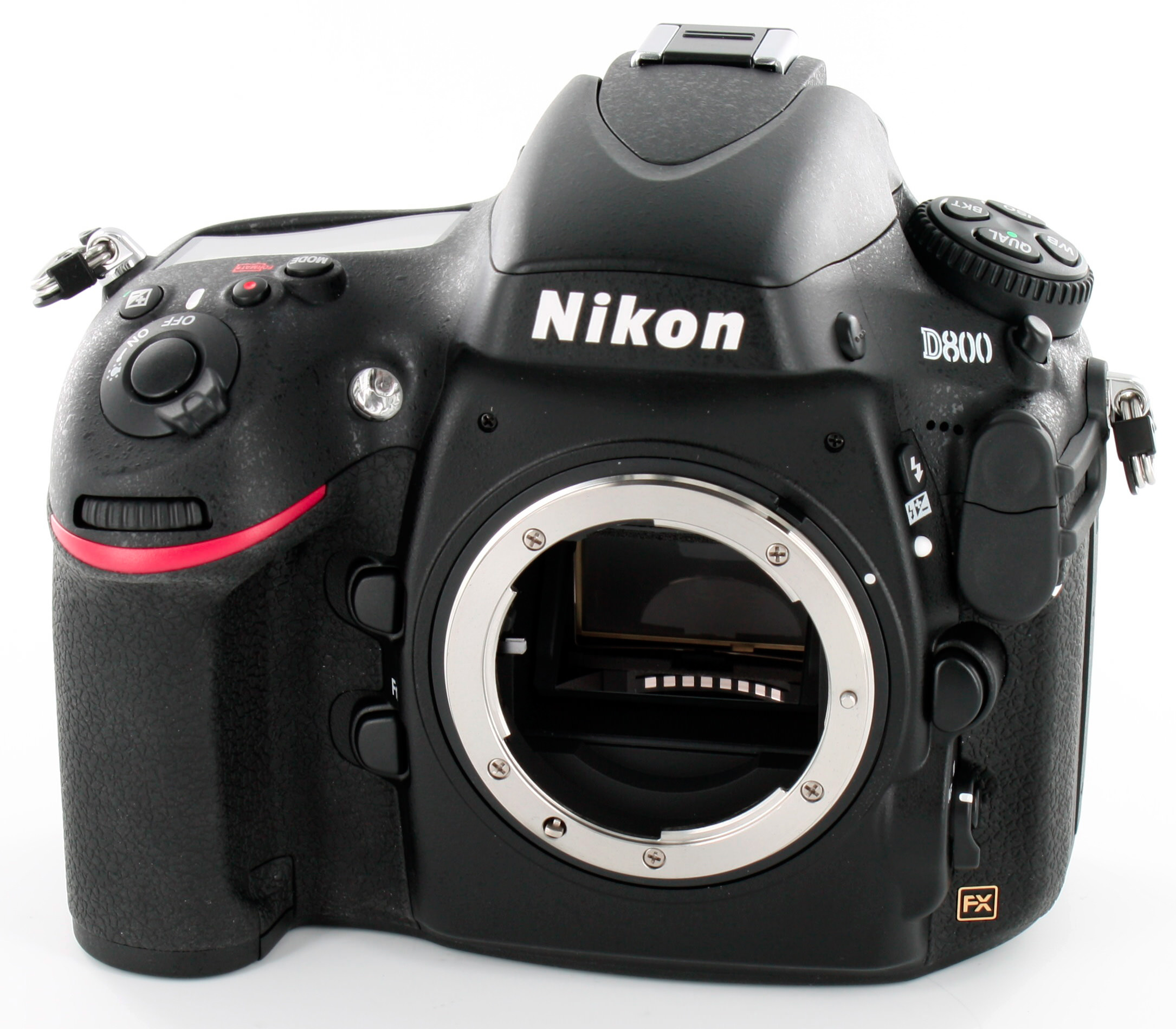
For me, that might be an old Nikon D700, a D3S or the magnificent D850 when I want every last piece of detail. The important thing is familiarity. When something happens in front of me, I do not want to search through menus or wonder which button controls the focus mode. The camera should feel like an old friendโ€”slightly battered perhaps, but always ready.

Then there is the lens.

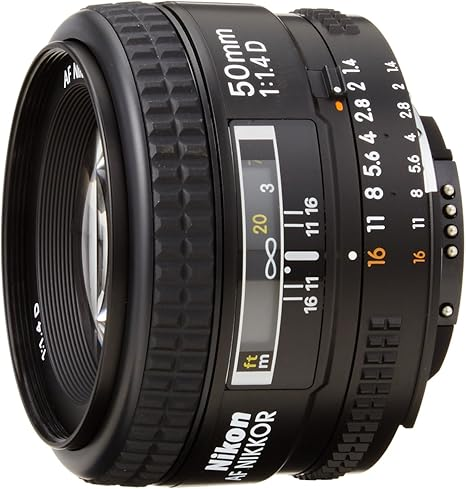
One good lens is often enough. A 35mm or 50mm prime makes a wonderfully simple travelling companion. A practical zoom such as a 24โ€“70mm or 24โ€“120mm gives greater flexibility without requiring a bag full of glass. If I know that people will be my principal subject, an 85mm may earn its place.

The temptation is to pack a lens for every possibility. Resist it. Too many choices slow the photographer down. You begin changing lenses instead of making pictures.

A spare battery is essential. Two are better if the day will be long. Batteries have a wicked sense of humour and usually expire just as the light becomes beautiful or something interesting begins to happen.

Memory cards should be reliable, sensibly sized and carried somewhere safe. I would rather use several moderate-capacity cards than trust an entire journey to one enormous card. Cards can fail, disappear or be accidentally formatted. Spreading the work across more than one is a small form of insurance.

Every evening, whenever possible, I copy the dayโ€™s photographs onto a laptop or portable drive. Ideally, I keep two copies in separate places. A camera can be replaced. The photographs from a journey cannot.


A comfortable camera strap matters more than most people realise. The strap supplied with the camera may be adequate for an afternoon, but after eight hours in the heat it can begin to feel like a cheese wire. A good shoulder or wrist strap keeps the camera secure without advertising its value to everybody in the street.

The camera bag should be small, strong and ordinary-looking. I do not need something that resembles military luggage and announces that expensive equipment is inside. It must protect the camera, provide quick access and leave enough room for the unglamorous necessities: water, tissues, a notebook and perhaps something to eat.


Good footwear may be the most important photographic equipment I own. Travelling photography is done with the feet. Interesting pictures are rarely made while sitting in an air-conditioned hotel room complaining about the midday light.

Comfortable, broken-in shoes allow me to keep walking, turn down another street and stay out for another hour. That extra hour is often when the best photograph appears.

Clothing should suit the place rather than the photographerโ€™s imagined appearance. Lightweight, loose clothing works in the Cambodian heat. A hat offers protection from the sun, while a light waterproof layer can save both photographer and camera when the sky suddenly opens.

Water is not optional. Neither is sun protection. An exhausted, dehydrated photographer stops seeing properly and begins making foolish decisions. Travel photography requires enough energy to remain observant, patient and respectful.

A small cleaning cloth and blower are useful, especially in dusty streets or humid conditions. There is no need to carry a laboratory. Most cleaning can wait until the evening. Changing lenses in wind, dust or heavy rain should be avoided whenever possible.


I also carry a notebook. A mobile phone can record names and details, but a notebook never runs out of power and does not distract me with messages. If I photograph somebody and speak with them, I can write down their name, the location and a few details about the encounter. Those notes may later give the photograph its proper meaning.

The phone remains valuable. It provides maps, weather information, translation, emergency communication and a perfectly capable backup camera. I may be an old photographer, but I am not foolish enough to ignore a useful tool simply because it does not have a Nikon badge.

Documents, money and emergency information need careful thought. I keep copies of my passport, insurance details and important telephone numbers separately from the originals. A little local currency should be kept somewhere accessible, with the remainder divided between safer locations.

Respect is another essential, although it weighs nothing.

Learn something about the country. Understand local customs. Notice when a camera is welcome and when it is not. A photograph is never worth humiliating somebody, entering a sacred place improperly or creating trouble for a person who has allowed you into their life.


Finally, carry curiosity.

Equipment may help us record what we find, but curiosity is what leads us towards it. Walk slowly. Look behind you, look up. Leave the obvious tourist route. Sit somewhere and allow life to continue without chasing it. Talk to people without immediately raising the camera.


The travelling photographerโ€™s essentials are not really about preparing for every possible picture. They are about remaining light enoughโ€”physically and mentallyโ€”to recognise the picture that is actually there.

After all these years, my packing list has become shorter. One trusted camera. One useful lens. Batteries, cards, water, good shoes and somewhere safe to store the photographs.

๐Ÿ“– Gear Collection โ€” Is It Truly an Addiction, or Something Else Entirely?

cameras, Fujichrome, fujifilm, Lenses, Lowepro, nikon, opinons, thoughts, photography, street, Travel, viltrox

Photographers joke about โ€œGASโ€ โ€” Gear Acquisition Syndrome โ€” as if itโ€™s a harmless quirk. But beneath the humour sits a real question: Why do so many photographers feel compelled to collect gear, even when they already have enough to make great images?

Is it addiction? Is it passion? Is it identity? Or is it something deeper โ€” a way of relating to the world?

Letโ€™s explore this with honesty and nuance.

๐Ÿง  1. The Psychology Behind Gear Desire

Gear collecting taps into several powerful psychological mechanisms. None of them are inherently unhealthy โ€” but they can become compulsive if left unchecked.

Dopamine and anticipation

The excitement isnโ€™t in the owning โ€” itโ€™s in the anticipation. The research is clear: dopamine spikes when we imagine possibilities, not when we achieve them.

A new lens promises:

  • a new way of seeing
  • a new creative direction
  • a new version of ourselves

Thatโ€™s intoxicating.

Identity and selfโ€‘expression

For many photographers, gear is part of their creative identity. A Fuji Xโ€‘Pro3 isnโ€™t just a camera โ€” itโ€™s a statement about how you see the world. A Nikon D300S isnโ€™t just a tool โ€” itโ€™s a connection to a certain era of photography.

Collecting becomes a way of curating your creative self.

Craftsmanship and tactile pleasure

Some gear simply feels good. Metal dials, aperture rings, optical glass โ€” these things have presence. Handling them is satisfying in a way thatโ€™s hard to explain to nonโ€‘photographers.

This isnโ€™t addiction. Itโ€™s appreciation.

๐Ÿ“ธ 2. When Collecting Becomes a Creative Practice

For many photographers, collecting gear is part of the craft itself.

Each tool shapes vision

A 20mm lens forces you to see differently than a 50mm. A rangefinder body changes your rhythm compared to a DSLR. A fast prime encourages intimacy; a telephoto encourages distance.

Collecting becomes a way of exploring different visual philosophies.

Gear as inspiration

Sometimes a new camera or lens unlocks a creative block. Not because itโ€™s โ€œbetter,โ€ but because itโ€™s different. It nudges you into new territory.

Historical and emotional connection

Older gear carries stories. A Nikon D2Hs isnโ€™t just a camera โ€” itโ€™s a piece of photographic history. Owning it connects you to the lineage of the craft.

This is collecting as creative archaeology.

โš ๏ธ 3. When It Starts to Look Like Addiction

There are moments when gear collecting crosses into unhealthy territory.

Signs include:

  • buying gear instead of making photographs
  • feeling restless or empty without the โ€œnext purchaseโ€
  • spending beyond your means
  • hiding purchases or feeling guilt
  • chasing perfection through equipment rather than practice

These patterns mirror addictive behaviour โ€” not because of the gear, but because of the emotional loop behind it.

But even then, the root cause is rarely the gear itself. Itโ€™s usually stress, boredom, loneliness, or a need for control.

๐ŸŒฑ 4. The Healthy Version of Gear Collecting

Most photographers fall into this category โ€” passionate, curious, and intentional.

Healthy collecting looks like:

  • buying gear that genuinely supports your creative goals
  • enjoying the craftsmanship and history
  • rotating gear in and out of your kit
  • using what you own
  • feeling joy, not pressure

In this form, collecting is no more โ€œaddictiveโ€ than a musician owning multiple guitars or a painter collecting brushes.

Itโ€™s part of the craft.

โœจ 5. Soโ€ฆ Is It Truly an Addiction?

In most cases, no. Itโ€™s a mix of:

  • passion
  • curiosity
  • identity
  • nostalgia
  • craftsmanship appreciation
  • the search for creative spark

But it can become addictive if it replaces the act of photographing or becomes a coping mechanism rather than a creative one.
The key is awareness. If collecting enriches your creative life, itโ€™s a gift. If it replaces your creative life, it becomes a trap.

๐ŸŽฏ Final Thought

Gear collecting is rarely about the gear. Itโ€™s about what the gear represents: possibility, identity, craftsmanship, memory, and the desire to see the world differently.

๐Ÿ“– Lowepro Stealth Reporter 200 AW โ€” Discussion & Evaluation for DSLR Use

cameras, Fujichrome, Lenses, Lowepro, nikon, opinons, thoughts, photography, street, Travel

The Lowepro Stealth Reporter 200 AW is a shoulderโ€‘style camera bag originally designed for photojournalists and news photographers, with an emphasis on speed, durability, and weather protection. It remains a strong option for DSLR shooters who need fast access and rugged reliability.

๐Ÿงฑ Build Quality & Design

According to Loweproโ€™s own description, the Stealth Reporter series was โ€œcreated for photojournalists and news photographersโ€ and built to withstand harsh field conditions while remaining lightweight and durable.
Key design elements include:

  • Magnesiumโ€‘reinforced structure (internal frame)
  • Heavyโ€‘duty materials and reinforced stitching
  • All Weather (AW) cover for rain, dust, and sand protection
  • Highly waterโ€‘resistant top zipper for fast access without opening the flap

This makes it particularly suitable for urban, documentary, and editorial DSLR work, where speed and protection matter more than hiking comfort.
๐Ÿ“ธ Capacity & DSLR Compatibility

The bag is sized for one DSLR body plus 3โ€“4 lenses, a flash, and accessories. This aligns well with typical DSLR kits such as:

  • A DSLR body (D700, D300S, D810, etc.)
  • A trio of primes (e.g., 35/50/85)
  • Or a zoom kit (24โ€“70 + 70โ€“200)
  • Flashgun + batteries
  • Memory cards (dedicated wallet holds up to 12 cards)

User feedback confirms it โ€œeasily takes a DSLR camera + a couple of lensesโ€ and is โ€œwell paddedโ€ and โ€œsturdyโ€.

โš™๏ธ Organization & Workflow

The Stealth Reporter 200 AW includes:

  • Removable cable management pouch
  • Memory card wallet (attaches to strap)
  • Multiple pockets for batteries, notebooks, filters, and personal items
  • Adjustable padded dividers for customizing DSLR layouts

This makes it ideal for fast-paced DSLR workflows, especially in news, street, and event environments.

๐Ÿš€ Strengths for DSLR Use

1. Fast Access

The top zipper allows you to grab your DSLR without opening the flap, a major advantage for street and press shooters.

2. Weather Protection

The AW cover provides full rain and dust protection, essential for field work in unpredictable conditions.

3. Professional Layout

Designed for working photographers, the internal layout supports efficient DSLR operation and quick lens changes.

4. Discreet Appearance

The bag looks like a messenger bag rather than a camera bag, reducing unwanted attention โ€” useful in sensitive environments.

5. Durability

User reviews highlight that it is โ€œbetter made than newer modelsโ€ and extremely sturdy.

โš ๏ธ Limitations for DSLR Use

1. Shoulder Fatigue

As a shoulder bag, it places all weight on one side. With a DSLR + lenses, this can become tiring during long assignments.

2. Limited Dualโ€‘Body Support

While it can fit one DSLR comfortably, dualโ€‘body shooters may find it cramped.

3. Bulk When Loaded

The bag becomes heavy and boxy when filled with DSLR gear.

4. No Dedicated Laptop Sleeve

Some versions lack a padded laptop compartment, limiting its use for hybrid photoโ€‘editing workflows.

โš–๏ธ Summary Table

CategoryStrengthsWeaknesses
AccessFast topโ€‘zip accessFull flap still slows deep access
WeatherAW cover, rugged buildAdds bulk when deployed
CapacityDSLR + 3โ€“4 lensesNot ideal for dualโ€‘body setups
ComfortPadded strapShoulder fatigue over time
DurabilityVery sturdy, proโ€‘gradeHeavier than modern bags
DiscretionLooks like a messenger bagStill bulky when full

โœจ Verdict

The Lowepro Stealth Reporter 200 AW is an excellent DSLR bag for photojournalists, street photographers, and documentary shooters who prioritize:

  • Fast access
  • Weather protection
  • Professional organization
  • Durability

It is less ideal for long hikes, dualโ€‘body setups, or photographers who need backpackโ€‘level comfort.

Final assessment: One of the best classic shoulder bags for DSLR field work โ€” rugged, fast, and intelligently designed, though heavy and less comfortable for allโ€‘day carry.

๐Ÿ“– Lowepro Stealth Reporter 200 AW โ€” Evaluation for Fujifilm XE2 & Xโ€‘Pro3 Kits

๐ŸŽ’ Why This Bag Works Even Better for Mirrorless

The Stealth Reporter 200 AW was originally designed for bulky DSLR bodies, so when you load it with smaller, lighter Fujifilm cameras, you get:

  • More space than you need (excellent for flexibility)
  • Better weight distribution
  • Faster access because the bodies donโ€™t snag on dividers
  • Room for accessories like chargers, batteries, filters, and notebooks

In other words, the bag becomes overโ€‘engineered for the Fuji kit โ€” which is a good thing.

๐Ÿงฑ How Your Fuji Kit Fits Inside

๐Ÿ“ธ Your loadout:

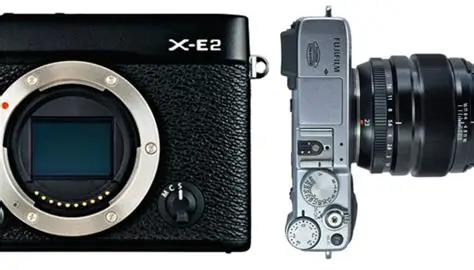
  • Fujifilm XE2
  • Fujifilm Xโ€‘Pro3
  • Three lenses (likely primes or compact zooms)

Typical layout inside the 200 AW:

  • Centre compartment: Xโ€‘Pro3 with lens mounted
  • Side compartment 1: XE2 body
  • Side compartment 2: Two primes stacked or one zoom
  • Front pocket: Batteries, cards, cleaning cloth
  • Side pocket: Filters, small notebook
  • Rear pocket: Passport, phone, flat items
  • Top zip access: Grab the Xโ€‘Pro3 instantly without opening the flap

This is exactly the kind of workflow the bag was designed for โ€” fast, quiet, efficient.

โœ… Strengths for Fuji XE2 + Xโ€‘Pro3 Users

1. Perfect size for a twoโ€‘body mirrorless kit

Youโ€™re not fighting the bagโ€™s dimensions. Everything fits with breathing room.

2. Fast access for street and documentary work

The top zipper is ideal for the Xโ€‘Pro3 โ€” a camera built for decisiveโ€‘moment shooting.

3. Discreet appearance

The bag looks like a messenger bag, not a camera bag. This pairs beautifully with Fujiโ€™s rangefinderโ€‘style bodies, keeping you lowโ€‘profile.

4. Weather protection

The AW cover is a huge advantage in Phnom Penhโ€™s sudden rainstorms or dusty dry season.

5. Quiet operation

The flap and zippers are relatively quiet โ€” important for street and candid work.

6. Room for extras

Because Fuji gear is compact, you can carry:

  • A small LED light
  • A power bank
  • A mini tripod
  • A notebook
  • Snacks or water

Without overloading the bag.

โŒ Weaknesses (Specific to Fuji Use)

1. Overkill for minimalists

If you ever go out with just one Fuji body and one lens, the bag feels too big.

2. Shoulder fatigue

Even with lighter mirrorless gear, a shoulder bag can strain over long days.

3. Not ideal for long hikes

Urban, editorial, and street? Perfect. Travel trekking? Less so.

4. Dividers designed for DSLR depth

Fuji bodies are slimmer, so you may need to reposition or doubleโ€‘fold dividers to avoid empty space.

โš–๏ธ Summary Table for Fuji Use

CategoryStrengthsLimitations
FitPerfect for 2 bodies + 3 lensesSlightly oversized for minimal kits
AccessTopโ€‘zip is ideal for Xโ€‘Pro3Full flap slows deep access
ComfortLighter load than DSLRShoulder fatigue on long days
DiscretionLooks like a messenger bagStill bulky when full
WeatherAW cover excellent for SE AsiaAdds bulk when deployed

โœจ Verdict

For a twoโ€‘body Fujifilm kit, the Lowepro Stealth Reporter 200 AW is almost the perfect shoulder bag:

Fast access, discreet design, weather protection, and enough space for a full working kit without feeling cramped.

Itโ€™s especially strong for:

  • Street photography
  • Documentary work
  • Editorial assignments
  • Urban travel
  • Fastโ€‘moving environments

Its only real drawback is the inherent limitation of shoulder bags: longโ€‘term comfort.

D700 vs D810 โ€” Resolution in Practice

cameras, Lenses, Lowepro, opinons, thoughts, photography, pictures, street

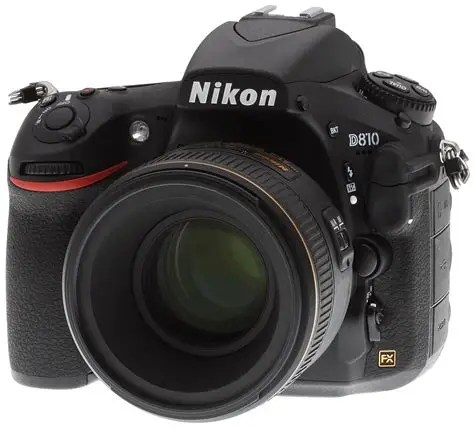
As someone who carries both the Nikon D700 (12MP) and D810 (36MP) in the same bag, Iโ€™ve had the rare privilege of comparing resolution not in theory, but in lived experience. Hereโ€™s how they differโ€”and where they converge.

๐Ÿง  Resolution vs Resilience

Ten Years with the Canon 1D Mark IV

cambodia, cameras, Lenses, Lowepro, opinons, thoughts, photography, street, Travel

GAS Management for the Ethically Curious Photographer

cameras, Lenses, Lowepro, opinons, thoughts, photography, street, Travel

Tuned, Not Trendy: Why Function Matters More Than Features

cambodia, cameras, Lenses, Lowepro, opinons, thoughts, photography, street, Travel

Why I Still Use the Nikon D3 and D3S in 2025

cambodia, cameras, Lenses, Lowepro, opinons, thoughts, photography, street, Travel

Built Like Tools, Not Toys

The Files Still Sing

Speed and Simplicity

Why I Still Carry Them

The Nikon D700

cameras, Lenses, Lowepro, opinons, thoughts, photography, pictures, street, Travel, Uncategorized, war
  1. Versatility: The full-frame sensor allows for greater control over depth of field, enabling photographers to achieve beautiful background blur (bokeh) and more creative compositions.